The Crown of Thorns
Anthony van Dyck, 1618
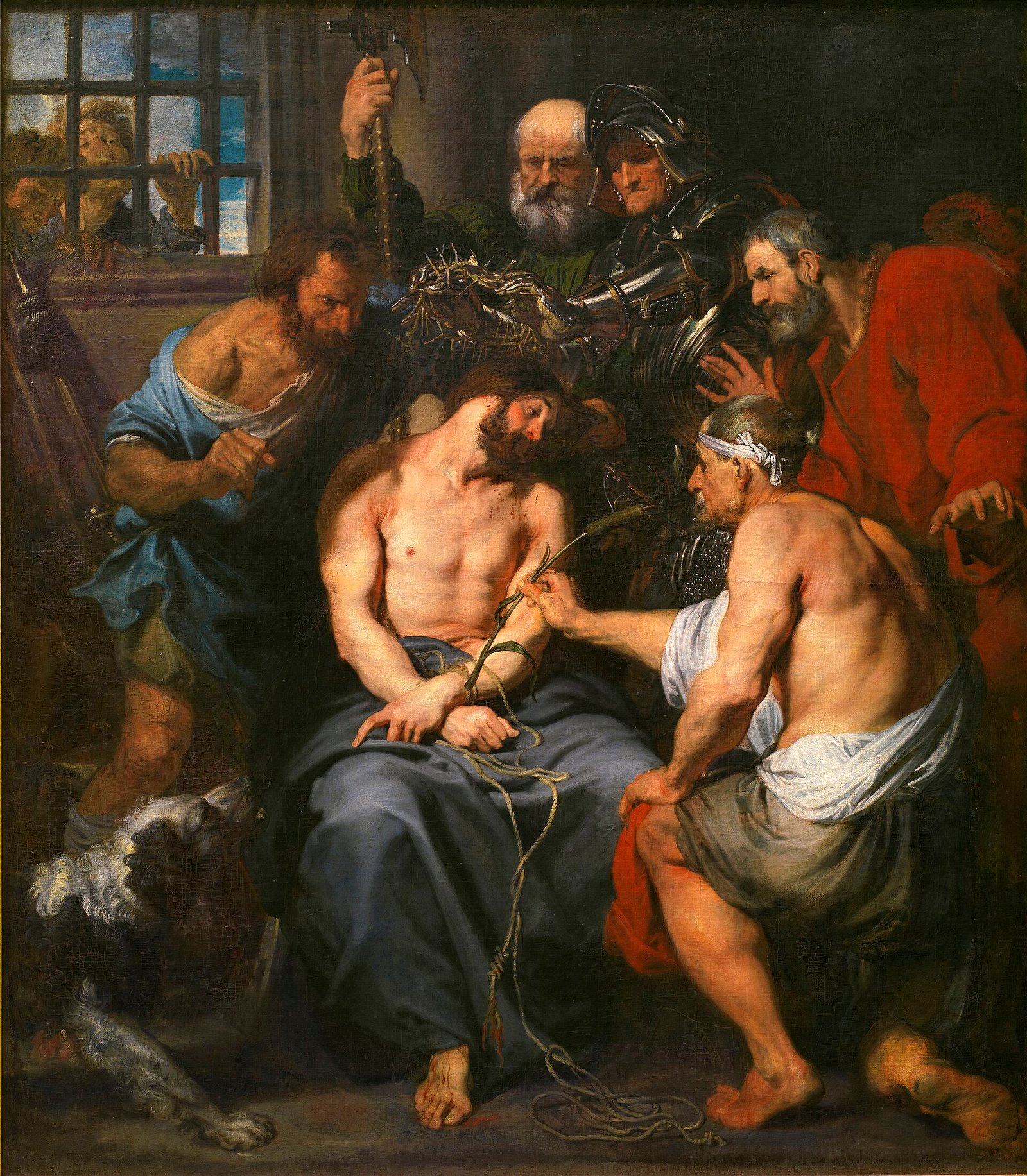
The Crown of Thorns is an oil painting on canvas that Anthony van Dyck made around 1618–1620, when he was still in his twenties and working as the main assistant and pupil of Peter Paul Rubens in Antwerp. The subject comes from the Gospels of Matthew and Mark, which describe in only a few lines how soldiers mock Jesus: they dress him in a cloak that mimics royal regalia and press a crown of thorns onto his head. Although the episode is brief in the sources, it became a popular theme in art, and painters such as Hieronymus Bosch, Titian and Caravaggio had treated it before him.
The composition centres on Christ, placed on the vertical axis of the picture and surrounded by soldiers whose expressions range from mockery to brutality. The restrained palette and strong chiaroscuro reflect Rubens's influence, as does the highly realistic modelling of the muscular bodies. One detail stands out: the soldier placing the crown is the only one wearing armour of the painter's own period, an anachronism that brings the scene closer to the viewer's time. At the feet of the figures, a dog adopts an aggressive pose that heightens the tension.
The treatment of Jesus's face shows the influence of Titian and the Venetian painters, whose work Van Dyck seems to have studied during his stay in Italy. Once finished, he offered the painting to Rubens, who declined it. It was then bought by Philip IV of Spain, who kept it at the Escorial before it entered the Museo del Prado in Madrid in 1839. The work shows a young painter blending the lessons of his master with the traditions he absorbed in Venice.
- Painter
- Anthony van Dyck
- Date
- 1618
- Medium
- oil paint, canvas
- Dimensions
- 225 × 197 cm
- Museum
- Museo del Prado, Madrid
- Genre
- religious art
- Depicts
- Crown of thorns, sword, Jesus Christ, combat helmet, spear, body armor
More works by Anthony van Dyck