Crucifixion
Anthony van Dyck, 1630
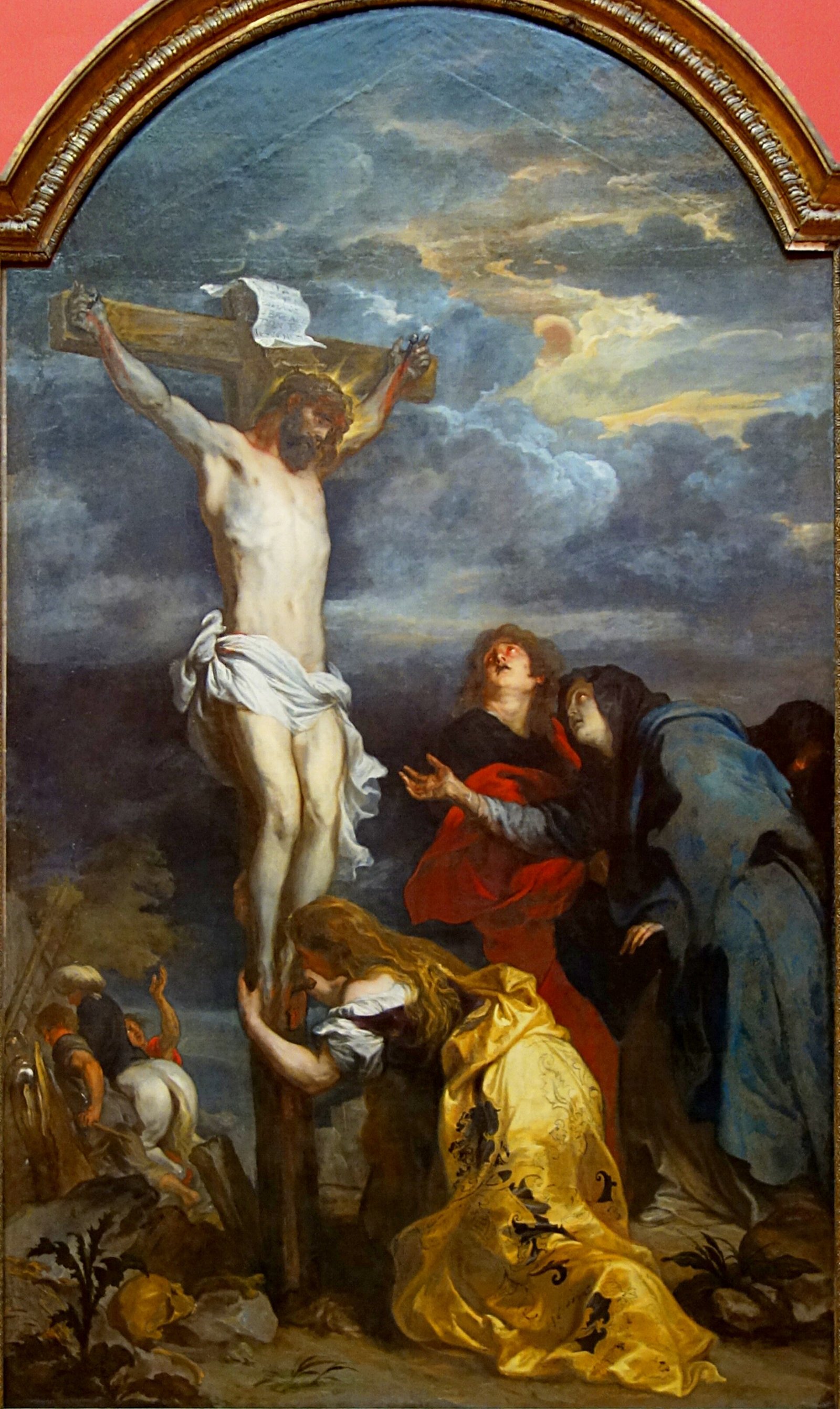
Anthony van Dyck's Crucifixion is an oil on canvas painting of about 1630, originally commissioned as the high altarpiece for the Récollets convent in Lille. It was made during the painter's second period in Antwerp, between his return from Italy and his departure for London. Van Dyck had already treated the same subject around 1617-1619, while still working as an assistant in Rubens's studio; that earlier version is now in the Louvre. The Lille picture is the more inventive of the two: the cross sits off-centre and at an angle, which gives the scene a sense of depth. The sky and Mary Magdalene's hair recall the Venetian painters Van Dyck had studied during his time in Italy.
The work is carefully symbolic. The three mourners wear colours with specific meanings: Mary Magdalene's golden yellow suggests eternal light, John's red refers to the Passion, and the Virgin's blue stands for the mantle of humanity. The shadowed figure at the far right is not clearly identified, though it may be one of the Marys. Beneath the cross, at the lower left, lies a skull said to be Adam's, a reference to Golgotha, the place of the skull. It is partly hidden by a thistle, a symbol of the Fall and original sin, whose spines recall Christ's crown of thorns. In the semicircle above the cross appears a mystic delta, an emblem of the Holy Trinity.
The painting was seized during the French Revolution and in 1795 became part of the founding collection of the Palais des Beaux-Arts de Lille, where it remains.
- Painter
- Anthony van Dyck
- Date
- 1630
- Medium
- oil paint, canvas
- Dimensions
- 109 × 124 cm
- Museum
- Palais des Beaux-Arts de Lille, Lille
- Movement
- Flemish Baroque painting
- Genre
- religious art
- Depicts
- Catholic priest, thunderstorm, Jesus Christ, Mary, John the Apostle, soldier, sky, Mary Magdalene
More works by Anthony van Dyck