Lady with an Ermine
Leonardo da Vinci, 1490
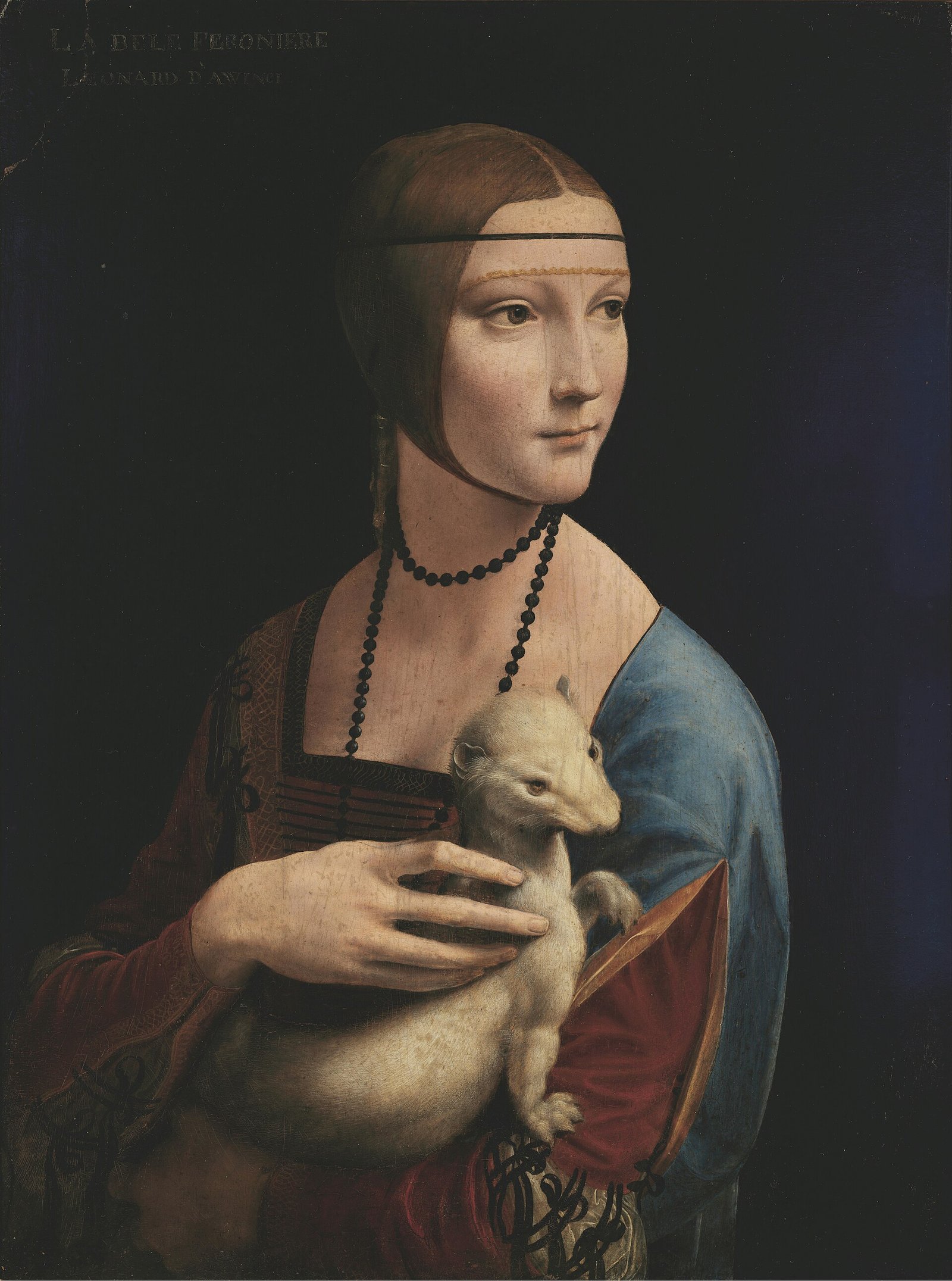
Lady with an Ermine is a portrait that Leonardo da Vinci painted around 1490, while he was in the service of Ludovico Sforza, Duke of Milan. Its sitter is almost unanimously identified as Cecilia Gallerani, a young woman from a non-noble family who arrived at the Milanese court in early 1489, at only fifteen, and soon became the duke's favourite mistress. Cecilia was admired for her beauty and her learning in literature and music; she was said to study Latin, write poetry in Italian and take part in philosophical gatherings. The painting is one of Leonardo's four portraits of women, alongside the Mona Lisa, the Portrait of Ginevra de' Benci and La Belle Ferronière.
The composition shows the young woman in three-quarter view, turned to one side, her body set on a diagonal while her face turns toward the viewer. The ermine she holds in her arms is far from a mere accessory: its presence is almost certainly symbolic. The duke was sometimes nicknamed «Ermellino», a link to the Order of the Ermine he had received in 1488, and the animal also recalls a drawing by Leonardo bearing the motto «Malo mori quam foedari», better to die than to be defiled. The sitter's surname also plays on the Italian word for the animal, a device Leonardo had already used in the portrait of Ginevra de' Benci.
The work has an eventful history as well. After passing through Polish hands, it was seized during the Nazi occupation, taken to Berlin and later to Kraków, where it hung in the offices of Governor Hans Frank. At the end of the war it was found in a mansion in Bavaria and returned to Poland. Today it belongs to the Polish state and is kept at the Czartoryski Museum, though for years it was displayed elsewhere while that institution was being renovated.
Its importance lies in the blend of portrait and allegory, in the delicate modelling and the twisting pose, features that anticipate the language of High Renaissance painting. The identification of the sitter, supported by documents and contemporary correspondence, also makes it one of Leonardo's best-documented portraits.
- Painter
- Leonardo da Vinci
- Date
- 1490
- Medium
- tempera, oil paint, panel, walnut panel
- Dimensions
- 54 × 40 cm
- Museum
- Czartoryski Museum, Kraków
- Movement
- High Renaissance
- Genre
- portrait
- Depicts
- Mustela putorius furo, Mustela erminea, Cecilia Gallerani, woman
More works by Leonardo da Vinci


