Madonna of the Carnation
Leonardo da Vinci, 1475
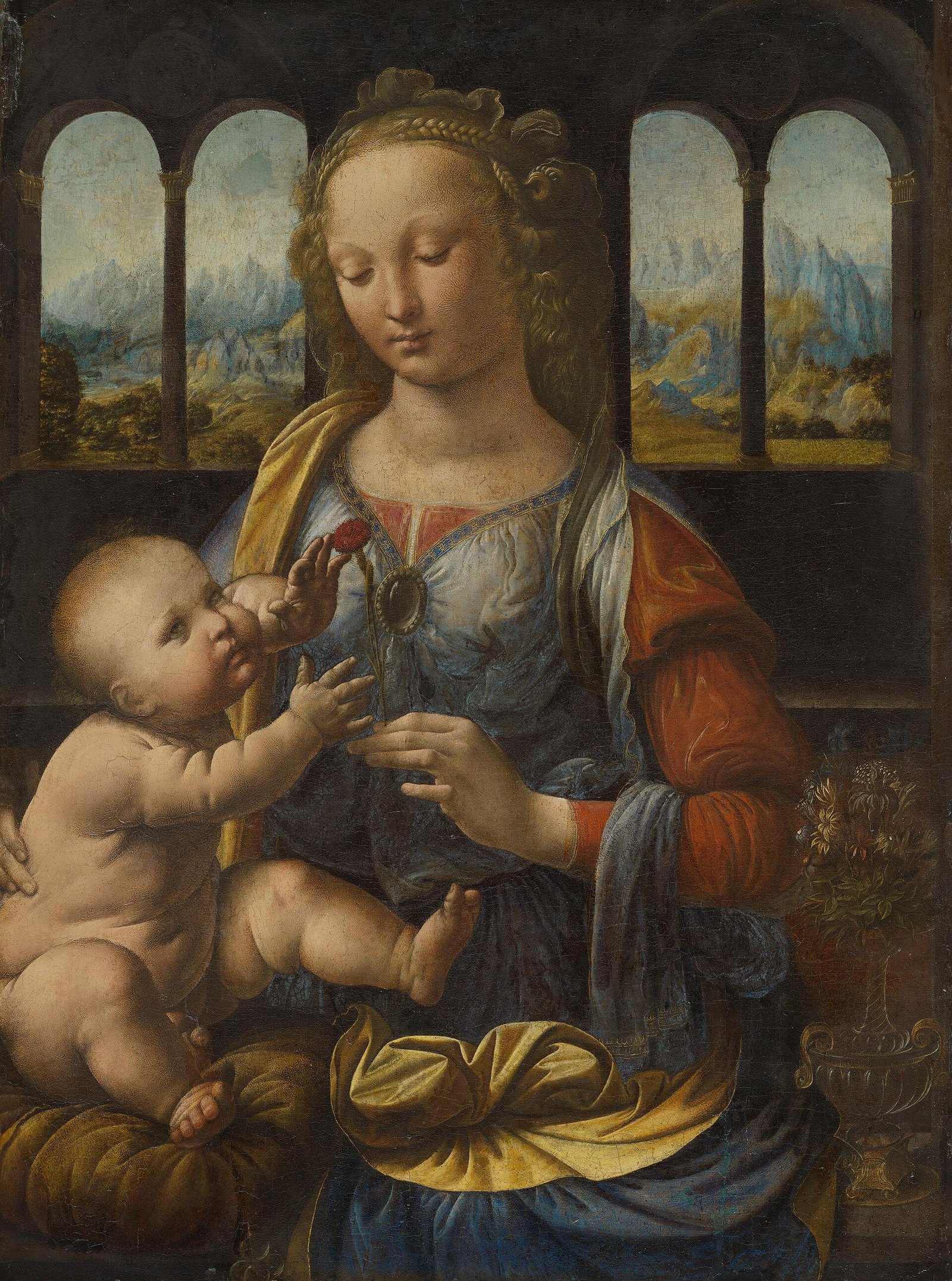
The Madonna of the Carnation is an oil on panel painting by Leonardo da Vinci, associated with the early Florentine Renaissance. It shows the young Virgin Mary in rich garments and jewellery, holding a red carnation in her left hand. The Christ Child sits near her and turns toward the flower, drawn to its colour, while Mary looks down at him with a calm expression. The red bloom has often been read as a hint of the Passion, though that interpretation is not documented with certainty.
The scene takes place in a dim interior where the faces catch the light more strongly than the surrounding objects, which sink into shadow. Behind the figures, two twin windows open onto a bright landscape of mountains or ridges that seem to hold the light. This contrast between the enclosed room and the luminous distance points forward to Leonardo's later interest in aerial perspective, the way colour and detail soften as they recede.
The painting belongs to the years when Leonardo trained in Verrocchio's workshop. For a long time it was attributed to the master, but historians now generally agree it is by Leonardo, probably painted during his apprenticeship. The hair, the hand, the folds of the drapery and the flowers resemble elements in his Annunciation, which supports that attribution.
The surface shows craquelure, which is usually explained by an excess of oil paint applied thickly and set too quickly. Although the proposed dates range across the 1470s, the work stands as an early witness to how Leonardo combined careful description, strong light and a deliberate treatment of landscape.
- Painter
- Leonardo da Vinci
- Date
- 1475
- Medium
- oil paint, panel
- Dimensions
- 62 × 48 cm
- Museum
- Bavarian State Painting Collections, Munich
- Movement
- Early Renaissance, Florentine Renaissance art
- Genre
- portrait, religious art
- Depicts
- Mary, Christ Child
More works by Leonardo da Vinci