The Death of Seneca
Jacques-Louis David, 1773
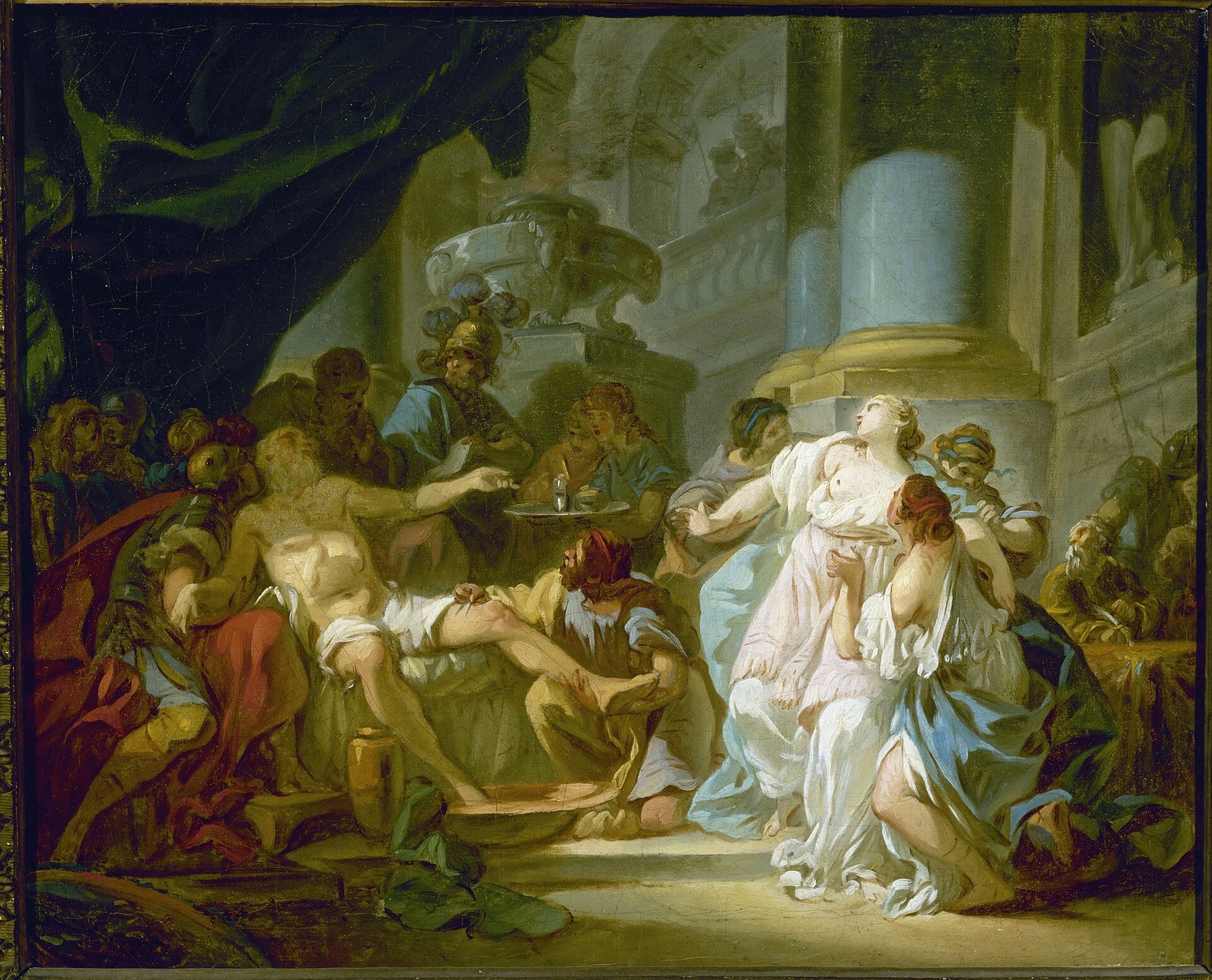
The Death of Seneca is an 1773 oil on canvas by Jacques-Louis David, painted for one of the most important contests of his early career. It depicts the suicide of the Stoic philosopher Seneca the Younger, who was sentenced to death by Nero after being implicated, perhaps wrongly, in the Pisonian conspiracy. Seneca accepts the sentence calmly, and the painting shows him in the midst of dying: his arm veins have been cut, and, as Tacitus recounts, his suffering drags on, so he asks for his ankles to be cut as well and takes a dose of hemlock offered by his friend and physician.
Seneca sits at the centre, surrounded by family, friends and disciples, while his wife Paulina, on the right, is led away after being prevented from following him in death on Nero's orders. The crowded arrangement of gesturing figures recalls the theatrical manner of Boucher, which sat uneasily with the austerity the Academy demanded for the subject, the death of Seneca as Tacitus told it. The jury preferred Jean-François Pierre Peyron's treatment of the same story, which had fewer figures, a darker palette and a more archaeological air, and David lost the prize. It was his third and penultimate attempt, and he would win the following year.
Today the work is valued as a document of a moment of transition. It shows a young David still steeped in Rococo taste, just before he turned toward the sterner classicism that would define his mature work. The painting is held at the Petit Palais in Paris.
- Painter
- Jacques-Louis David
- Date
- 1773
- Medium
- oil paint, canvas
- Dimensions
- 43 × 53 cm
- Museum
- Musée des Beaux-Arts de la ville de Paris, Paris
- Movement
- Neoclassicism
- Genre
- history painting
- Depicts
- Seneca
More works by Jacques-Louis David


