The Death of Socrates
Jacques-Louis David, 1787
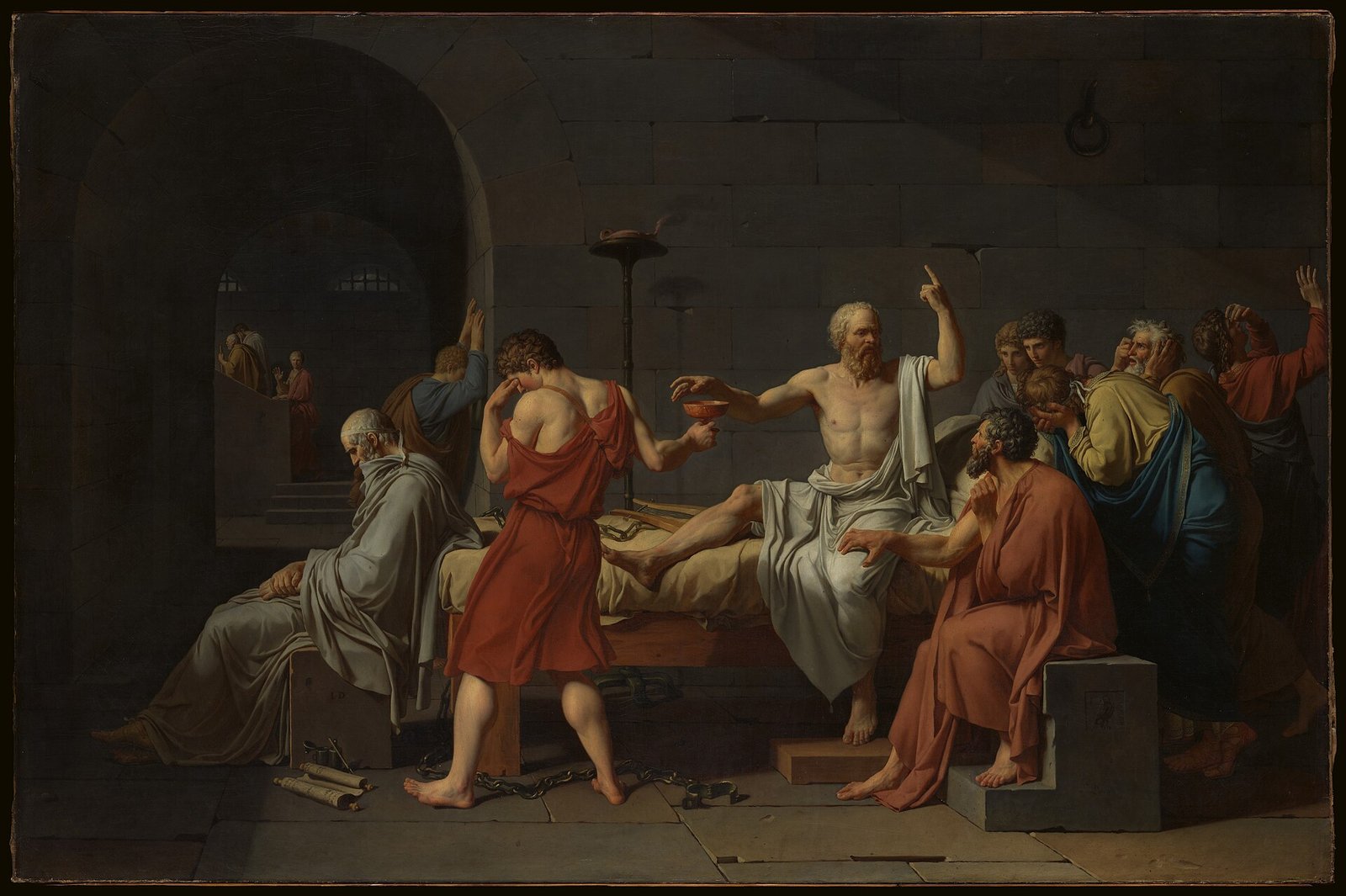
The Death of Socrates is an oil on canvas of 1787 in which Jacques-Louis David works within the French Neoclassical tradition. It shows the last moment of the Athenian philosopher, sentenced to drink hemlock for his ideas about the traditional gods and for, as the charge went, corrupting the city's young. The commission is usually linked to the Trudaine brothers, though sources disagree on whether it dates from 1786 or whether David had already conceived the scene around 1782; the picture was finished in Paris.
What makes it compelling is its staging. Socrates sits upright on the bed at the centre, one arm raised as he keeps talking to his followers, while nearly everyone around him is visibly distressed. Crito, at the foot of the bed, grips his knee and listens intently; the young man who offers the cup turns his face away, and Plato, slumped at the far end of the bed, looks down in grief. In the background, through the arch and up the staircase, Xanthippe, Socrates' wife, gazes back at the scene with melancholy.
David departs from historical fact. He removes many characters who appear in Plato's dialogues and alters the ages of the disciples: Plato, who was young at the time, is shown as an old man, which suggests the scene may be a recollection filtered through memory. Socrates' face, more idealised than the classical bust usually taken as his likeness, reinforces that reading. The work feels less like a documentary record than a philosophical reflection.
Colour also serves the emotion. Reds grow more intense toward the centre and fade at the edges, and the dark red tunic of the cup-bearer concentrates the tension. Socrates and Plato, the two serene figures, wear a bluish white that sets them apart. The subdued palette has been read as a reply to criticism of David's Oath of the Horatii, whose colours were called garish.
The signatures carry meaning too. David signed in full beneath Crito and used only initials beneath Plato, a choice often read as an identification with the disciple who holds on to his master's moral principles, and as an acknowledgement of the literary source.
The painting matters because it condenses the Neoclassical ideals of civic virtue and Stoic calm, presenting death as a quiet passage rather than a defeat.
- Painter
- Jacques-Louis David
- Date
- 1787
- Medium
- oil paint, canvas
- Dimensions
- 130 × 196 cm
- Museum
- Metropolitan Museum of Art, New York City
- Movement
- academic art, Neoclassical painting
- Genre
- history painting
- Depicts
- suicide, stairs, sadness, Conium maculatum, chain, forced suicide, trial of Socrates, torch
More works by Jacques-Louis David