The Girlhood of Mary Virgin
Dante Gabriel Rossetti, 1848
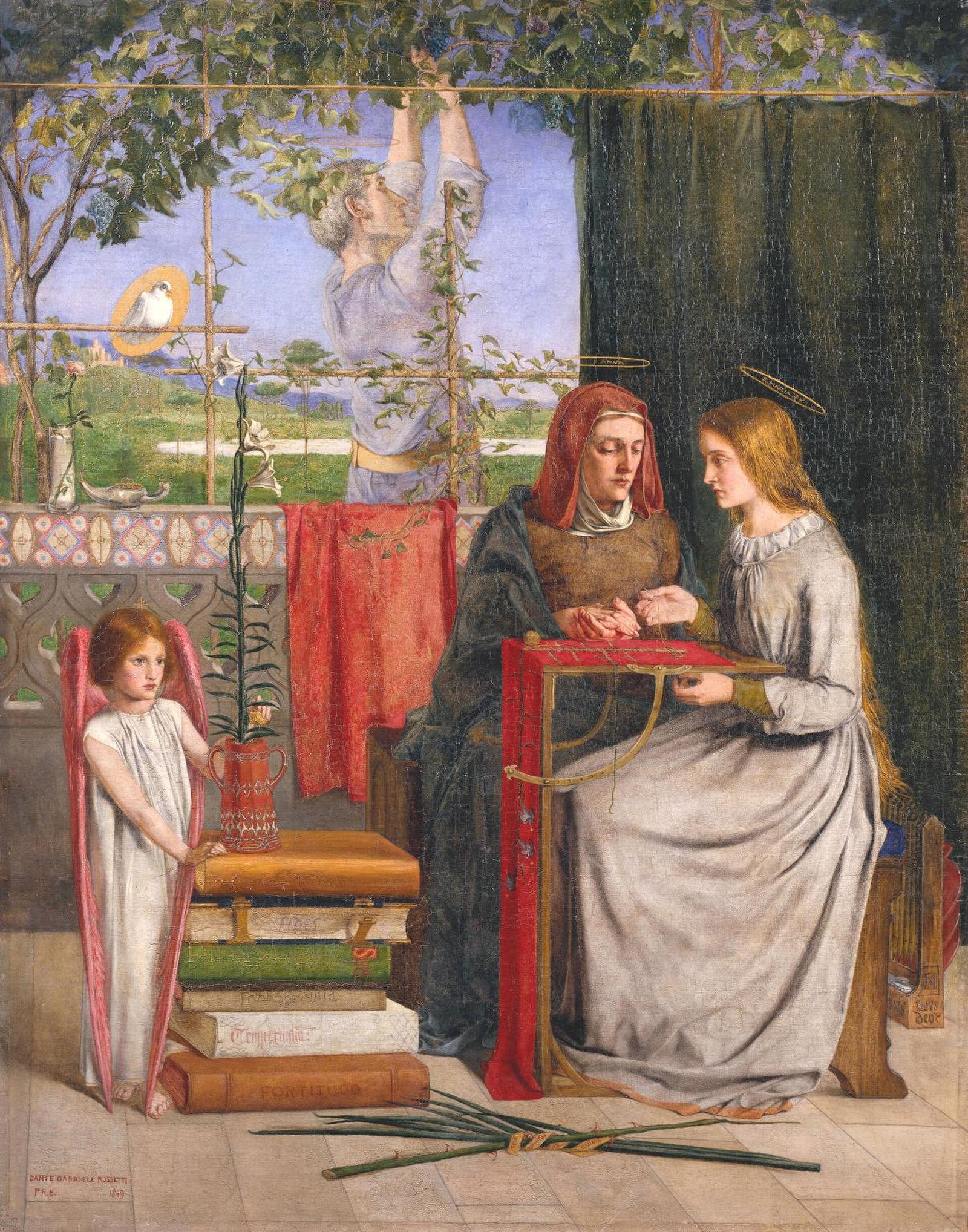
The Girlhood of Mary Virgin is an oil on canvas that Dante Gabriel Rossetti painted in 1848 and that is now held by Tate. It was his first completed oil painting and is one of the foundational works of the Pre-Raphaelite Brotherhood. The subject, Mary being taught by her mother Anne, had a long tradition in medieval and Renaissance art, where the young girl was usually shown with a book on her lap. Rossetti departs from that model: Mary embroiders a lily, a traditional emblem of her purity, while her father Joachim prunes a vine in the background. The vine is shaped like a cross, foreshadowing Christ, who describes himself as the true vine, and the passion that awaits him. The painting is full of quiet symbols. A crossed palm branch on the floor points to Palm Sunday and Good Friday, pale roses and thorny branches on the wall refer to the Passion and to Mary's seven joys and seven sorrows, the oil lamp stands for piety, and a dove prefigures the Annunciation. Rossetti wrote two sonnets to explain this imagery. The technique also drew attention: he worked in oils with watercolour brushes, in thin layers over a very smooth white ground, so that the colours stayed transparent. The models were people close to him. His mother posed for Anne, his sister Christina for Mary, and the family servant for Joachim. The painting was later altered, including a change in the colour of the angel's wings, and it remains a key work for understanding the early years of the Pre-Raphaelite group.
- Painter
- Dante Gabriel Rossetti
- Date
- 1848
- Medium
- oil paint, canvas
- Dimensions
- 83 × 65 cm
- Museum
- Tate, London
- Movement
- Pre-Raphaelite Brotherhood
- Genre
- religious art
- Depicts
- Saint Anne, Mary
More works by Dante Gabriel Rossetti