Pear Tree
Gustav Klimt, 1903
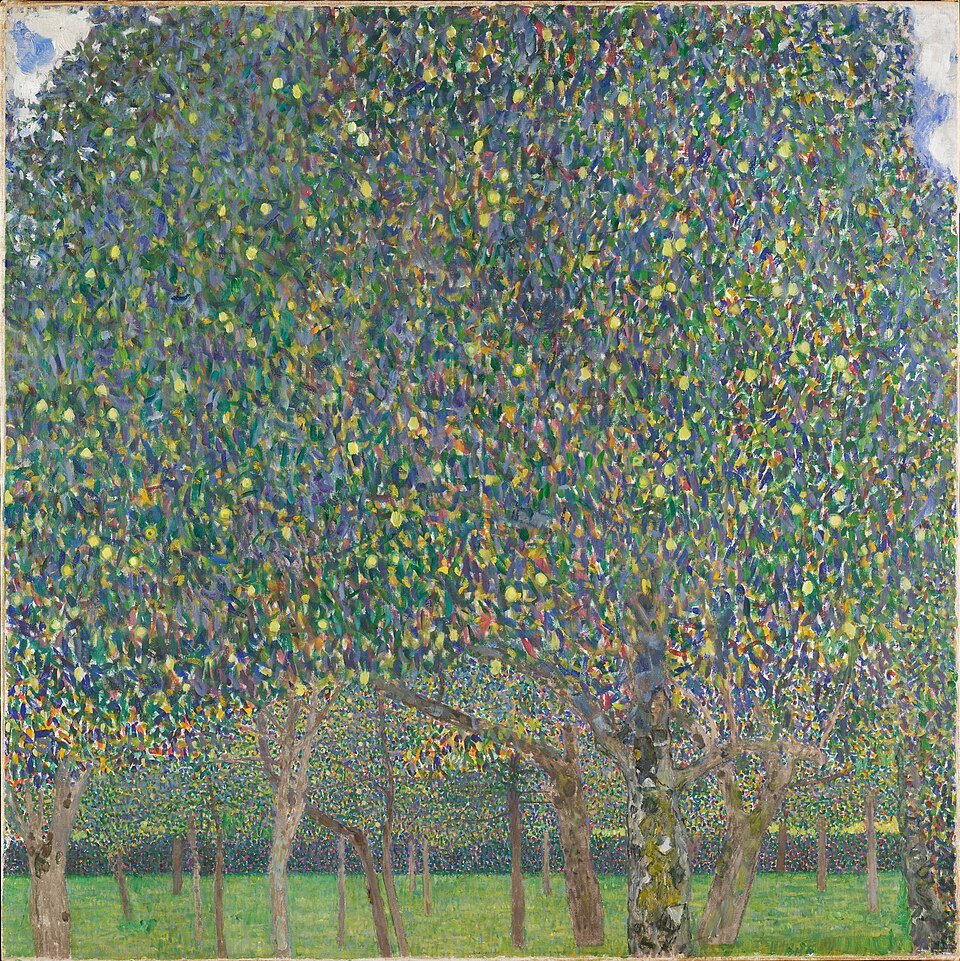
Pear Tree is an oil painting on canvas from 1903 in which Gustav Klimt depicts a pear tree in full bloom. He probably began it during a stay by Lake Attersee that summer and finished it in his Vienna studio, in time for his retrospective at the Vienna Secession in November. He gave the work to Emilie Louise Flöge, yet he kept working on it afterwards, probably until his death.
The picture belongs to a turning point in the artist's career. Up to 1902 his landscapes kept a strong link to nature, with organic forms and atmospheric effects; afterwards he moved away from direct observation and toward greater abstraction. He may have known Monet through reproductions by 1900, and at the 1903 Secession show he saw works by Cézanne, Monet, Seurat, Gauguin and Van Gogh up close. Pear Tree is among his first landscapes in this late manner, shaped by Pointillism.
The tree fills the composition, its branches merging into a dense canopy that shows the sky only in the upper corners. The square canvas departs from the horizontal format usually associated with landscape, a choice linked to the square viewfinder Klimt used to frame his subjects. Small dabs of paint describe leaves, blossoms and fruit. The flat, shimmering surface recalls both post-Impressionist painting and Byzantine mosaics. Stephan Koja notes that the spreading foliage echoes the flat decorative surfaces of Klimt's Golden Phase, and that in later works such as Roses Under Trees (1905) a painted mosaic spreads over the canvas like a carpet.
- Painter
- Gustav Klimt
- Date
- 1903
- Medium
- oil paint, gold leaf, canvas
- Dimensions
- 101 × 101 cm
- Museum
- Busch–Reisinger Museum, Cambridge
- Movement
- Vienna Secession
- Depicts
- tree, pear
More works by Gustav Klimt


