Saint Jerome penitent
Caravaggio, 1600
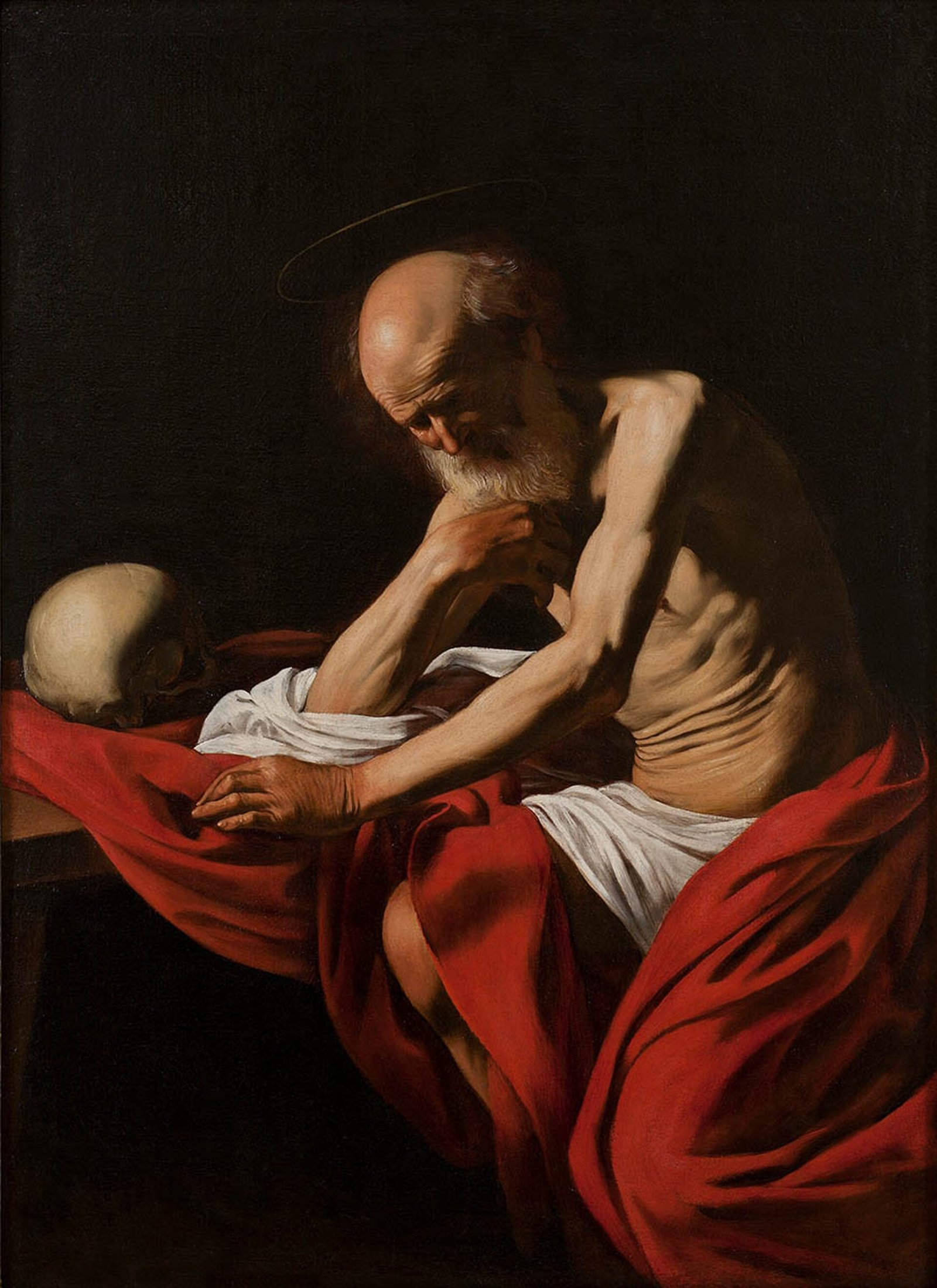
This canvas by Caravaggio shows Jerome, the hermit and Father of the Church, hunched and with a lined, weathered face, lost in contemplation of a skull he holds before him. The skull is one of his traditional attributes, a reminder of the inevitability of death and the emptiness of worldly things. The figure fills most of the picture and emerges from a dense darkness typical of tenebrism, so that attention falls on the aged body and the meditative gesture rather than on any setting.
The sources suggest Caravaggio painted Jerome several times, though it is unclear whether he did so by choice or at the request of patrons. This version gave him the chance to study aged, wrinkled skin, a subject that clearly interested him. It is usually dated to around 1600-1605. Its early history is probably tied to the Giustiniani family: the banker Vincenzo Giustiniani and his brother, Cardinal Benedetto, who assembled a large group of the artist's religious works. An inventory of 1638 lists a Saint Jerome of the same dimensions, which supports this link without fully confirming it.
The painting has an unusual trajectory. It entered the Catalan monastery in 1915 attributed to José de Ribera and was recognised as Caravaggio's only in 1943, when Roberto Longhi proposed the attribution. The biographer Peter Robb has noted its close resemblance in mood to the John the Baptist in Kansas City, painted at about the same time. It matters too because it is one of the few securely attributed originals by the master in Spanish public collections.
- Painter
- Caravaggio
- Date
- 1600
- Medium
- oil paint, canvas
- Dimensions
- 137 × 100 cm
- Museum
- Museum of Montserrat, Monistrol de Montserrat
- Movement
- Baroque
- Genre
- religious art
- Depicts
- Jerome
More works by Caravaggio