Saint Elisabeth of Hungary healing the poor
Bartolomé Esteban Murillo, 1672
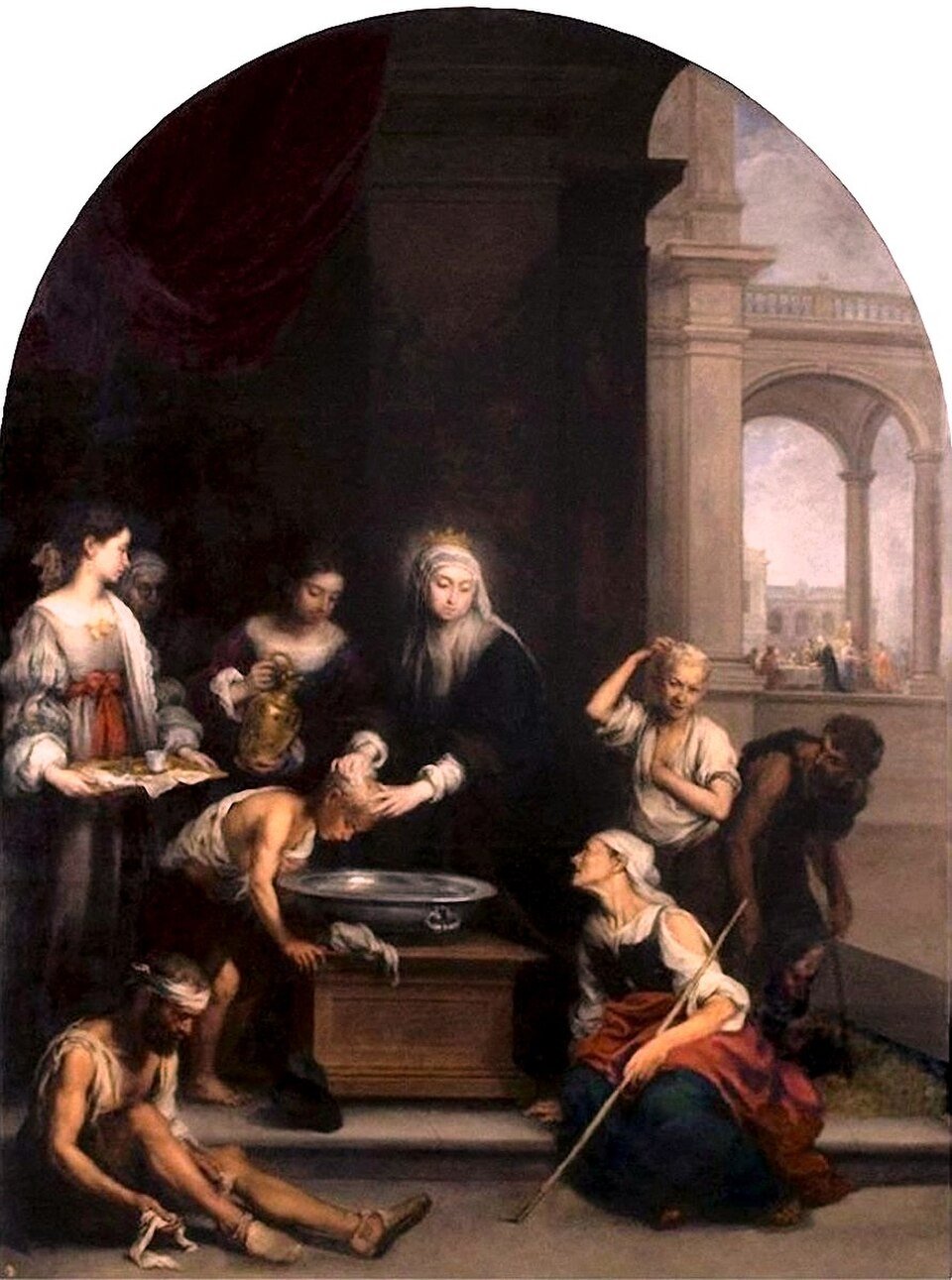
Murillo painted this canvas in 1672 at the request of Miguel de Mañara, to decorate the church of San Jorge in the hospital of the Brotherhood of Holy Charity in Seville. It was one of a series of paintings meant to remind the members of the confraternity that works of mercy were the path to eternal salvation. The saint, the Hungarian princess Elisabeth, who devoted her life to caring for the sick and died very young, is shown tending to a child with tinea capitis, a scalp infection caused by fungi that led to hair loss, itching and sores from scratching. The sick children belonged to very poor families, and the disease spread easily in crowded conditions with poor hygiene, which was common at the time. Choosing children rather than adults is one of the features that set this work apart from other depictions of the same subject.
Murillo builds the scene around a deliberate contrast. On one side, elegantly dressed ladies, one holding a basin, assist the saint; on the other, the ragged and dirty bodies of the young patients fill the foreground. A golden light bathes the scene, softening the outlines and giving the monumental architecture an atmospheric quality, while the details of the figures remain clear. In the background, beneath a portico, a second scene shows the saint feeding the poor, which widens the charitable meaning of the whole.
The painting's history was eventful. During the Peninsular War it was seized by Marshal Soult and taken to Paris, and after Napoleon's fall it returned to Spain, though not immediately to Seville. It remained in Madrid until 1901, and the Brotherhood pressed for years for its return, until it was put back in its original location in 1939.
- Painter
- Bartolomé Esteban Murillo
- Date
- 1672
- Medium
- oil paint, canvas
- Dimensions
- 325 × 245 cm
- Museum
- Hospital de la Santa Caridad, Seville
- Genre
- religious art
More works by Bartolomé Esteban Murillo


