Venus Frigida
Peter Paul Rubens, 1614
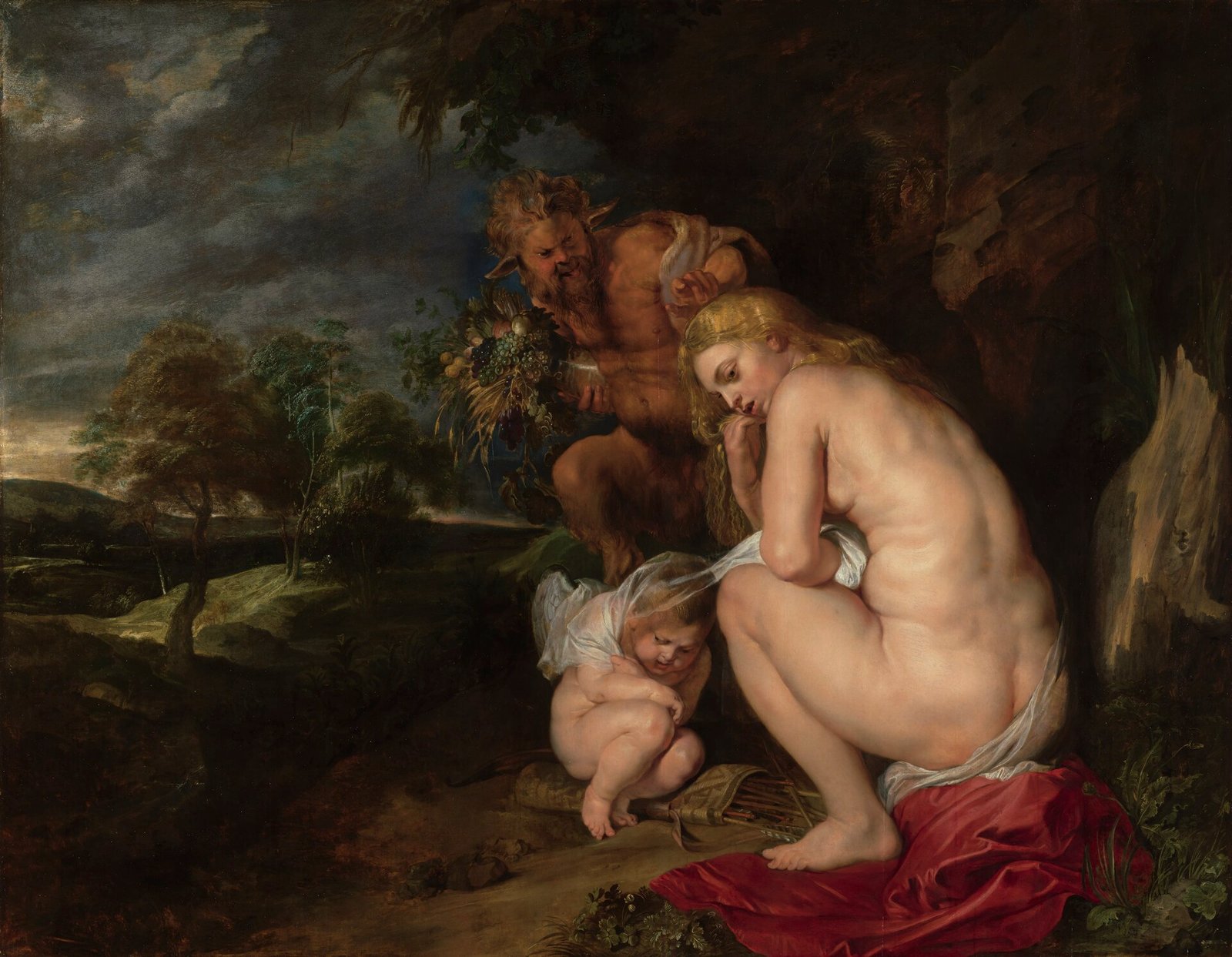
Venus Frigida, painted by Peter Paul Rubens in 1614, takes its title from a line by the Roman playwright Terence: "Sine Cerere et Baccho friget Venus", or "without Ceres and Bacchus, Venus freezes". The phrase means that love cannot survive without bread and wine. Rubens shows Venus seen from behind, seated in the foreground and visibly chilled. Her son Cupid huddles at her feet, having swapped his arrows for the goddess's thin veil to keep warm. A mocking satyr points at her, holding a cornucopia filled with ears of wheat and bunches of grapes, emblems of Ceres and Bacchus that refer directly to the saying.
The pose derives from an ancient marble statue that Rubens had seen during his time in Mantua, where he served the Gonzaga family. That sculpture later passed to England, into the collection of Charles I, and eventually to Peter Lely, which is why the figure is known as the Lely Venus. Rubens had himself advised the English king on antiquities, so he knew the piece well.
The painting matters for its treatment of the female nude. Rubens painted real, fleshy bodies rather than idealised ones, yet he gave them a warm sensuality. He built the skin tones over a grey imprimatura, an almost transparent underlayer that let the flesh glow through, and then added a transparent pinkish glaze. The result is skin that shifts between rose and bluish tints, convincing even in the shadows and half-shadows.
Technical examination showed that the original panel was made from two joined boards. The work belongs to what is usually called his classical period, roughly 1612 to 1616, and it is marked by a well-ordered, balanced composition and a fresh, controlled palette.
- Painter
- Peter Paul Rubens
- Date
- 1614
- Medium
- oil paint, canvas, panel
- Dimensions
- 145 × 186 cm
- Museum
- Vlaamse Kunstcollectie
- Genre
- mythological painting
- Depicts
- Venus, Sine Cerere et Baccho friget Venus
More works by Peter Paul Rubens


