
Peter Paul Rubens (Siegen, 1577 - Antwerp, 1640) was the most influential painter of the Flemish Baroque tradition. Born in the Holy Roman Empire to parents who had fled Antwerp for their Calvinist faith, he spent most of his working life in the city they had left, then part of the Spanish Netherlands. His paintings, full of movement, colour and sensuality, shaped the look of Catholic Baroque art in northern Europe during the first half of the seventeenth century. He matters as much for the large workshop he ran, for his work as a diplomat and for the way he combined a deep study of classical antiquity with the Flemish tradition of close observation.
Origins and training
His father, Jan Rubens, was a lawyer who had served as an alderman in Antwerp before converting to Calvinism. In 1568 the family fled to Cologne because of religious persecution. Jan later became involved with Anna of Saxony, the second wife of William of Orange, which led to his imprisonment and to a sentence confining him to Siegen, where Peter Paul was born. After Jan died in 1587, his widow took her children back to Antwerp, by then reconverted to Catholicism. The young Rubens received a humanist education at a Latin school, where he studied Latin and classical literature alongside Balthasar Moretus, grandson of the printer Christophe Plantin.
Family hardship forced him to work early. He first served as a page to Countess Margaretha de Ligne-Arenberg at Oudenaarde, but his real interest lay in drawing. As a boy he had copied prints by Hans Holbein the Younger, Tobias Stimmer and Marcantonio Raimondi. Around 1592 he began an apprenticeship with the landscape painter Tobias Verhaecht, but after about a year he left to pursue history painting. He then worked with Adam van Noort, one of the so-called Romanists, artists who had travelled to Rome and returned with Italian models. His last master was Otto van Veen, who gave him the ideal of the pictor doctus, the learned painter who knows art theory, classical literature and the masters of the Renaissance. Rubens completed his apprenticeship in 1598 and that same year entered the Antwerp Guild of St Luke as an independent master.
Italy and the discovery of the masters
In 1600 he travelled to Italy with his first pupil, Deodat del Monte. In Venice he saw the work of Titian, Veronese and Tintoretto, whose colour and composition left a lasting mark on his palette. He soon entered the service of Vincenzo Gonzaga, Duke of Mantua, a keen collector. His duties included portraits of the ducal family, copies of works in the collection and the decoration of the palaces. With the duke's backing he went to Rome in 1601, where he studied Greek and Roman art, especially the Hellenistic group of Laocoön and His Sons, and copied works by Michelangelo, Raphael and Leonardo. He was also struck by the naturalism of Caravaggio, whose work he later defended, for example by recommending that the duke acquire The Death of the Virgin.
In Rome he completed his first major altarpiece commission, a triptych for the church of Santa Croce in Gerusalemme. In 1603 he was sent to Spain on a diplomatic errand, delivering gifts from the duke to Philip III and to his favourite, the Duke of Lerma. He landed at Alicante and, finding the court had moved to Valladolid, travelled there overland. During his stay he painted the equestrian Portrait of the Duke of Lerma, notable for its balance and vigour and for its foreshortening of the horse, and some works on the busts of apostles, now in the Prado. This journey began a long pattern in which art and diplomacy went together.
Between 1604 and 1608 he remained in Italy, first in Mantua and then in Genoa and Rome. In Genoa he painted many aristocratic portraits, including the Marchesa Brigida Spinola-Doria and the portrait of Maria Serra Pallavicino, often considered among his finest, whose manner later influenced Van Dyck, Reynolds and Gainsborough. There he also made the drawings of the city's palaces that were published in 1622 as Palazzi di Genova. The book spread the Genoese palace model across northern Europe and gave him a model for his own house in Antwerp. In Rome, between 1606 and 1608, he received his most important commission so far: the high altar of Santa Maria in Vallicella, the Chiesa Nuova. The first version, a single canvas of saints adoring the Virgin and Child, was soon replaced by a version on three slate panels, with a removable copper cover, also painted by him, that allowed the miraculous image to be shown on special feast days. Romans, unused to Flemish painting, were struck by the new manner.
What he learned in Italy stayed with him for life. He went on writing letters in Italian, signed himself as Pietro Pauolo Rubens and often spoke of his longing to return, a wish that never came true.
Antwerp and the workshop
In late 1608 he set out for Antwerp on hearing that his mother was ill, but she died on 19 October before he arrived. He had planned to go back to Italy, yet the situation in Antwerp kept him there. The city was then hopeful after the Treaty of Antwerp, signed on 9 April 1609, which opened the Twelve Years' Truce between Spain and the United Provinces, and it expected a revival of its commerce. In that setting the city council commissioned from him The Adoration of the Kings for the Chamber of the Estates, where the negotiations were held. The subject alluded discreetly to the benefits the city hoped to gain from the agreement. The painting, now in the Prado, earned him 1,800 florins.
In September 1609 he became court painter to the governors of Flanders, Archduke Albert and Infanta Isabella Clara Eugenia, with an annual salary and permission to live in Antwerp rather than at the court in Brussels and to take other clients. On 3 October 1609 he married Isabella Brant, daughter of a learned and wealthy municipal official with whom he kept a close relationship. In 1610 he moved into a house he had bought and rebuilt to his own design, mixing Italian Renaissance models, especially Genoese palaces, with Baroque and Flemish elements. The house, now the Rubenshuis, held his workshop, library and one of the largest art collections in the city. Since 1946 it has been a museum, although only the portico and the garden pavilion of the original survive.
His altarpieces for the cathedral of Our Lady, The Raising of the Cross (1610) and The Descent from the Cross (1611-1614), established him as Flanders' leading painter. The first combines Tintoretto's Crucifixion for the Scuola di San Rocco in Venice, Michelangelo's dynamic figures and his own personal style, and it is regarded as a prime example of Baroque religious art.
He ran a large workshop of apprentices, assistants and specialists. His most famous pupil was Anthony van Dyck, whom Rubens himself judged the best of his students. He often collaborated with Frans Snyders, a painter of animals and still lifes, and with his friend Jan Brueghel the Elder, a flower painter. The workshop executed parts of paintings, supervised copies and produced prints. Rubens was especially active in graphic work. He designed book illustrations, above all for Balthasar Moretus, and issued engravings under his own control to spread his fame and to counter unauthorised reproductions, particularly in the United Provinces. He obtained privileges for his prints in several territories and hired engravers such as Lucas Vorsterman, Paulus Pontius and Willem Panneels. He was a demanding employer, and his dealings with Vorsterman, who left the workshop under pressure, show how hard he could be on his collaborators.
Diplomatic missions and the Marie de' Medici cycle
In 1621 Marie de' Medici, the Queen Mother of France, commissioned from him two large allegorical cycles on her life and that of her late husband, Henry IV, for the Luxembourg Palace in Paris. The cycle devoted to the queen, made up of twenty-one canvases plus portraits, was completed in late 1624 and installed in 1625. It is now in the Louvre. The series on Henry IV was never finished, although he made some preliminary sketches.
After the Truce ended in 1621, the Spanish Habsburgs entrusted him with diplomatic missions. Between 1627 and 1630 he moved between the courts of Spain and England in an attempt to secure peace between the Spanish Netherlands and the Dutch Republic, and he also visited the Dutch Republic as both artist and diplomat. Some courtiers did not accept a man who worked with his hands as an equal, while many others received him as a gentleman. Philip IV ennobled him in 1624 at the request of Infanta Isabella Clara Eugenia, who also named him gentleman of the chamber. Charles I of England ennobled him in 1630, and Cambridge University awarded him an honorary Master of Arts in 1629.
In September 1628 he arrived in Madrid for a second visit, staying until April 1629. He was lodged in the Alcázar and became friends with the court painter Diego Velázquez. It was Rubens who urged Velázquez to travel to Italy to complete his training, and the two agreed to go together, but Rubens went back to Antwerp and Velázquez made the journey alone. During that stay he painted works for the king and the Marquis of Leganés, and he copied many paintings by Titian from the royal collection. An inventory after his death lists no fewer than thirty copies after the Venetian master. The following year he went to London, where he painted the Allegory of Peace and War (1629), now in the National Gallery, which he gave to Charles I as a gift and which expresses his commitment to peace.
The last decade and Het Steen
In 1630, four years after the death of Isabella Brant, he married Hélène Fourment, sixteen years old and daughter of a silk and tapestry merchant, who was also the niece-in-law of his first wife. He was fifty-three. They had five children, the last born in 1641, eight months after the painter's death. Hélène became his main model in the 1630s, and she is recognisable in many of the voluptuous female figures of those years, in The Judgement of Paris and The Three Graces, both in the Prado, and in Helena Fourment Coming from Her Bath. He also painted several portraits of her.
In this decade he continued to take commissions from the Spanish court. Philip IV asked for paintings for the Torre de la Parada, a hunting lodge outside Madrid, mostly scenes from classical mythology, many realised with the help of his workshop. Charles I commissioned ceiling paintings for Inigo Jones's Banqueting House at Whitehall. At the same time he explored a more personal kind of painting, much of which he never meant to sell.
In 1635 he bought the estate of Het Steen at Elewijt, in the countryside near Antwerp, where he spent much of his time. He had painted landscapes since the late 1610s, but owning the estate led him to devote himself to the genre more intensely. A View of Het Steen in the Early Morning, in the National Gallery in London, and Farmers Returning from the Fields, in the Palatine Gallery in Florence, show an exuberant nature and a highly personal style. He died on 30 May 1640 in Antwerp, aged sixty-two, of heart failure brought on by the chronic gout he suffered from. He was buried in the church of St James in the city. In 1642 his widow had placed over his grave a painting of The Virgin and Child with Saints, in which it is believed that the painter portrayed himself as St George and Hélène as Mary Magdalene.
Style and technique
Rubens's paintings are recognisable for their vivid colour, taken from the Venetian school and above all from Titian, and for the movement of their compositions. His male figures are muscular, under the influence of Michelangelo, and his female figures are sensual, often foreshortened and painted with loose, fluid brushwork. He worked on panel longer than many of his contemporaries, even for very large pictures, though he also used canvas, especially for works that had to travel far. For some altarpieces he used slate to reduce glare. His subjects were varied: religious, historical, mythological and allegorical scenes, hunts, landscapes and portraits. According to Michael Jaffé's catalogue he produced 1,403 works, leaving aside the copies made in his workshop, and about fifteen hundred paintings survive together with almost nine thousand drawings.
His graphic and design work was equally large: cartoons for tapestries, such as the series on the history of Decius Mus, Constantine, the Triumph of the Eucharist and the story of Achilles, and frontispieces and illustrations for Antwerp publishers. He also made drawings in red chalk, a technique he used throughout his career.
Legacy
Rubens died wealthy and widely admired, and his influence was broad. Van Dyck, trained in his workshop, carried his manner to England, and collaborators such as Jordaens, Quellinus and Thulden carried it on in Flanders and the north. His name gave rise to the adjective Rubenesque, used for a generous female figure, and his model of the learned painter who could deal with rulers and master the theory of art became a reference for later academies. Today the largest collection of his works is in the Prado, with about ninety paintings, although the figure varies according to the attribution of some pieces. Important works also survive in the Rubenshuis in Antwerp, the Louvre, the National Gallery in London, the Alte Pinakothek in Munich and the Kunsthistorisches Museum in Vienna.
Timeline
- 1577
- Born in Siegen, in the Holy Roman Empire, on 28 June.
- 1568
- The family flees to Cologne because of religious persecution.
- 1592
- He begins his apprenticeship with the landscape painter Tobias Verhaecht.
- 1598
- He completes his training with Otto van Veen and enters the Antwerp Guild of St Luke as a master.
- 1600
- He travels to Italy and enters the service of the Duke of Mantua.
- 1603
- Diplomatic mission to Spain, where he paints the equestrian portrait of the Duke of Lerma.
- 1606
- He works in Rome on the altarpiece of Santa Maria in Vallicella, his most important commission to date.
- 1608
- He returns to Antwerp after his mother's death.
- 1609
- The Twelve Years' Truce is signed and he becomes court painter; he marries Isabella Brant.
- 1610
- He paints The Raising of the Cross for Antwerp Cathedral and moves into his house in the city.
- 1621
- Marie de' Medici commissions the cycles for the Luxembourg Palace.
- 1624
- Philip IV grants him letters of nobility.
- 1628
- Second stay in Madrid, where he meets Velázquez.
- 1629
- He paints the Allegory of Peace and War in London; Cambridge University grants him an honorary degree.
- 1630
- He marries Hélène Fourment; Charles I of England ennobles him.
- 1635
- He buys the estate of Het Steen at Elewijt.
- 1640
- He dies in Antwerp on 30 May and is buried in St James' Church.
Works (456)


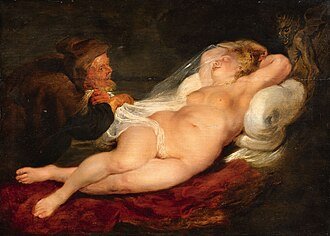


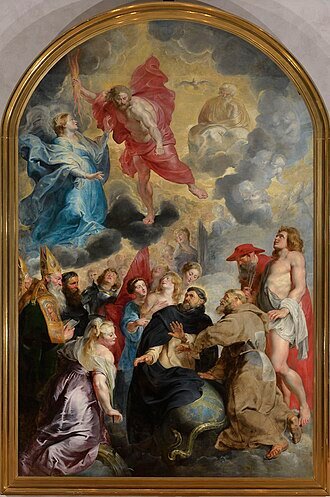


History painting showing Lucretia and Sextus Tarquinius, the central figures of an episode from ancient Rome. Rubens painted it in 1610 in tempera on canvas. It is now held by the Hermitage Museum, where it stands among the Flemish painter's works on historical and legendary subjects.
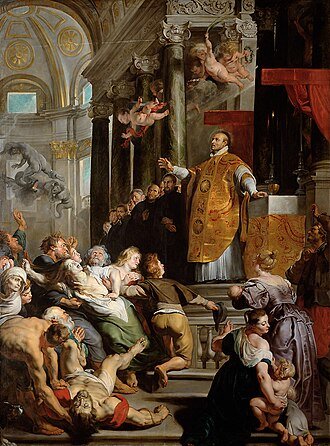
A religious work by Rubens, dated 1618 and painted in oil on canvas, centred on Ignatius of Loyola. Its monumental dimensions suggest a large setting and an intent to impress viewers. The title refers to a miracle attributed to the saint, whose specific details are best checked in specialist sources.

Portrait of Clara Serena Rubens, painted in 1625 in oil on panel. Its title links the sitter to the household of the Infanta Isabella, though the exact nature of her role is not specified. She gazes straight out at the viewer, a direct and calm presence that gives the image its immediacy.

This panel by Peter Paul Rubens, dated 1616, shows Judith holding the head of Holofernes, the biblical moment when the heroine beheads the Assyrian general. The composition focuses on the woman and her grim trophy, lit with strong contrasts that bring out the sword, the necklace and the rings. The available record offers no details about its commission or its early reception.

This oil on canvas by Peter Paul Rubens, dated 1601, depicts Saint Sebastian tended by angels after his martyrdom, a subject of religious devotion frequently treated in painting of the period. No further details about its commission or history are recorded, so it is best to confine remarks to what the image itself suggests: a wounded body treated with tenderness within a devotional composition.

This tall, narrow panel shows Helena Fourment looking directly at the viewer. The record attributes the work to Peter Paul Rubens and dates it to 1642, a date to treat with caution since the painter died in 1640. Painted in oil on panel, it places the sitter's frontal gaze at the centre of the composition.


This painting shows Prometheus, the figure from Greek mythology who stole fire from the gods to give it to humankind. Rubens presents him at a moment of physical strain, with a taut body and light concentrated on the figure. The record offers no further details about its commission or history, so it is best to limit ourselves to what the work itself shows.

Rubens painted this work in 1630 on the theme of a Roman triumph, the procession Rome held to honour its victorious generals. The title names the subject, but the available information does not identify specific figures or a particular episode, so the scene is best read through its general pageantry. It hangs in London's National Gallery.

Mythological painting by Peter Paul Rubens, dated 1632 and executed in oil on panel. Going by its title, it shows Venus beside an armoured man, identified as Mars, the god of war, in a scene drawn from classical mythology. It is catalogued as a portrait historié, a genre that blends portraiture with a mythological or historical subject.

Mythological painting by Peter Paul Rubens, dated 1621 and executed in oil on panel. Its subject is Silenus, a figure from classical mythology shown in a state of drunkenness. The available information says nothing about the commission or the later history of the panel, so the reading rests on the subject and on the painterly handling.

A portrait of a boy identified as Albert Rubens, shown together with birds. Painted in 1625 in oil on an oak panel of small format, it presents an intimate, close subject. No documented details about its commission or the circumstances of its creation are known, so it is best described cautiously.


Portrait of Thomas Howard, 2nd Earl of Arundel, painted by Peter Paul Rubens in 1630 in oil on canvas. The modest format focuses attention on the sitter alone, with no narrative setting. Held by the National Gallery in London, it offers a close view of Rubens's handling in a single-figure portrait of an English nobleman.

Painted by Peter Paul Rubens in 1612, this large oil on canvas shows the body of Jesus of Nazareth being taken down from the cross. It is now housed in the Basilica of Our Lady of Miracles in Saint-Omer. Its monumental scale and religious theme suggest it was made for a place of worship.
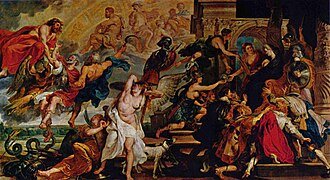
Rubens fills this vast canvas with allegorical figures: Minerva, Mercury, Bellona and Saturn appear alongside a personification of France, a widow, and Marie de' Medici enthroned. Henri IV is raised in a scene of triumph, set beside a triumphal arch, an eagle, a serpent, a dog and spoils of war. Nudes and symbols combine to mark the proclamation of the regency, as the title indicates.

The painting depicts a mythological episode in which Achilles, shown among women, is recognised when a weapon is revealed to him. Rubens painted it in 1617 in oil on a large canvas, and the theme of discovery lets him explore the tension between the hero's appearance and his true identity.

Dated 1634, this equestrian portrait by Peter Paul Rubens shows the Cardinal-Infante Ferdinand of Austria in armour and a hat, mounted on a horse. Its title refers to the battle of Nördlingen, so the image ties the sitter to a military event rather than presenting him only as a courtly figure. Painted in oil on canvas, it relies on the armour and the horse to convey the prince's martial role.

Painted by Rubens in 1630 on panel, this work shows David and Abigail, figures from the Old Testament, at the moment they meet. As a religious painting, its meaning rests on the biblical episode it recalls, while the details of its commission and history are not known with certainty. It is best read mainly through what we see: the composition, the colour and the arrangement of the figures.

A history painting showing an elderly Seneca in a bath during a forced suicide. The naked, pale body contrasts with the blood spreading through the water, and the scene conveys a restrained drama. Rubens painted it in 1610 in oil on a wooden panel.


Painted by Peter Paul Rubens in 1634, this oil-on-canvas work is of large scale and belongs to religious art. It presents Jesus of Nazareth, whose gaze is turned toward the viewer. The available record offers no further details about its composition, commission or context, so any reading of the scene should stay close to what the painting itself shows.

Rubens painted this work in 1638 in oil on oak panel, depicting the Massacre of the Innocents, the episode from the Gospel of Matthew in which soldiers kill the children of Bethlehem. The scene unfolds as a whirl of bodies, spears and intertwined infant figures. A cherub appears among them, offering a heavenly counterpoint to the earthly brutality.

Rubens depicts the myth in which Perseus rescues Andromeda, a young woman held captive and shown nude. Pegasus, the sea and Ceto, the sea monster, complete the scene. Painted in oil on canvas in 1630, the work belongs to mythological painting and the nude, and is held in Berlin's Gemäldegalerie.

A family portrait in which Rubens appears with his second wife, Helena Fourment, and one of their children, painted in 1635 in oil on wood. The large-format composition places the couple in an open-air setting, with the small child held close to his mother. The intimate, domestic tone reflects the artist's family life in his maturity. According to the record, the work belonged to the Museum of the Führer.

This painting shows Saint Cecilia of Rome playing the virginal, a keyboard instrument related to the harpsichord. Dated 1640 and painted on an oak panel, it is attributed to Peter Paul Rubens, though both the authorship and the date should be read with some caution. As a religious subject, the scene centres on the musical instrument, which is the element that identifies the saint.

A landscape where grazing cows and rural daily life take centre stage, alongside a milkmaid, a woman and a group of wildfowlers accompanied by a hound. A forest closes the scene, and the figures sit comfortably within the countryside. Dated 1636 and painted on panel, the work comes from a later stage of Rubens's career. Its commission and specific meaning are not well documented, so interpretations should stay cautious.

Portrait of a young girl identified by the title as Clara Serena Rubens, the painter's daughter. Dated 1615, this small oil painting concentrates on the sitter's face and bearing, offering an intimate view of a child rather than a formal, public scene. Its modest scale invites viewers to look closely at the young model and shows Rubens's attention to a child's presence and features.

This large painting by Rubens, dated 1615, depicts the martyrdom of Saint Catherine of Alexandria. The scene includes a crown, an angel, a soldier, a Catholic priest and an axe, alongside less expected elements such as a ram, a dog and Apollo, which probably point to a symbolic reading rather than a purely narrative one.

Painted by Rubens in 1639, this panel shows a tournament staged beside the moats of a castle surrounded by water. Riders and lances animate the scene, which opens onto a wide landscape. It is linked to Elewijt Castle. Its appeal lies in combining landscape, architecture and a chivalric episode.


Portrait of Helena Fourment in her wedding dress, painted by Peter Paul Rubens on an oak panel. It is dated to around 1630 and is now held in the Bavarian State Painting Collections. The figure fills the centre of the vertical format, drawing the eye to the dress and the sitter's presence.

Mythological painting by Peter Paul Rubens, dated 1639, showing Diana and her nymphs at the moment they are surprised by satyrs. The subject comes from classical mythology, and the work is set in a large, landscape-format canvas. It is held in the Museo del Prado.

This mythological painting by Peter Paul Rubens, dated 1615 and held in the Museo del Prado, shows a satyr alongside a nymph and a cornucopia, a traditional symbol of abundance. The record offers no further details about its commission or history, so it is best to describe the scene cautiously based on its main elements.

Painted by Peter Paul Rubens in 1617, this oil on canvas is held at the Vienna Museum of Art History. Its title refers to Cimon and Iphigenia, two figures from the classical tradition. Information about its commission or original destination is limited, so it is best to approach the painting cautiously, focusing on its composition and colour.

Dated 1620, this oil on canvas shows a road along which a horse-drawn wagon loaded with stone makes its way. A stonemason accompanies the scene, and human labour is woven into the landscape. The available information does not clarify the commission or meaning of the work, so it is best to focus on what is visible.

Peter Paul Rubens painted this Crucifixion of Jesus Christ in 1613, in oil on an oak panel. The scene is set at Calvary, centred on Christ on the cross, and belongs to the genre of religious painting. The available information does not make it possible to establish the work's original commission or its later history.

This Rubens canvas depicts Henry IV during the siege of Amiens, which took place in 1597. Painted in 1630, more than three decades after the siege, it belongs to the landscape genre, so the broad setting plays a prominent role. It is now held at the Gothenburg Museum of Art.

Rubens painted this mythological scene on panel around 1623. Diana and her nymphs lie asleep while satyrs watch them from hiding. The contrast between the calm women and the furtive satyrs gives the composition its tension. The picture is now held by the Musée de la Chasse et de la Nature, a museum devoted to hunting and nature.

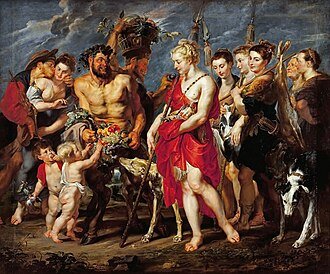
Rubens painted this mythological scene in 1615, showing Diana, goddess of the hunt, setting off with her nymphs and a hound. Among the figures, Isabella Brant is recognisable, and a satyr adds a contrasting presence to the group. The canvas blends a classical narrative with lively, animated figures in motion.

Painted by Peter Paul Rubens in 1618 in oil on panel, this work shows Saint Francis of Assisi receiving the infant Christ, in a scene that also includes the Virgin Mary and a woman. The title points to the moment when the saint takes the Child into his arms, a subject common in religious art.


This large composition by Rubens depicts the martyrdom of Saint Livinus, a bishop who, according to tradition, was killed in the seventh century. Painted around 1633, the scene is built around dynamic figures and strong contrasts of light and shadow, hallmarks of Flemish Baroque painting. Its monumental format suggests a work meant for a large religious setting.

A forest scene in which a deer hunt unfolds at dawn. The early light and the mass of trees shape the composition, while the hunters and the animal provide the narrative focus. Painted in oil on panel in 1635, the work places landscape at the centre of the picture.


Painted by Peter Paul Rubens around 1614, this canvas shows the taking down of Jesus of Nazareth from the cross, a subject frequently treated in religious art. Executed in oil on canvas, its tall format, over three metres high, suggests it was probably conceived for a large space. It is held at the Musée des Beaux-Arts in Valenciennes.

Rubens painted this mythological scene in 1616, in oil on panel. It brings together Atalanta, Meleager, a wild boar and a dog, alongside a man and a woman, suggesting a hunting episode. The subject probably relates to the Calydonian boar hunt, a Greek myth in which both heroes take part. The painting reflects the artist's interest in figures in action and in the world of the hunt.

This small oil on copper, dated 1597, portrays a man whose identity remains uncertain. The title suggests he may have been an architect or a geographer, but that remains a hypothesis rather than a confirmed fact. The panel's modest size, roughly 22 by 15 centimetres, invites a close, intimate look at the sitter.

Study of Two Heads is an oil on panel dated 1609 and attributed to Peter Paul Rubens. It shows two male faces handled more as character studies than as finished portraits. The work probably served as a preparatory or workshop study, in which the painter explored the modelling of the human head. Without further reference texts, caution is advisable about its original purpose.


This work by Peter Paul Rubens, dated 1612 according to its record, shows two sleeping children in oil on canvas. No further reference material is available, so the commission and the precise meaning of the scene cannot be confirmed. Its appeal lies mainly in the intimate, quiet theme of childhood rest, handled with a careful attention that rewards a slow look.

An allegory combining a woman, a cornucopia and a cherub, motifs that relate to the theme of abundance. Attributed to Peter Paul Rubens and dated 1630, it is executed in oil on canvas on a very large scale. With the information available, the commission and original setting cannot be specified, so the scene is best read through its symbols.


This panel by Rubens, dated 1617 and held at the Museo del Prado, belongs to the series of the five senses that the painter and his workshop produced around those years. It shows Venus and Cupid in a garden with flowers, a dog, a vessel and an architectural element. The scene evokes the sense of smell through the blossoms and the figure of Venus, who seems to invite the viewer to breathe in the fragrance surrounding her.

Taste is an allegory painted by Peter Paul Rubens in 1618, on a panel in landscape format. The scene gathers an abundant table of fruit, wine and meat, with a watching dog nearby, and reads as a reflection on the sense of taste, one of the five senses. Visible details include an hourglass and mythological figures such as Bacchus, whose presence points to the pleasure of wine. The painting invites viewers to connect the feast with the senses and the fleeting nature of earthly pleasures.

Painted by Peter Paul Rubens in 1609, this large oil on canvas is held at the Prado Museum in Madrid. Its title, The Recognition of Philopoemen, points to the moment the figure is identified. The scene includes a table, wickerwork and an axe, everyday objects that give the monumental composition a grounded, domestic character.

Portrait of the Infanta Isabel Clara Eugenia painted by Rubens in 1615, in oil on canvas. The sitter appears in an interior with a view onto a garden landscape, dressed in black with jewelled details and accompanied by a glove, a fan and a seat. The record also refers to Mariemont, the castle of Charles of Lorraine, though its connection to the scene cannot be established from the available information. The painting is held at the Museo del Prado.


Portrait of Marie de Medici, Queen of France, painted by Peter Paul Rubens in 1622 in oil on canvas. The record also links the work to pearls and a gem, but these details are imprecise and should be read with caution. The painting is held by the Prado Museum and belongs to the portrait output of the artist.

Portrait of Anne of Austria, Queen consort of France, painted by Peter Paul Rubens in 1622 in oil on canvas. The record offers little further information about the work, so any reading of its commission or setting would go beyond what can be stated with confidence. What is visible is a standing portrait with an architectural element beside the sitter and a gem as a notable detail, features that suggest the formal tone typical of courtly portraiture.

Painted in oil on panel in 1625 by Peter Paul Rubens, this religious work centres on a sculpture. Its title refers to the triumph of the Eucharist over idolatry, a doctrinal theme. Held in the Museo del Prado, it shows Rubens's command of composition and colour. Beyond these basic facts, the available sources do not allow us to say with certainty who commissioned it or the circumstances of its making.

Painted in oil on canvas around 1630 by Peter Paul Rubens, this religious work shows the Holy Family together with Saint Anne, the grouping in which Mary, Joseph and the Christ Child appear alongside the Virgin's mother. The composition brings the figures together in a close arrangement typical of devotional painting. The available information does not allow us to determine the commission or the specific circumstances of its creation.

Mythological work by Peter Paul Rubens, dated 1636 and painted in oil on canvas. The record points to a scene of combat and feasting, with elements such as swords, spears, a table and a fountain. Its large format and dynamic arrangement of figures invite a reading as a narrative of violence amid a banquet. Beyond these elements, the details of its commission and meaning cannot be confirmed here, so any interpretation should remain cautious.

Narcissus, painted by Peter Paul Rubens in 1636, shows the youth of classical mythology leaning over the water, absorbed in his own reflection. The scene belongs to mythological painting and is held in the Museo del Prado. Executed in oil on canvas, the work presents a luminous figure set within a calm landscape that frames the episode. Beyond these facts, the available information does not establish the commission or further details of its history.

A mythological painting by Rubens, dated 1636, depicting the episode in which Zeus, disguised as a bull, abducts Europa. The scene unfolds by the sea, where the princess clings to the animal as it wades through the waves. It is a small panel now held in the Museo del Prado, and its loose brushwork and warm palette are typical of the Flemish master's late output.

This small oak panel, painted in oil around 1636, shows Diana, goddess of the hunt, accompanied by her nymphs in pursuit of a stag. The scene unfolds in an open landscape where the female figures, with luminous bodies and vigorous movements, gather around the prey. The warm palette and quick brushwork convey the immediacy of the chase. Its horizontal format and mythological subject make it a good example of the taste for classical themes in Flemish Baroque painting.

Painted around 1620 by Peter Paul Rubens, this large canvas shows Ignatius of Loyola, founder of the Society of Jesus, in a religious composition. The available record does not specify its commission or original location, so it is best described cautiously: a devotional work in the Counter-Reformation tradition, executed in oil on canvas.

Portrait of Philip Rubens, the painter's brother, dated 1610 and painted in oil on an oak panel. As the title makes clear, the sitter is the artist's brother, and the work concentrates on his figure and presence rather than on a narrative scene. Its genre is portraiture, with attention centered on the sitter's face.

Oil on panel from 1612 depicting the biblical episode of the Sacrifice of Isaac, in which Abraham prepares to offer his son at God's command. It is a religious painting held at the Nelson-Atkins Museum of Art. Little is known about its commission or early reception, so the image itself is the best guide to reading it.


This portrait shows Helena Fourment wearing a pearl necklace and a beret, details that draw attention to her face and shoulders. Dated 1630 and painted in oil on panel, it is attributed to Peter Paul Rubens and is held by the Royal Museums of Fine Arts of Belgium. Portraits of this kind focus attention on the sitter's appearance.


The painting shows Moses together with the serpent, a religious subject of biblical inspiration dated 1610 and executed in oil on panel. The serpent becomes a central visual element, while the figure of Moses completes the scene. Rubens approaches a theme with a long tradition in religious painting.
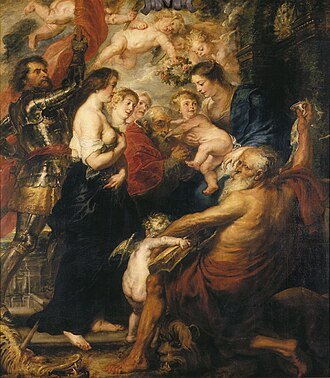
The Virgin appears with the Christ Child surrounded by several saints: Jerome, George and Mary Magdalene, alongside an unidentified woman. This large oil on panel, dated 1638, is attributed to Peter Paul Rubens. Its scale suggests it was probably intended for devotional use or an altarpiece, though little is known about its commission.


Painting by Peter Paul Rubens dated 1606, executed in oil on canvas. It depicts Sebastian of Milan, a saint of Christian tradition, within religious art. Available information does not clarify its commission or finer details of its composition, so this description is limited to its subject and medium.

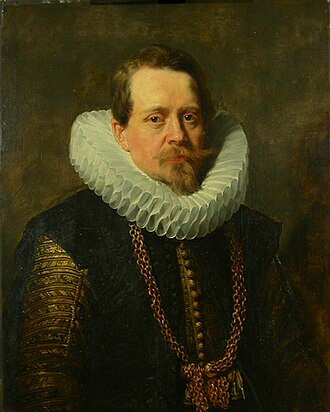
Portrait of Jean Charles de Cordes, painted by Rubens in 1618 in oil on panel. It is a bust-length portrait of the sitter named in the title, shown in the foreground against a plain background. Without further documentation, the work is best understood as an example of the painter's portraiture around that period.


Peter Paul Rubens painted this Lamentation in 1612, in oil on canvas. The scene shows the dead body of Jesus of Nazareth surrounded by mourners, one of them a woman. The body of Christ is shown in foreshortening, giving weight and emotional intensity to the religious composition. Its commission and original setting are not documented here.

Painted by Peter Paul Rubens in 1610, this oil on canvas belongs to religious art and depicts the biblical moment when the angel tells Mary she will become a mother. The subject was widely treated in painting of the period, and the work is held at the Rubenshuis.
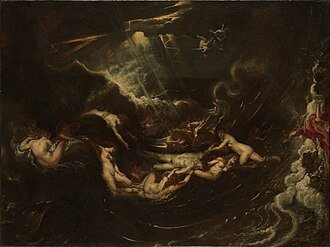
With this canvas Rubens took up the mythological story of Hero and Leander, the lovers separated by the Hellespont strait. Dated 1604 and painted in oil on canvas, it draws on a theme from classical literature that offered artists a rich narrative subject. It is now held in the collection of the Yale University Art Gallery in the United States.

Baroque work by Peter Paul Rubens, dated 1611 and painted in oil on canvas. It depicts the taking down of Jesus of Nazareth from the cross, a common subject in religious painting. It is held in Antwerp. The available sources do not allow further details about its commission or composition to be specified.

Oil on canvas dated 1618, gathering the Virgin, the Christ Child, Saint Elizabeth and the young Saint John the Baptist, with a lamb that points to Christ's future sacrifice. The scene feels intimate and domestic within a religious subject, with the figures grouped around the child. Its key feature is its authorship by Peter Paul Rubens, who painted it at the height of his career, when his workshop operated at high output.

Painted by Peter Paul Rubens in 1611 on an oak panel, this religious work depicts the Massacre of the Innocents. Violence and nude figures dominate the scene, with the composition focusing on the brutality of the episode. Today it belongs to the National Gallery in London, where visitors can see it.

The painting shows a seated Venus with fair, flowing hair, accompanied by Eros, who carries a quiver and has wings, while a mirror reflects her image. It is dated 1608 and attributed to Rubens, though the title recalls a work of the same name by another artist, so the authorship and title should be checked before being taken as certain.


This oil on panel from 1633, held at the National Gallery in London, depicts the mythological scene in which the shepherd Paris must choose the most beautiful goddess among Hera, Athena and Aphrodite, after the quarrel sparked by the apple of discord. Hermes appears as the messenger, and the group includes nude female figures set against a rural landscape. The generous flesh tones and warm colouring are recognisable traits of Rubens's style.

Rubens painted this mythological scene in 1606, in oil on wood. Set in a rural landscape, it shows the shepherd Paris facing a choice among three goddesses: Venus, Minerva and Juno. The composition centres on the young man and on the contrast between the divine figures and the pastoral surroundings.

Large-scale mythological painting by Peter Paul Rubens, executed in oil on canvas in 1635. The composition is built around a tree and a horse, which place the scene in a natural setting. Its large format gives the scene considerable presence. The work is held at the Nationalmuseum in Stockholm.


Painted by Peter Paul Rubens in 1633, this religious work depicts a miracle attributed to Saint Justus of Beauvais, linked to the city of Beauvais. The scene brings together a soldier and a natural landscape, placed within Catholic tradition. Its subject places it among the artist's devotional paintings.


Portrait of two boys, Albert and Nicolaas Rubens, painted in oil in 1627. The record identifies Nicolaas as Lord of Rameyen, a title pointing to a family of some standing. Without further reference sources, little more can be said with confidence beyond the sitters' identities, the date and medium, and the work's presence in the Liechtenstein Museum.

The Three Graces, painted by Rubens in 1622, shows the Charites nude and intertwined in a compact group of luminous flesh. Executed in oil on oak panel, the work is held at the Academy of Fine Arts in Vienna. The figures form a circular movement that balances the three silhouettes, and the warm handling of colour and light reflects the painter's interest in the female body and in mythological subjects.


Painted in 1611 in oil on panel, this religious work depicts the moment when the body of Jesus of Nazareth is taken down from the cross. Joseph of Arimathea and Nicodemus are present alongside him, as are John the Evangelist and Mary Magdalene. The central panel is kept in Antwerp Cathedral.


Mythological painting by Peter Paul Rubens, dated 1637, showing Semele and Jupiter. In the classical story, Semele died after seeing her lover in his divine form. The work is held by the Royal Museums of Fine Arts of Belgium. Beyond its subject and date, the record offers little information about its commission or reception.

Large religious painting by Rubens from 1608, executed in oil on a tall canvas. It depicts Flavia Domitilla alongside Nereus and Achilleus, figures from Christian religious tradition. It is now housed in the church of Santa Maria in Vallicella, so it was probably conceived for that sacred setting.
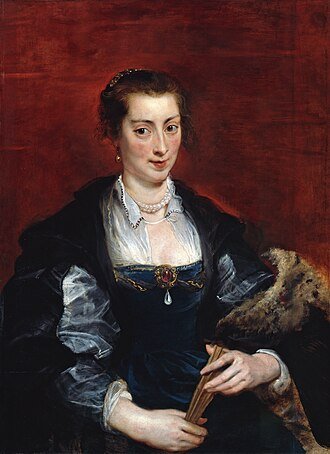
Portrait of a woman painted on panel, with a pearl necklace, a brooch and a fan among the details of her dress and pose. Tradition links the sitter to Isabella Brant, but this identification is not certain, so the title should be read with caution. The work is held in the Gemäldegalerie in Berlin.

A mythological painting by Peter Paul Rubens titled Fortuna, referring to the figure of classical tradition who personifies chance and destiny. Dated 1630, it was painted on an oak panel and is held at the Gemäldegalerie in Berlin. The small scale of the panel invites close, attentive viewing of its figure and symbolism.

Small panel painting showing the lamentation over the dead Christ, a moment in which his followers mourn beside his body. Dated 1610 and attributed to Peter Paul Rubens, it belongs to the artist's religious output. Its modest scale suggests close, intimate viewing, though its original setting is not recorded here.

Painted by Peter Paul Rubens in 1625, this oil on canvas shows the Virgin and Child within a religious context. The scene includes a bouquet of flowers, a book and the act of breastfeeding, details that place the image in the realm of devotion. No further information about its commission or reception is available.

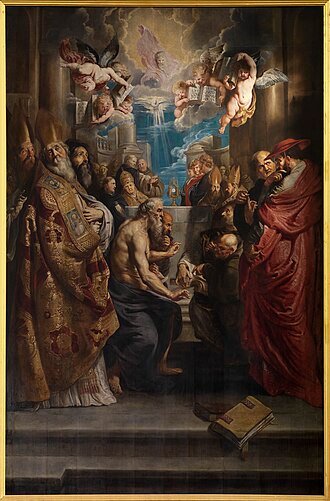
Religious painting dated 1601, executed in oil on panel and of large scale, now kept in the church of St Paul. Its subject is the Eucharist, understood as the real presence of Christ in the sacrament. Given its size, it seems meant for a place of worship, though the exact commission is not documented.

Painted by Peter Paul Rubens in 1609, this oil on canvas belongs to religious art and depicts the Adoration of the Shepherds, the moment when humble visitors come to honour the newborn child. Given its large scale and devotional character, it was probably intended for a place of worship, although the available sources do not allow us to say more about its commission.

Peter Paul Rubens painted this religious scene in 1612 in oil on panel. It shows the moment when the body of Jesus of Nazareth is taken down from the cross, a subject frequently treated in Christian art. The painting is now held by the Courtauld Gallery.


Small copper panel painted in oil by Peter Paul Rubens, showing Jesus of Nazareth dead and mourned in the Lamentation scene. Dated 1605, it is a work of religious art. Its modest size and metal support invite close, intimate viewing.

Portrait of Caspar Schoppe, painted by Peter Paul Rubens in 1606 in oil on canvas. The work shows the sitter with a restrained presence typical of the genre, and belongs to the portraits the artist produced in the early years of his career. Since the record offers few details about its commission or reception, it is best to limit comments to what the image itself allows us to see.


This 1618 painting by Peter Paul Rubens is an oil on canvas landscape. Its title, Winter: The Interior of a Farm, points to a rural scene in the cold season, though little more is known about its composition or commission. It is now held in the Royal Collection.

It shows Leda, a figure from Greek myth, seated in a rural landscape beside a swan, the form in which the myth associates Zeus or Jupiter. The mythological scene centers on a female nude, with hip and buttock prominent in the foreground. Painted in 1599 on panel, it pairs the figure with an open sky and a countryside setting.


Mythological painting by Peter Paul Rubens, dated 1610 and executed in oil on panel. It shows Venus and Adonis, the figures of the myth telling of the goddess's love for the young hunter, a subject often treated in classical literature and art. The work is held at the Museum Palace of Art in Düsseldorf.

Painted in oil on canvas in 1611, this large work by Rubens depicts the Supper at Emmaus, the Gospel episode in which Jesus of Nazareth, already risen, shares a meal with two disciples. As a religious painting, it is today housed in the church of Saint-Eustache in Paris.

Painted by Peter Paul Rubens in 1617, this large canvas shows the moment when the body of Jesus of Nazareth is carried to the tomb. Executed in oil on canvas, it belongs to religious art and its tall, monumental format places it among the painter's large-scale works. It is listed at the Église Saint-Géry, a church setting linked to worship.

Portrait of Marie de' Medici showing the queen with a crown, alongside Bellona, the Roman goddess of war, and a putto, or winged child. Painted in oil on canvas in 1623 by Peter Paul Rubens, the work combines a real sitter with allegorical figures to present her in a symbolic light. It is now held in the Louvre.

Oil on canvas by Peter Paul Rubens, dated 1637 and held at the Louvre, in a vertical format with a nude subject. The title refers to the death of Dido, yet the figure listed for the scene is Pantea Arteshbod, so the subject should be treated with caution until it has been verified.


Rubens painted this small oil on panel in 1620, showing the crucifixion of Jesus of Nazareth at the moment the cross is lifted. Now in the Louvre, it belongs to religious painting. Its modest size suggests close, intimate viewing, though little is known here about its original purpose.

The painting depicts the meeting of Abraham and Melchizedek, accompanied by a soldier and a column that frame the scene. Its religious subject defines the work. The available information does not clarify its commission or other details, so the museum's catalogue is the best place to expand on its context.


Portrait of a clothed woman, painted in oil on panel and held at the Louvre. The title identifies the sitter as Isabella Brant (1591-1626) and dates the work to after 1625. The composition centres on the figure and her dress, presented with a direct and restrained presence. As a wooden support, the panel shows the handling of the paint surface.

Portrait of Anne of Austria, Queen of France, painted by Peter Paul Rubens around 1620. The sitter is seated, wearing a formal dress decorated with lace and jewellery, and the white collar draws attention to her neck. The work is held in the Louvre. Beyond these details, little can be stated with certainty about its commission or reception.


The painting shows the coronation of Marie de' Medici at the Basilica of Saint-Denis, with a large composition that includes the queen, Margaret of Valois, a cardinal, a child and a dog. Rubens worked in oil on canvas and paid close attention to costumes, lace and jewels, which give the scene its solemn tone.

This large history painting by Rubens, dated 1623, belongs to the series commissioned by Marie de Medici to decorate the gallery of her Parisian palace. It shows a solemn official ceremony, with soldiers, a flag and a child beside a balustrade and a monumental doorway. Its scale and theatrical composition aim to convey the authority of the regent.

Painted in 1623, this allegorical work depicts the birth of the Dauphin at Fontainebleau in 1601, alongside mythological figures such as Apollo, Pegasus and Cybele. The scene blends a historical event with symbolic imagery, which probably refers to the newborn's future. Without further reference material, the exact role of each figure remains uncertain.


Painted by Rubens in 1623, this allegory shows the birth of Marie de' Medici with symbols linked to Florence, such as the river Arno shown beside a reed. A woman, a baby and a putto appear among a column and clouds, in a scene focused on maternal love.


The panel shows the biblical episode of Lot leaving Sodom with his family, accompanied by an angel and a donkey among the figures. Painted in oil on panel by Rubens in 1625, it belongs to the religious art genre in his output. It is now held at the Louvre Museum.

It depicts Clelia, a heroine of Roman legendary history, crossing the Tiber on horseback at a ford, among nude figures and others. The date given, 1650, is doubtful since Rubens died in 1640, so it should be treated with caution. It is now held in the Louvre Museum.


Painted by Rubens in 1614, this mythological nude shows Eros from behind, one wing visible, standing as he carves a bow with a knife. The figure turns his gaze toward the viewer, and a branch, a book and a piece of cloth sit nearby. Nothing is recorded here about its commission or original destination.

Large oil on canvas in which Rubens stages the war in heaven, the clash between loyal and rebel angels drawn from religious tradition. It is held at the Electoral Gallery in Düsseldorf. Packed with bodies in motion, the scene conveys the expulsion of the fallen angels.

Portrait of Helena Fourment, painted by Peter Paul Rubens in 1630. The sitter wears a hat with a feather and is shown with a glove, details that lend the figure an elegant air. Executed in oil on canvas, the work belongs to the portrait genre and focuses attention on the woman rather than on a setting. Saying more about its commission or context would require further documentation.

This small panel, dated 1636 and held at the Prado Museum, shows Apollo with the serpent Python, as its title indicates. It is classed as a mythological painting centred on the god. Beyond its title and date, no further details of its commission, composition or specific meaning are available, so any reading rests on the myth and on the image itself.

A mythological painting by Peter Paul Rubens, dated to around 1630 and held at the Museo del Prado. Its subject is the Golden Fleece, the golden ram's skin that Jason and the Argonauts sought in Colchis. No further details about its composition or commission are recorded, so it is best to confine any description to its subject and date.

This mythological painting by Peter Paul Rubens, dated 1636 and held in the Museo del Prado, shows Tereus, sword in hand, at a moment centred on a woman named Itys. The large canvas brings to painting an episode of cruelty and revenge from mythological tradition, and its interest lies above all in the dramatic tension of the bodies and in the vivid colour associated with the artist.

This oil on canvas, dated 1636 and held in the Museo del Prado, shows Mercury, the messenger god of classical mythology, identified with the Greek Hermes. He appears nude, with a drape that barely covers his body and the caduceus as his distinguishing attribute. No further details about its commission or context are available.

This oil-on-canvas painting, dated 1636, is a mythological work by Peter Paul Rubens. Its title, Fortune, refers to the goddess of luck, and the record identifies its central motif as a globe. Without further references, it is best described cautiously, avoiding any claim about a commission or a specific meaning that is not documented.

Mythological painting by Peter Paul Rubens, dated 1635 and executed in oil on canvas. It shows Europa with a bull, and its title, The Rape of Europe, tells us that the central figure is the woman carried off by the animal. The work is held at the Museo del Prado, where this mythical subject can be seen.

This mythological painting, dated 1635 and executed in oil on canvas, takes as its subject the fall of Icarus, the figure from Greek myth who, according to the story, perished after plunging into the sea for flying too close to the sun. The record offers no details about its commission or specific composition, so the scene is best examined closely. It is now held in the Museo del Prado.

This mythological painting by Rubens, dated 1636 according to its record, shows Apollo in full pursuit of Daphne, the nymph who, to escape him, asked for help and was turned into a laurel tree. The work is held in the Museo del Prado. The scene centres on the god, whose impetuous movement contrasts with the plant-like stillness beginning to take hold of the young woman. Further detail on its composition or commission would require information not given here.

Painted by Peter Paul Rubens in 1636, this large-scale composition shows Bacchus advancing in a chariot surrounded by figures celebrating his triumph. The work belongs to mythological painting and is held at the Museo del Prado. With the available information, no further details about its commission or original context can be confirmed.

This mythological painting by Rubens shows Perseus rescuing Andromeda, a chained figure who is presented to the viewer's gaze. Perseus appears in armour and holding a sword, in a scene of heroic liberation. The record indicates oil on canvas and a tall, large format that lends the figures a monumental presence. With no further references available, it is best to limit the description to the subject and the technique of the work.

Portrait of Isabel de Borbón, presented as Queen of Spain, painted by Peter Paul Rubens in 1628. It is an oil-on-canvas portrait now held at the Hermitage Museum. No information about its commission or context is available, so any reading should stay close to what the composition itself shows.


This large mythological painting by Rubens, dated 1618 and executed in oil on canvas, depicts the hunt of the Calydonian boar, an episode in which Meleager and Atalanta appear among the hunters chasing the beast. Its considerable size and crowded composition of figures in motion convey the energy of the scene. Beyond these basic facts, the record does not allow us to establish further details about its commission or reception.


Rubens depicted Jerome dressed as a cardinal, a figure the work's title makes explicit. Painted in oil on panel in 1625, the picture belongs to religious art and is held in Vienna. The available information does not establish the commission or the composition in further detail.

Painted by Peter Paul Rubens in 1633, this oil on panel suggests a park setting where a group of people enjoys leisure time together. As a landscape, it gives the natural surroundings a central role alongside the human scene. The title alone indicates a cheerful social gathering, so the specific events remain open to interpretation.

The painting depicts Jesus of Nazareth in a moment of mourning, as its title Lamentation of Christ suggests. Rubens painted it in 1614 in oil on panel. The available information does not clarify who commissioned it or under what circumstances, so it is best read as an example of the religious subjects the Flemish painter explored.


Rubens painted this pastoral scene in 1618 in oil on panel. It shows milkmaids tending cattle in a landscape whose title links it to Laeken. Rather than focusing on an event, the picture seems to concentrate on everyday rural labour and the animals. It is held in the Royal Collection.


Mythological painting by Peter Paul Rubens, dated 1616 and executed in oil on canvas on a large scale. It shows Diana, the goddess, surrounded by her nymphs as satyrs watch them from hiding, a moment built around surprise and concealed observation. The work is now in the Royal Collection in the United Kingdom.
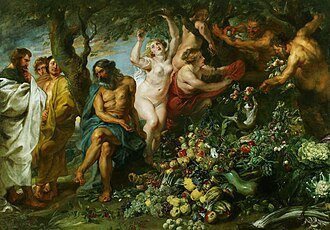
Pythagoras Advocating Vegetarianism is a large canvas by Peter Paul Rubens, dated 1624, belonging to the mythological genre. Its central figure is Pythagoras, the philosopher who dominates the scene. Without additional reference texts, our reading stays close to what the title suggests: a message about abstaining from eating meat and certain plant foods.


Painted by Peter Paul Rubens in 1613, this oil on panel depicts the martyrdom of Saint Lawrence, a common subject in religious art. Its tall vertical format, about two and a half metres high, gives the saint's suffering a commanding presence. It is recorded in the collection of Johann Wilhelm von der Pfalz, though the commission and original setting are not documented here.

Portrait of a man identified as a Franciscan friar by its title, painted in oil on canvas in 1615 by Peter Paul Rubens. A skull appears alongside the sitter, an element often associated with reflection on mortality. The available record offers no details about the commission or original setting, so any reading of the scene should remain tentative.

Oil on oak panel by Peter Paul Rubens, dated 1615, showing Jesus of Nazareth crucified. It belongs to religious art, a subject frequently treated in Baroque painting. The work is listed in the collection of Johann Wilhelm von der Pfalz, with no further information about its commission.

Portrait of Jan Brant, painted by Peter Paul Rubens in 1635 in oil on panel. Standing just over a metre high, it has a vertical format. Reliable details of its commission or composition are not known, so this account is limited to its genre and technique, which place it within Rubens's portrait work.

This mythological painting by Peter Paul Rubens, dated 1635, shows Meleager and Atalanta, figures from Greek mythology. Executed in oil on a large canvas, it reflects the Baroque taste for dynamic bodies and vivid flesh tones associated with the Flemish master. It is held in the Alte Pinakothek in Munich.


This oil on canvas depicts the Virgin Mary during her education, a subject in religious painting in which the young woman is shown being taught, usually alongside her mother. Rubens painted it in 1630, and the composition centres on the figure of the Virgin and the domestic setting surrounding her. With the information available, the commission and the original destination of the work cannot be determined with certainty.


Painted by Peter Paul Rubens in 1614, this religious work uses oil on panel to show the Holy Family accompanied by a parrot, which gives the painting its title. The available information does not clarify who commissioned it or what the bird is meant to signify, so any reading should stay close to what the scene itself shows.


Portrait of an unidentified young woman, painted in oil on panel in 1600 and attributed to Peter Paul Rubens. She wears a stomacher bodice, a diadem-style headdress and a millstone collar, and holds a rosary, an object linked to Catholic devotion.


Peter Paul Rubens painted this portrait of Charles de Longueval in 1621, working in oil on panel. Its fairly modest size points to a personal commission rather than a grand official image. The painting now belongs to the Hermitage Museum, and as a portrait it places the sitter's individual presence at its centre.
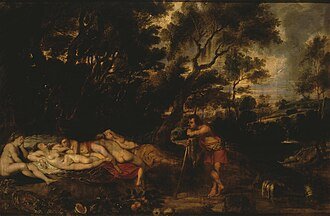
Although catalogued as a landscape, this panel places Cimon and Iphigenia within a natural setting, so the two figures give the scene its narrative focus. Rubens painted it in oil on wood in 1630, and the surrounding countryside takes up a significant part of the picture. It is held at the Hermitage Museum in Saint Petersburg.


This large canvas by Rubens shows a lion hunt in which men and animals clash in the foreground, within a crowded space of bodies, motion and violence. Dated 1616 and painted in oil on canvas, it stands out for its dynamism and the contrast between the strength of the big cats and the turmoil of the hunters.
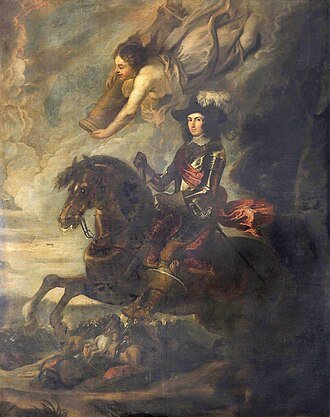
Equestrian portrait dated 1630 and attributed to Peter Paul Rubens, showing a rider mounted on horseback. The title names Charles Colonna, Duke of Marsi, while the sitter is recorded as Egidio Colonna, a discrepancy worth keeping in mind. Without further documentation, the context of the commission and the finer details of the composition cannot be established with confidence.


Oil on canvas dated 1630 and held at the Uffizi Gallery, this religious work by Rubens shows Judith and Holofernes, figures from the biblical Book of Judith. The available information does not clarify its commission or history, so the reading of the scene should rest mainly on the image itself.

Abundance is the English title of a work by Peter Paul Rubens, the seventeenth-century Flemish painter. The record offers no details about its date, commission or specific subject, so the scene cannot be described with certainty. The title does suggest a theme of plenty, fertility or richness, a recurring concern in the artist's output.

A portrait of a nun absorbed in prayer, dated 1635 and painted in oil. The composition concentrates all attention on the religious woman, shown in a devout pose without any narrative scene around her. The work is attributed to Rubens and is now held by the Metropolitan Museum of Art in New York, where it offers a quieter, more personal side of his output.


Religious painting by Rubens, dated around 1627 and executed in oil on panel. It shows a woman on a cart, a scene that the title, Triumph of the Faith, suggests is an allegory of spiritual victory. Little is known about its commission or original destination, so the reading of the composition should be taken cautiously.

The scene shows Lot and his family leaving Sodom, guided by an angel who accompanies the group during their escape. Rubens painted it in oil in 1615 as a religious work. With the available information, it is not possible to confirm its commission, its original destination, or the reception it received at the time.


This 1612 painting by Peter Paul Rubens depicts the Entombment of Jesus of Nazareth, the moment when his body is laid in the tomb after the crucifixion. Executed in oil on an oak panel, it belongs to the religious art genre and is held by the National Gallery of Canada.

Painted by Peter Paul Rubens in 1615, this oil on canvas depicts the Assumption of the Virgin, a religious subject. Its very large format, around five metres high, suggests a work made for a spacious setting. The scene centres on the rising figure of Mary, with a dynamic composition and the vivid colour associated with Flemish Baroque painting.

This work by Peter Paul Rubens, dated 1625 and painted in oil on canvas, belongs to religious art and depicts the coronation of the Virgin Mary. Its large vertical format, more than four metres tall, suggests it was meant for a sizeable space. The record offers no further information about its commission or background, so it is best to stick to what the painting itself shows.

Painted by Peter Paul Rubens in 1635, this oil on canvas belongs to religious art and depicts Judas Maccabeus in his triumph. Its large format, over three metres tall, suggests a work conceived on a monumental scale. Today the painting is held in Nantes.

Rubens's oil on canvas shows Saint Francis of Assisi receiving the Christ Child from the Virgin Mary, with an angel present in the scene. It belongs to Flemish Baroque painting and to religious art. The composition is organised around the gesture of handing over the Child.


This oil-on-panel work by Peter Paul Rubens, dated 1610, treats a religious subject: the crucifixion of Jesus of Nazareth. The available information does not specify its commission, composition or specific symbolism, so the scene is best approached by looking closely at the painting itself.

Dated 1608 and painted by Peter Paul Rubens, this work depicts the biblical scene in which Cain kills his brother Abel, a subject belonging to religious art. It is executed in oil on oak panel and belongs to the Antoine Seilern collection. The available details do not clarify who commissioned it or its later history.

This small oil-on-panel work by Peter Paul Rubens, dated 1609, depicts Samson and Delilah, figures from the biblical narrative in the Book of Judges. It belongs to the religious art category and is held by the Cincinnati Art Museum. Its modest size suggests a work meant for close viewing, though its original patron is not recorded here.


A small panel by Rubens, dated 1628, showing the entry of King Henry IV into Paris, a subject typical of history painting. Its modest size and oil-on-panel technique suggest it was probably not meant as a large altarpiece or palace decoration. The movement of the scene and the lively brushwork help the viewer follow the procession, though its original commission is not known with certainty.


This small landscape by Rubens shows a tower that the record identifies as Elewijt Castle, set in a rural scene of fields and trees. Painted on an oak panel, the work presents a calm view of the terrain, with the tower as its central feature. Its modest size suggests a piece meant for quiet viewing rather than a large commission.

Large oil on canvas dated 1613, belonging to religious art. It depicts Jerome, a figure of the Christian tradition. The available information does not establish the commission or original setting, so a reading must rest on the saint's figure and on the work's tall, large-scale format.

Mythological painting dated 1616, made by Peter Paul Rubens on canvas. The scene shows Diana, goddess of the hunt, accompanied by a hunting dog, game and fruit, with Pan also present among the group. The work is held in the Staatliche Kunstsammlungen in Dresden.

This mythological painting by Peter Paul Rubens, dated 1613 and executed in oil, shows Hercules in a drunken state, a figure associated with the hero's strength and with a scene of excess. Its square format, measuring 220 centimetres on each side, makes it a large work, now held in Dresden's Staatliche Kunstsammlungen.

This large seascape by Rubens, dated 1635, shows the sea and a boat in oil on canvas. Its English title places the subject in a prince's voyage from Barcelona to Genoa between 1634 and 1635, though the available record offers few further details about the scene itself. At nearly four metres wide, the canvas places the viewer close to the water.

This small copper panel by Rubens, dated 1612, depicts the death of Hippolytus, a figure from Greek mythology. The record offers no further details about its commission or context, so it is best to stay with what the work shows: a mythological scene painted in oil on a metal support, a less common choice in his output.
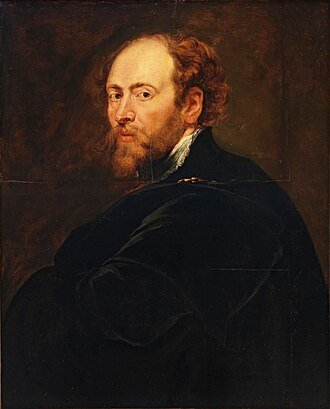
This self-portrait by Peter Paul Rubens, dated 1618 and painted in oil on panel, shows the artist looking directly at the viewer with a calm expression. The work is held in the Uffizi Gallery in Florence. Beyond these basic details, it can be described as an intimate portrait in which the painter presents himself as the main subject.


This small panel by Rubens, dated 1614, depicts the Flight into Egypt in a moonlit night scene. The Virgin rides a donkey carrying the Child, guided by an angel who seems to clear the way through the darkness. The handling of nocturnal light and the contrast between figures and landscape reflect the painter's interest in luminous effects within a sacred subject.

Peter Paul Rubens painted this scene of the burial of Jesus of Nazareth in 1615, in oil on panel. It belongs to religious art and is part of the Antoine Seilern collection. Few details are known about its commission or composition, so its interpretation should be approached with caution.

This oil painting on an oak panel belongs to religious art and depicts a miraculous catch of fish. Its main figures are a fisherman and his boat, shown in a small format that may suggest a private or devotional setting, though this is not confirmed. The composition centres on the boat and the labour of the man.

This panel by Rubens, dated 1618, depicts the Gospel episode of the miraculous draught of fishes. After a fruitless night, a man tells the fishermen to cast their nets again, and they come back so full they nearly tear. Painted in oil on panel in a tall format, it is a religious work, though its original setting should be described with caution.

Rubens's copy of a portrait of Baldassare Castiglione that Raphael painted around 1514-1515. Rubens follows Raphael's composition closely, so the work records how Baroque painters studied and reworked Italian Renaissance models. It is a painted reinterpretation of a celebrated courtier, rather than an independent portrait.

Peter Paul Rubens painted this small oil on panel in 1620, depicting the martyrdom of Saint Ursula of Cologne, a subject from religious art. Its modest size probably points to a format meant for private devotion, although its original destination is not documented here.


Central panel of the triptych Rubens painted for Antwerp Cathedral, showing Christ's cross being hoisted with visible strain: bodies stretch along diagonals while ropes run through the composition. The dramatic scene, on a large scale, captures the decisive moment of the crucifixion. It remains in the cathedral.

This right-hand panel belongs to a religious work painted in oil on wood showing the Elevation of the Cross, a scene from the Passion of Christ. A woman and a child appear in it, arranged with restraint within a tall composition suited to a sacred setting. The painting remains in Antwerp Cathedral, a location that points to its liturgical purpose.


Painted by Peter Paul Rubens in 1637, this mythological scene shows Hippodamia at the moment she is seized by a centaur. The work is an oil painting on panel, and its small format invites close viewing. It is held by the Royal Museums of Fine Arts of Belgium.


Small oil sketch on panel by Peter Paul Rubens showing Venus, a subject from classical mythology. It was made as a preparatory study for the Torre de la Parada, and the larger finished works for that project were probably developed from sketches like this one. Its modest size and loose handling let viewers follow the painter's working method at the stage of invention.

This mythological painting shows Ganymede receiving a cup from Hebe while Zeus presides over the scene. In classical myth, Hebe served nectar to the gods, and the canvas captures that moment of handover. Rubens painted it in 1611 on a large square canvas, roughly two metres a side, giving the figures ample room within the composition.




A small oil-on-panel work by Rubens showing a child, identifiable as Cupid from its mythological subject, riding a dolphin. Dated 1636, it belongs to the genre of mythological painting. It is held by the Royal Museums of Fine Arts of Belgium. Its small size invites close looking.

Small-scale mythological painting, oil on panel from 1636, showing giants and titans fallen among rocks. The title suggests it refers to the myth of the giants' struggle, though little is known about the scene's commission or context. Its modest size invites a close, unhurried look at the tangled figures.

Dated 1630 and painted in oil on canvas, this religious work depicts a miracle attributed to Benedict of Nursia. Its large format suggests a generous display space, though reliable information about who commissioned it or where it was originally meant to hang is not available.

Portrait of Paracelsus, painted by Peter Paul Rubens in 1625 in oil on panel. The sitter is identified in the record as Theophrastus Bombastus von Hohenheim, and a book appears in the image as part of the composition. The upright panel is held by the Royal Museums of Fine Arts of Belgium.

This canvas by Peter Paul Rubens depicts Saint Augustine of Hippo, a central figure of Christian thought, within religious art. Painted in oil on canvas around 1630, it belongs to the devotional output of the Flemish painter. The record offers no further details about its commission or history, so any reading of the scene should be approached with caution.

A work by Peter Paul Rubens dated 1620 and painted in oil on panel. It belongs to the religious genre and shows the Coronation of the Virgin Mary, who occupies the central place in the composition. The available information does not clarify the original commission or its later history, so it is best approached mainly through its subject and technique.


In this large 1633 canvas, Rubens shows Tomyris, queen of the Scythians, as she plunges the head of the dead Cyrus II the Great into a vessel of blood. Around her appear a servant, a dog, a tapestry and a vessel, details that accompany the queen in the scene.
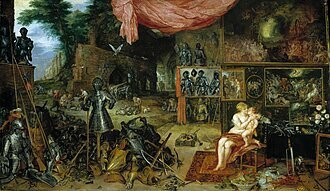
This 1618 oil on panel by Rubens belongs to an allegorical series devoted to the five senses. Here touch is suggested through a crowded interior filled with weapons, a helmet, armour, a shield, a cannon, a gun and a painting, alongside a glass and a kissing couple. The scene invites us to feel and handle each object, so the sense becomes a matter of material things and activity. It is best read with caution, since the precise meaning of each element is not fully settled.

Painted in oil on panel, this horizontal work shows a horse and a man, and its title links it to a triumph of Henry IV. It is dated 1630 and attributed to Peter Paul Rubens. Held at the Metropolitan Museum of Art, its modest format probably points to a small-scale piece, though its commission and original setting remain uncertain.


Portrait of Agrippina the Elder and her husband Germanicus, painted by Rubens in 1614 on panel. Its listed details describe Germanicus with fair hair and Agrippina wearing jewels: a ruby, a pearl and a diadem. The record offers no further information about commission or context, so this reading is limited to the features visible in the portrait.


The painting depicts the biblical episode in which Samson is seized after Delilah learns the secret of his strength. Classed as religious art and dated 1609, it is attributed to Peter Paul Rubens. Without reference texts, details of commission, composition or technique cannot be confirmed here, so the work is best appreciated by looking closely at the canvas itself.


A preparatory study in which Rubens sketches the abduction of Ganymede, the young Trojan who, according to myth, was carried off to Olympus by an eagle. Small in format and painted in oil on panel, the work offers a glimpse of the artist's creative process. As a sketch, the record does not state the original destination of the painting or the circumstances of its commission.


Oil on panel dated 1615 and attributed to Rubens, showing the Virgin Mary gazing at the sleeping Christ Child. The subject, common in religious painting, stresses tenderness and the mother's attentive look toward her son. The modest size suggests, probably, a piece made for private devotion.


Portrait of Nicolas Trigault, an oil on canvas painted by Peter Paul Rubens in 1617. It shows the sitter who gives the work its name, within the portrait genre and on a large scale. The available information does not specify the commission or the circumstances in which it was made, so the image is best read with caution.


Portrait in oil on panel, dated 1630 and attributed to Peter Paul Rubens. Its vertical format and modest size suit an intimate, close study of a single figure, the central concern of the portrait genre. The record offers no information about the sitter or the commission, so any further reading should remain cautious.

Peter Paul Rubens is the painter credited for this work, but the record offers no further details about its subject, date, commission or technique. Rubens was one of the great figures of Flemish Baroque painting, known for dynamic compositions, warm colour and his command of the human figure. Without further reference material, the specific content of the picture cannot be established.

This oil on panel by Peter Paul Rubens, dated 1615, depicts Tiberius and Agrippina, figures from the Roman imperial world. The record describes Tiberius as a fair-haired man linked to the Roman emperor, and a woman wearing a pearl and a diadem. He appears with a triumphal crown and a mantle, and the pairing suggests a solemn portrait of a couple. Without further sources, caution is advisable regarding the commission and the specific context of its making.

Portrait of Hypolite de Male, wife of Henri de Vicq, lord of Meulevelt, painted by Peter Paul Rubens in 1625. The small panel is executed in oil. Little is documented about the sitter: her name and marriage are recorded, but her birth and death dates are unknown, so her identity rests almost entirely on the work's title.
Where to see the work
- Museo del Prado Madrid · 53
- Louvre Museum Paris · 36
- Royal Museums of Fine Arts of Belgium Brussels-Capital Region · 30
- Kunsthistorisches Museum Vienna · 20
- Hermitage Museum Saint Petersburg · 18
- Gemäldegalerie Berlin Berlin · 15
- Bavarian State Painting Collections Munich · 14
- Onze-Lieve-Vrouwekathedraal Antwerp · 10
- National Gallery London · 10
- Metropolitan Museum of Art New York City · 10
- Johann Wilhelm von der Pfalz collection Düsseldorf · 9
- Vlaamse Kunstcollectie · 9
- Galleria Palatina Florence · 8
- Staatliche Kunstsammlungen Dresden Dresden · 8
- Liechtenstein Museum Vienna · 8
- Royal Collection · 7
- Electoral Gallery Dusseldorf Munich · 6
- Rubenshuis Antwerp · 5
- Galería Nacional de Arte Washington, D.C. · 4
- Palais des Beaux-Arts de Lille Lille · 4
Teachers and pupils
Studied with
- Tobias Verhaecht 1561–1631
- Otto van Veen 1556–1629
- Adam van Noort 1562–1641
Pupils
- Anthony van Dyck 1599–1641
- Jan Boeckhorst 1605–1668
- Justus van Egmont 1602–1674
- Erasmus Quellinus II 1607–1678
- Cornelis Schut 1597–1655
- Theodoor van Thulden 1606–1669
- Abraham van Diepenbeeck 1596–1675
- Frans Wouters 1612–1659
- George Jamesone 1589–1644
- Lucas Franchoys the Younger 1616–1681
- Cornelis Schut III 1629–1685
- Willem Panneels 1600–1634
Curiosities
An altarpiece over his grave
In 1642 his widow had a painting by Rubens placed over his tomb, framed in marble: The Virgin and Child with Saints. It is believed that the painter portrayed himself as St George and Hélène Fourment as Mary Magdalene. It is one of the few occasions on which his private life appears so directly in a work destined for a religious setting, which is why historians have studied it closely.
A friend of Velázquez in Madrid
During his second stay in Madrid, from 1628 to 1629, Rubens became friends with Diego Velázquez. It was Rubens who persuaded the Sevillian to travel to Italy to complete his training, and the two planned to go together. In the end Rubens went back to Antwerp and Velázquez made the journey alone. Rubens had also copied many works by Titian from the royal collection, and his post-mortem inventory lists no fewer than thirty copies after the Venetian master.
A truce commemorated in paint
His first major municipal commission in Antwerp was The Adoration of the Kings, for the Chamber of the Estates, where the negotiations of the 1609 treaty were held. The subject discreetly alluded to the benefits the city hoped to gain from the agreement between Spain and the United Provinces. He received 1,800 florins for the canvas, a considerable sum, and the work, now in the Prado, remains one of the clearest links between his painting and the public life of his time.