Alvise Vivarini (also Luigi Vivarini) was an Italian Early Renaissance painter who worked mainly in Venice, where for decades he was the leading local artist before the rise of Giovanni Bellini. Born on Murano, he belonged to a family dynasty of painters. He was probably trained by his uncle Bartolomeo Vivarini, and on his mother's side he was related to Giovanni d'Alemagna.
His first documented work as an independent artist is the 1476 polyptych for the Franciscans of Montefiorentino, which shows respect for the family workshop as well as the simplifying influence of Antonello da Messina, then active in Venice. His style was more advanced than that of his predecessors, with richer architectural perspective, warm colour and a lyricism that give his best panels a personal character. Among his major works are the Saint John the Baptist in the Thyssen-Bornemisza Museum in Madrid, the Pentecost altarpiece in the Bode Museum in Berlin, and the Apotheosis of St Ambrose in the Frari in Venice.
In 1488 he received a commission to decorate the Hall of the Great Council in the Doge's Palace, shared with Giovanni Bellini. Death prevented him from finishing the cycle, and the two paintings he did complete were destroyed in the fire of 1577. His last years were marked by an illness that, according to documents, ruined him physically and financially, and his late work shows fatigue and a certain creative stagnation. The Apotheosis of St Ambrose was finished by his pupil Marco Basaiti. His other pupils included Girolamo Mocetto and Vincenzo Catena.
His legacy lies in bridging the tradition of the Vivarini family and the Venetian painting of the sixteenth century, although he often stood in the shadow of Bellini.
Works (10)

This tempera panel shows the Virgin Mary holding the Christ Child, accompanied by a woman and a young boy. Its title refers to a compositional type in which sacred figures gather in one shared space, as if taking part in a quiet conversation. Dated 1480, its large scale suggests a devotional purpose, although its original location is not known for certain.
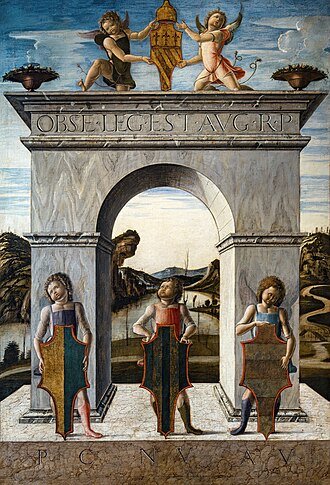
Painted on canvas, this work presents a triumphal arch honouring Doge Nicolò Tron, with a coat of arms and an angel, set beside a landscape and a stretch of water. Its architectural character suggests a celebratory scene, although the commission and the circumstances of its making are not documented here.
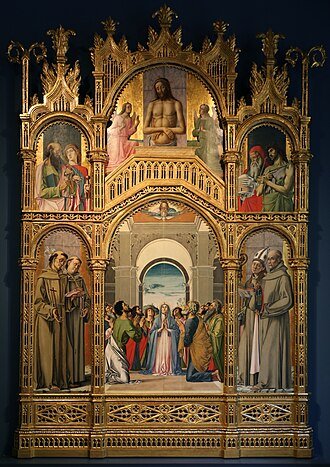

Alvise Vivarini painted this Annunciation in 1478, combining tempera and oil on wood panel. Its tall, narrow proportions, roughly 225 by 114 centimetres, give it a vertical format. The work is held at the Pinacoteca di Brera. The available information does not clarify its original commission or the place it was made for.
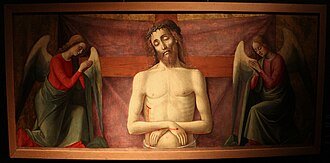


Christ Blessing is a religious painting dated 1494 and attributed to Alvise Vivarini. It is held at the church of San Giovanni in Bragora in Venice. No further details about its commission or technique are recorded, so any reading of the image should remain cautious. Its interest lies in the gesture of blessing, a common motif in devotional painting.
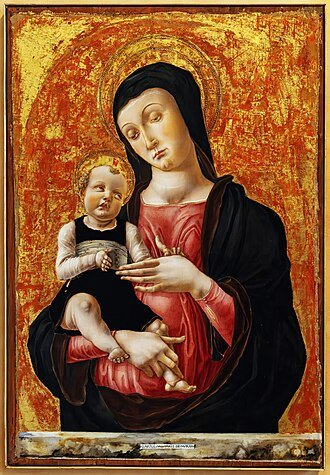
A work by Alvise Vivarini, a Venetian painter active in the fifteenth century, dated around 1450 and executed in tempera on panel. It belongs to religious painting and shows the Virgin with the Child, a devotional subject widely popular at the time. The available information does not clarify the commission or original setting, so it is best read as evidence of the religious imagery of its era.

This work shows the Virgin Mary holding the Christ Child, a subject very common in religious painting. The record dates it to around 1450 and attributes it to Alvise Vivarini, a painter active in Venice. Without further sources, it is not possible to specify the original commission or details of its composition and symbolism. It is held in the Venetian church of San Giovanni in Bragora.
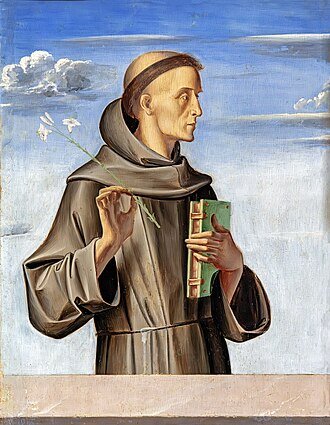
A small egg-tempera panel in which Alvise Vivarini depicts Saint Anthony of Padua, a figure widely venerated in the Veneto. The record dates it to around 1480 and places it today in the Correr Museum in Venice. Given its modest size, it was probably intended for private devotion rather than a large altarpiece. Beyond these details, it is best described with caution, since no sources here document its commission or composition.
Where to see the work
- Gallerie dell'Accademia Venice · 2
- San Giovanni in Bragora Venice · 2
- Museo Correr Venice · 2
- Gemäldegalerie Berlin Berlin · 1
- Pinacoteca di Brera Milan · 1
- Museum Adriano Bernareggi Bergamo · 1
- Santa Maria Gloriosa dei Frari Venice · 1
Curiosities
A disputed signature
One painting bears a signature of a supposed earlier Luigi Vivarini, dated 1414, who would have been the father of Antonio. That hypothesis rests on the signature, but the date is considered probably a forgery added at a later time. It is an example of the attribution doubts that surround this family of painters.
A salary from the state
In 1492 the Venetian Council was so pleased with his paintings for the Hall of the Great Council that it named him Depentor in Gran Conseio, with a salary of five ducats a month. Despite this public commission, he continued painting altarpieces for private patrons, showing that work for the state did not replace his workshop activity.