
Bartolomé Bermejo
1440–1500 · Hispano-Flemish painter of the Crown of Aragon
Bartolomé Bermejo, also known as Bartolomé de Cárdenas, was one of the most important painters of the Hispano-Flemish style. He is traditionally believed to have been born in Córdoba around 1440, although the sources differ on the date and place of his death, usually given as around 1500 in Barcelona. His significance lies in blending Spanish craft traditions with the oil technique of Flemish painters.
His documented career begins in 1468, when he signed in Xàtiva a contract for an altarpiece dedicated to Saint Michael, where he describes himself as a citizen of Valencia. He moved constantly, living in Valencia, Daroca, Zaragoza and Barcelona. In 1474 he took on the altarpiece of Saint Dominic of Silos in Daroca, where he lived as a resident without citizenship. In Barcelona he painted the Pietà of Canon Desplà, dated 1490.
His style combines a Flemish attention to detail, seen in plants and armour, with gold backgrounds inherited from earlier Spanish painting. His best-known works include the Virgin of Montserrat triptych in Acqui Terme, which he left unfinished, the altarpiece of Saint Engracia, and the Christ of the Pietà at Peralada Castle. His links with Jewish and converso communities in Daroca appear in the records and in his marriage to Gracia de Palaciano.
His reputation grew largely thanks to the studies that Diego Angulo Íñiguez devoted to his work in the 1930s, which made it possible to attribute a considerable number of paintings to him. Today he is regarded as a key figure for understanding the dialogue between Spanish and Flemish painting in the late fifteenth century.
Works (10)



This panel by Bartolomé Bermejo, dated 1468 and painted in oil, shows the archangel Michael at the moment of defeating the devil. According to the record, it belongs to Renaissance religious art, and its tall, narrow vertical format suggests a work intended for a specific devotional setting. Its original commission is not documented here, so any further interpretation should be approached with caution.
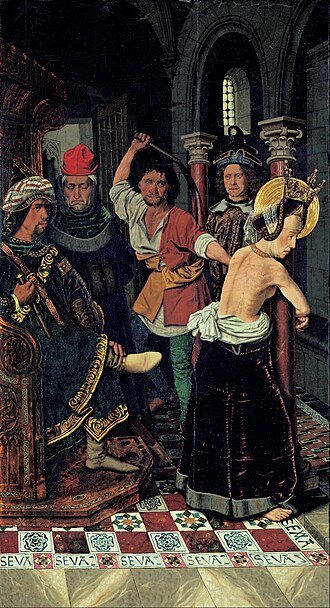
This oil-on-panel painting by Bartolomé Bermejo, dated 1474, depicts the martyrdom of Saint Engracia of Zaragoza, a figure from religious tradition linked to the Aragonese city. The scene focuses on the victim and the punishment she endures, handled with the restrained seriousness typical of devotional art of the period. Its upright format and modest size suggest it may have been made for private devotion, though the record offers no further information about its original purpose.

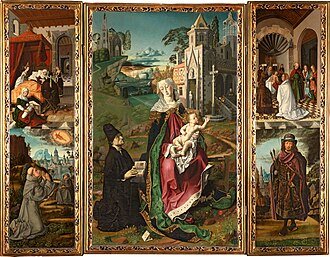
This oil-on-panel painting with gold leaf shows the Virgin nursing the Christ Child, a devotional image known as the Nursing Madonna. It is dated around 1470 and attributed to Bartolomé Bermejo, a painter of Córdoba origin who worked in the Crown of Aragon. The gold background and shimmering gilded surfaces recall Gothic tradition, while the modelling of the figures points toward Renaissance painting. The work is held at the Museo de Bellas Artes in Valencia.

Altarpiece painted by Bartolomé Bermejo in 1476, executed in oil and gold leaf on panel. Its design brings together religious scenes centred on Saint Dominic of Silos, while the extensive use of gilding lends the ensemble richness and solemnity. It is now held in the Museo del Prado.

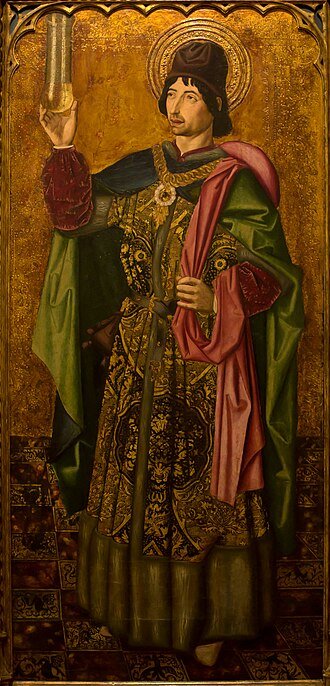
Panel by Bartolomé Bermejo dated 1477, showing Saint Damian, a figure linked to Christian martyrdom and medicine. It was executed in tempera and oil on wood, a combination that allows luminous effects and fine detail in the garments and face. The record offers no further information about its commission or origin, so it is best read as evidence of religious painting in the Renaissance in the Iberian Peninsula.
Where to see the work
- Museo del Prado Madrid · 1
- Museu Nacional d'Art de Catalunya Barcelona · 1
- Cathedral of the Holy Cross and Saint Eulalia Barcelona · 1
- National Gallery London · 1
- Bilbao Fine Arts Museum Bilbao · 1
- Museu de Belles Arts de València Valencia · 1
- National Museum of Ancient Art Estrela · 1
Curiosities
A triptych finished by another workshop
The Virgin of Montserrat triptych in Acqui Terme is by Bermejo only in its central panel. For reasons that remain unknown, he left the work unfinished, with the designs for the side panels barely sketched. Rodrigo de Osona and his workshop completed the painting, which shows how shared commissions operated in workshops of the period.
A Hebrew inscription on a Christian Christ
On the tomb of the Christ of the Pietà at Peralada Castle there is an inscription in square Hebrew script, yet its content is entirely Christian. Beneath the cloth covering Christ, a trace of circumcision has also been noted, a detail that stresses his Hebrew origin. These features have been linked to the painter's possible converso background.
An altarpiece that nearly disappeared
The Saint Michael from Tous appears in an 1886 inventory of the parish church, described as very deteriorated but of some value. It later passed to the descendants of Julius Wernher, the diamond magnate, and since 1995 it has been held at the National Gallery in London. It is one of the earliest documented works linked to his activity.