
Fra Bartolomeo
1472–1517 · Florentine Renaissance painter of religious subjects
Fra Bartolomeo, also known as Fra Bartolommeo and, in his youth, as Baccio della Porta, was one of the leading painters of the Renaissance in Florence. He was born on 28 March 1472 in Savignano di Prato, near Florence, and died in that city on 31 October 1517. He spent most of his career painting religious subjects, especially static groups of figures such as the Virgin and Child with saints. His importance lies in how he combined the Tuscan tradition with the light, colour and compositional balance of the High Renaissance, a shift in which his friendship with Raphael played a significant part.
Training in Rosselli's workshop
He received the nickname Baccio della Porta, roughly 'Baccio of the Gate', because his house stood near the Gate of San Pier Gattolini. Starting in 1483 or 1484, on the recommendation of Benedetto da Maiano, he apprenticed in the workshop of Cosimo Rosselli. After leaving it he became drawn to the work of Leonardo da Vinci, and in 1490 or 1491 he began a collaboration with Mariotto Albertinelli. In these early years his work shows the influence of Piero di Cosimo, Rosselli's assistant, as well as Domenico Ghirlandaio and Filippino Lippi.
Savonarola and the religious life
In the late 1490s Baccio was drawn to the teachings of Fra Girolamo Savonarola, who denounced the contemporary art he regarded as vain and corrupt. Savonarola argued that painting should serve as a direct visual illustration of the Bible, educating those unable to read it. From this period dates the portrait of the preacher, from 1498, now in the Museo Nazionale di San Marco in Florence, which remains the best-known image of the reformer. The following year he received a commission for a fresco of the Last Judgement for the Ospedale di Santa Maria Nuova. It was left unfinished and completed by Albertinelli and Giuliano Bugiardini.
On 26 July 1500 he became a Dominican friar, and from then on he was known as Fra Bartolomeo. The following year he entered the convent of San Marco. For several years he gave up painting, both out of his commitment to convent life and in the climate that followed Savonarola's death.
Return to painting and the meeting with Raphael
In 1504 his superiors asked him to resume painting for the benefit of the order, and in obedience he became head of the monastery's workshop. That year he began a Vision of St Bernard for the family chapel of Bernardo Bianco in the Badia Fiorentina, finished in 1507. The painting survives in poor condition, but its style marks a change, as its figures and drapery move with a new grace.
Soon after, Raphael visited Florence and befriended the friar. The exchange ran both ways. Bartolomeo learned perspective from the younger painter, while Raphael developed his skill in colour and in the handling of drapery. Their friendship continued when Bartolomeo left for Rome, leaving in Raphael's hands two unfinished pictures that Raphael completed.
Journeys and late commissions
At the start of 1508 he moved to Venice to paint God the Father, Saint Mary Magdalen and Saint Catherine of Siena for the Dominican church of San Pietro Martire in Murano, works shaped by Venetian colourism. Because the Dominicans did not pay for them, he took the panels back to Lucca. In October 1509, working there with Albertinelli, he painted an altarpiece of the Madonna and Child with saints for the local cathedral. On 26 November 1510 Piero Soderini commissioned an altarpiece for the Sala del Consiglio in Florence, now in the Museum of San Marco. Two years later he finished another altarpiece for the cathedral of Besançon.
In 1513 he went to Rome, where he painted Saints Peter and Paul, now in the Vatican Pinacoteca. From the following years come the Saint Mark the Evangelist for the Palazzo Pitti and the frescoes in the Dominican convent of Pian di Mugnone, a district of Fiesole just outside Florence. He had promised Duke Alfonso I d'Este of Ferrara a Feast of Venus, of which only some drawings survive. His last known work is a fresco of Noli me tangere, also at Pian di Mugnone. He died in Florence in 1517.
Style and major works
His figures are generally small and heavily draped, qualities that critics held against him as defects. To show that his style did not reflect a lack of power, he painted the magnificent Saint Mark the Evangelist, ranked as his masterpiece, and a Saint Sebastian so strongly expressive of suffering and agony that it was removed from the chapel of a convent where it had been displayed. His compositions are admired for their handling of light and shadow, the richness and delicacy of their colour, and the fine drawing of figures and drapery. He was also among the first to use jointed lay figures to study the human body.
Among his best-known works are the Presentation in the Temple (1516), now in the Kunsthistorisches Museum in Vienna, the Saint Catherine (1511) in the Louvre, the Pietà (1516) in the Palazzo Pitti, and the Besançon cathedral altarpiece (1511-1512).
Legacy
His pupils included Ridolfo Ghirlandaio, son of Domenico Ghirlandaio, along with Cecchino del Frate, Gabriel Rustici and Fra Paolo Pistolese. His legacy lies chiefly in having joined the order of Florentine tradition to the luminous balance of the High Renaissance. Some of his landscape drawings are also among the earliest of their kind by any Italian artist. His portrait of Savonarola remains the most widely known image of the reformer.
Works (29)


This oil on panel, dated 1512 and attributed to Fra Bartolomeo, shows the Virgin and Child with saints, a subject common in religious painting. Its considerable size, over two and a half metres tall, suggests it was probably made for a place of worship, though its original setting is not certain. It is now kept in the cathedral of Besançon.
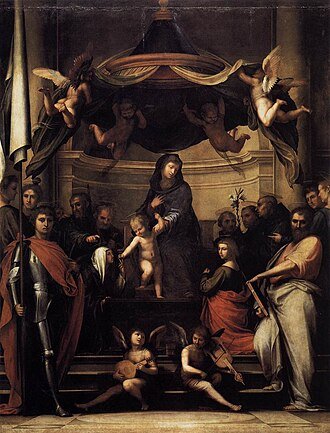
Religious High Renaissance painting on panel, dated 1512 and made by Fra Bartolomeo. It depicts the Mystic Marriage of Saint Catherine of Siena, where the saint appears with the Christ Child in the presence of the Virgin Mary, in a devotional scene. Its large scale gives the composition a solemn, monumental presence.

This panel by Fra Bartolomeo, dated 1499 and painted in oil on wood, depicts the Adoration of the Child, a devotional subject common in religious painting of the period. The scene centres on the newborn infant and those who gaze upon him, with close attention to gesture and to the calm of the group. As a work of religious art, its main purpose was to encourage prayer and meditation before a sacred image.
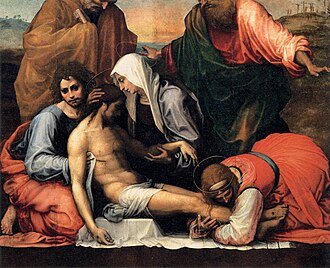
The panel shows the grief surrounding the body of Jesus of Nazareth, with Mary Magdalene and other mourners gathered close to him in a moment of restrained sorrow. Painted in 1511 during the High Renaissance, it arranges its figures in a balanced, compact group, with clear modelling and a calm palette. It is often cited as an example of religious painting of its period.

The panel shows God the Father flanked by two female saints, Catherine of Siena and Mary Magdalen, on a large upright format. Painted in oil on wood, it belongs to the High Renaissance, a period valued for balanced compositions. The available information does not specify its commission or original setting.


High Renaissance work dated 1509 showing the Virgin Mary with the Christ Child in a sacra conversazione arrangement, where sacred figures gather in a calm, unified setting. It is held at the Museo di San Marco in Florence and is attributed to Fra Bartolomeo. The available data place it within early sixteenth-century Florentine painting.


A religious painting from 1514, done in colour on panel. It depicts Job, the Old Testament figure known for his trials. It belongs to the High Renaissance and is held at the Galleria dell'Accademia in Florence. Details of its commission and precise composition cannot be confirmed with certainty.


Painted in oil on panel in 1497 by Fra Bartolomeo, this work shows the Virgin Mary seated in a landscape, her blond hair parted in the middle and a halo above her head. The naked Christ Child rests on a cushion beside the young John the Baptist, completing the sacred group.


This work by Fra Bartolomeo, dated 1515, depicts Saint Mark, the evangelist, in a religious composition typical of the High Renaissance. Its tall vertical format, over three metres high, gives the figure a monumental presence. It is now held in the Palatine Gallery.

Small tempera panel that brings together three episodes from Christ's infancy: the Annunciation, the Circumcision and the Nativity. The scenes feature the Virgin Mary, a woman and the Christ Child. Its modest size probably points to devotional use, though nothing is recorded about its original commission.

This painting shows the moment when the risen Christ meets Mary Magdalene, a scene named after the Latin phrase from the Gospel of John meaning "Do not touch me." Fray Bartolomeo painted it in 1506 in oil on canvas. Today it is held at the Louvre in Paris.

This panel by Fra Bartolomeo, dated 1515, shows the Virgin Mary and the Holy Spirit as a dove, alongside saints including John the Baptist, Francis of Assisi, Mary Magdalene, Margaret of Antioch and Paul the Apostle. A sword, a column, a throne and a vessel complete the scene. It is held in the Louvre.

Portrait of a Man is an oil on panel dated 1507 and attributed to Fra Bartolomeo. It belongs to the portrait genre and is held at the Metropolitan Museum of Art in New York. Without further documentation, it is best approached cautiously, noting its small format and the panel support, a common choice of the period.

Oil on panel dated 1504 and attributed to Fra Bartolomeo, this work belongs to religious art and centres on the Christ Child. Its large vertical format suggests a piece made for a setting of devotion on a substantial scale. The available information does not specify the commission or the original context.


Where to see the work
- Louvre Museum Paris · 4
- Galleria Palatina Florence · 4
- Uffizi Gallery Florence · 3
- Museum of San Marco Florence · 2
- National Gallery London · 2
- Galleria dell'Accademia Florence · 2
- Metropolitan Museum of Art New York City · 2
- Kunsthistorisches Museum Vienna · 1
- Museo di Capodimonte Naples · 1
- Galleria Borghese Paris · 1
- Villa Guinigi National Museum Lucca · 1
- Alte Pinakothek Munich · 1
- Museum of Grenoble Grenoble · 1
- Art Institute of Chicago Chicago · 1
- Hermitage Museum Saint Petersburg · 1
Teachers and pupils
Studied with
- Piero di Cosimo 1462–1522
- Cosimo Rosselli 1439–1507
Pupils
- Ridolfo del Ghirlandaio 1483–1561
Curiosities
A neighbourhood nickname
Before taking the name Fra Bartolomeo he was known as Baccio della Porta, a nickname that comes from the location of his house near one of Florence's gates, the Gate of San Pier Gattolini. He carried this name through his years as an apprentice and young painter, until he entered the Dominican order in 1500.
A Saint Sebastian that was too intense
According to the accounts, his Saint Sebastian expressed suffering and agony so powerfully that it was judged excessive and removed from the chapel of a convent where it had been displayed. The episode sums up the tension of the period between the emotional force of a religious image and the restraint that was expected of it.
A costly acquisition
Around 1996 the J. Paul Getty Museum in Los Angeles acquired a painting of his, the Holy Family, for almost 2,000 million pesetas. The sum shows how highly the market now values his work, although in his own lifetime he was chiefly a painter much in demand in Florence and other cities of central Italy.