
Govert Flinck (Cleves, 1615 - Amsterdam, 1660) was a Dutch painter of the Baroque period, trained in Rembrandt's workshop and one of the most respected artists of his generation in the Netherlands. He matters because his career shows how Rembrandt's style spread among his pupils, and how some of them sought their own alternatives.
Born in Cleves, Flinck was apprenticed by his father to a silk merchant, but his secret passion for drawing led him to Leeuwarden, where he lodged with the Mennonite Lambert Jacobszon, better known as a travelling preacher than as a painter. There he met Jacob Backer and came into contact with the Uylenburgh family, linked to Rembrandt. Around 1637 Joachim von Sandrart found him in Amsterdam, regarded as one of Rembrandt's best pupils and living at the dealer Hendrik Uylenburg's house. For years he worked in his master's manner, following it closely in works made between 1636 and 1648.
Aspiring to be a history painter, he looked to Rubens, which brought him official and diplomatic commissions. His ties with Cleves were significant: he was presented at the court of the Great Elector Frederick William of Brandenburg and received the patronage of John Maurice of Nassau. Among his main works are Isaac Blessing Jacob (1638), group portraits of civic guards and, above all, the Peace of Münster, lively in its faces and rich in Rembrandtesque colour. In his mannerist pictures, such as Solomon Prays for Wisdom, the composition and colour look weaker.
After his death, Rembrandt was asked to finish one of his commissions, and the result, The Conspiracy of Claudius Civilis, was rejected by the authorities. Much of his output has been lost, and his presence in Spanish museums is slight, with works only attributed to him. Today he helps us understand Rembrandt's workshop and the development of seventeenth-century Dutch painting.
Works (11)


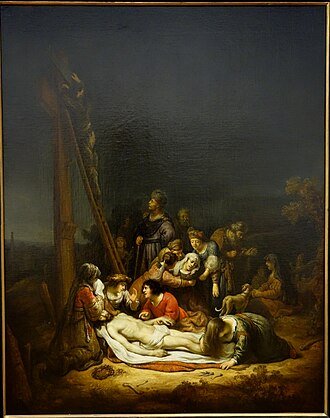
Govert Flinck painted this Lamentation in 1637, a religious subject. It shows mourning over the death of Christ, a theme widely treated in Christian art. Beyond that, the available information says little about its commission, original setting or formal features. It is now held by the National Museum of Western Art.


This oil portrait by Govert Flinck presents a young woman dressed as Flora, the Roman goddess of flowers, with the floral attributes typical of allegory. The record dates it to around 1640 and places it today in the Museum of Fine Arts in Nantes. The painting blends portraiture with mythological figure, a practice common in its period.

Portrait of a man in profile painted by Govert Flinck in 1637, on a small panel. The sitter is shown from the side, a device common in Dutch portraiture of the period that emphasizes the outline of the head and the profile of the face. The record offers no further details about the commission or the identity of the sitter.

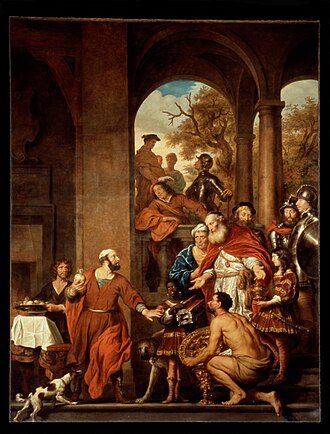
Painted by Govert Flinck in 1658, this large-format work shows Solomon at prayer, asking for wisdom as recounted in the First Book of Kings, chapter 3. Its monumental canvas gives the scene an imposing presence. Today it is held at the Royal Palace in Amsterdam.

A genre scene dated 1636, painted in oil on canvas. Its title presents Rembrandt dressed as a shepherd, with a staff and a flute, a costume common in the pastoral imagery of the period. Rather than an individual likeness, the picture seems conceived as a rustic type. It is held in the Rijksmuseum.
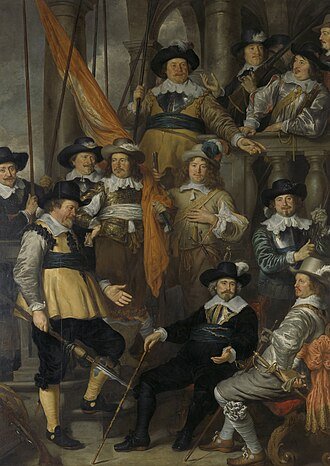
Group portrait of a company of the civic militia, or schutterij, painted in oil on canvas. It belongs to the schutterstuk genre, in which members of these companies were shown alongside their weapons. Among the objects included are a musket, a ladder and a halberd, which allude to the group's military role.
Where to see the work
- Rijksmuseum Amsterdam · 3
- Royal Palace of Amsterdam Amsterdam · 2
- Isabella Stewart Gardner Museum Boston · 1
- Wallace Collection London · 1
- National Museum of Western Art Tokyo · 1
- Mauritshuis The Hague · 1
- Nantes Museum of Arts Nantes · 1
- Leiden Collection New York City · 1
Teachers and pupils
Studied with
- Rembrandt 1606–1669
Curiosities
A discreet self-portrait
In the Peace of Münster, a canvas with 19 life-size figures, Flinck painted his own face on the left, peering from an entrance. It is one of the few secure references to his appearance in his work, and it shows how group painters often placed themselves discreetly within the scene they depicted.
A commission he could not finish
In November 1659 the burgomaster of Amsterdam commissioned from Flinck twelve canvases showing heroic figures such as David, Samson, Marcus Curius and Horatius Cocles, along with scenes of Batavians and Romans. He managed only sketches before he died. After his death Rembrandt was asked to complete one of the commissions, and the result was rejected by the authorities.
A house full of study material
Flinck married in 1656 the daughter of Ver Hoeven, a director of the Dutch East India Company. His house, decorated with old casts, costumes and a fine collection of prints, often received the stadtholder John Maurice, whose portrait survives in a work by the scholar Barleius. The setting reflects his place among the city's patrician circles.