
Giovanni Francesco Barbieri, known as Guercino (Cento, 1591 – Bologna, 1666), was an Italian Baroque painter and draftsman who worked mainly in Bologna and Rome. His career bridges the classical tradition of the Bolognese school and the full Baroque. His early paintings have a vigorous naturalism, while his later ones show a more balanced, classical calm. He was also a prolific draftsman, and his drawings are admired for their luminosity and lively line.
Childhood and early years in Cento
He was born in Cento, a town on the Po plain between Ferrara and Bologna, in the region of Emilia-Romagna. His family were humble farmers; his father was Andrea Barbieri and his mother Elena Ghisellini. He was cross-eyed, and the nickname by which he became universally known comes from the Italian word guercio, meaning squinter. He was largely self-taught. At around sixteen or seventeen he joined the workshop of Benedetto Gennari the Elder, a painter of the Bolognese school, who was his first known teacher.
His first important commissions came in his home town. Between 1615 and 1617 he painted frescoes for Casa Pannini in Cento, where the naturalism of the landscapes already shows considerable artistic independence. The same interest in landscape appears in canvases from the period such as Moonlit Landscape, now in the Nationalmuseum in Stockholm.
Bologna and the first major commissions
In 1615 he moved to Bologna, where he could study the valuable paintings preserved in the city. There he won the praise of Ludovico Carracci, who was by then elderly. Guercino always acknowledged that his early style had drawn on the Carracci, especially on a Madonna painted by Ludovico for the Capuchin church in Cento, affectionately known as “La Carraccina”.
For Cardinal Giacomo Serra, the papal legate in Ferrara, he painted two large canvases, Elijah Fed by Ravens and Samson Seized by the Philistines. Both are strongly Caravaggesque in style, although it is unlikely that he had seen any work by Caravaggio at that point. Around 1618 he painted Et in Arcadia ego, in which two shepherds pause before a tomb in an idyllic landscape. The picture contains the first known use of the Latin motto, later taken up by Poussin and others, meaning that death lurks even in the most peaceful place. Closely related is the Flaying of Marsyas by Apollo, which shares the same pair of shepherds and is now in the Palazzo Pitti in Florence. As he often said, his style in these years was strongly shaped by the Carracci.
Rome, 1621–1623
In 1621 the Marquis Enzo Bentivoglio recommended him to the newly elected pope, the Bolognese Alessandro Ludovisi, who took the name Gregory XV. Guercino spent two productive years in Rome, from 1621 to 1623. There he painted the frescoes of the casino of the Villa Ludovisi, including Aurora, Fame and Night, and the ceiling of the basilica of San Crisogono, showing Saint Chrysogonus in Glory. He also painted a portrait of Gregory XV, now in the Getty Center.
Many regard his finest work from this period as The Burial of Saint Petronilla, made for St Peter’s in the Vatican and now in the Capitoline Museums in Rome. After Gregory XV died in 1623, Guercino returned to Cento.
Back in Bologna and the second manner
In 1626 he began his frescoes in Piacenza Cathedral. Around 1628 his style changed in what scholars call the seconda maniera, or second manner. His figures took on an imposing presence, closer to the ideals of physical perfection that the Roman school founded by Raphael had pursued a century earlier. His later paintings are also clearer and more luminous, and they resemble the work of his contemporary Guido Reni, who even accused him of plagiarism. The softer, sweeter figures of these works drew criticism from later centuries, although in his lifetime his fame was considerable.
Commissions multiplied. In 1641 the prior of the Certosa di Pavia asked him for a large altarpiece of the Virgin and Child enthroned between Saints Peter and Paul. In 1655 the Franciscan Order of Reggio paid him 300 ducats for Saint Luke Displaying a Painting of the Madonna and Child, now in the Nelson-Atkins Museum of Art in Kansas City, and the Corsini family paid the same sum for a Flagellation of Christ painted in 1657.
A prolific workshop
Guercino was known for the remarkable speed with which he completed his pictures. He is credited with 106 large altarpieces for churches and about 144 paintings on other subjects and formats. He was also an extremely prolific draftsman. His drawings, usually in ink, washed ink or red chalk, were mostly preparatory studies, though he also drew landscapes, genre scenes and caricatures for his own enjoyment. His fluent lines combine quick, calligraphic strokes, dots, dashes and parallel hatching to describe form.
After the death of his commercial rival Guido Reni in 1642, he moved his busy workshop to Bologna, where he took over Reni’s role as the city’s leading painter of sacred subjects.
Final years and legacy
He continued to paint and teach until his death in Bologna in December 1666, and by then he had amassed a considerable fortune. As he never married, his estate passed to his nephews and pupils, Benedetto Gennari II and Cesare Gennari. At his own request he was buried beside his brother Paolo Antonio, also a painter, in the church of San Salvatore in Bologna. Other pupils included Giulio Coralli, Sebastiano Ghezzi and Matteo Loves.
His presence in Spain is significant. The Museo del Prado holds eight of his paintings, among them Susanna and the Elders, Saint Augustine Meditating on the Trinity, a Penitent Magdalene and Saint Peter Freed by an Angel, which was engraved by Ramón Bayeu, as well as several drawings. Lot and His Daughters, at the Monastery of El Escorial, and Christ and the Samaritan Woman, at the Thyssen-Bornemisza Museum in Madrid, are also important. In modern scholarship, Denis Mahon became his greatest champion, curating the major exhibitions devoted to him in 1968 and 1991.
Works (201)






Guercino painted this oil on canvas in 1650, a work of religious art showing David holding the head of Goliath. The subject comes from the biblical account of the encounter between the two. Available information does not describe its commission or compositional details, so the painting is best approached through its theme and its handling of paint.

This painting by Guercino, dated 1619, depicts the Gospel episode of the return of the prodigal son. The scene centres on the meeting between the young man, kneeling and downcast, and the father who welcomes him back. Without further documentation on its commission or early reception, the image itself is the safest guide: the gesture of reconciliation at its heart.


Painted by Guercino in 1647, this work shows Saint Peter weeping before the Virgin Mary, in a scene linked to the Gospel episode in which the apostle repents after denying Christ. The record places it in the Louvre and describes it as a religious oil painting on canvas. Beyond these details, caution is advisable regarding its commission context.
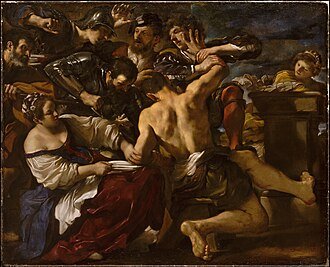
This 1619 oil painting by Guercino depicts the biblical moment when Samson is seized by the Philistines after being betrayed by Delilah. The scene centers on the hero, whose captivity is conveyed through the tension of the bodies and the contrast of light and shadow. As a religious work, it turns an Old Testament story into a direct, dramatic composition.

Large canvas by Guercino in which the landscape holds as much weight as the group of nude women bathing by the water. The subject also falls within mythological painting. Dated 1620, the work shows figures and nature closely integrated, though no reliable information survives about its commission or precise meaning.
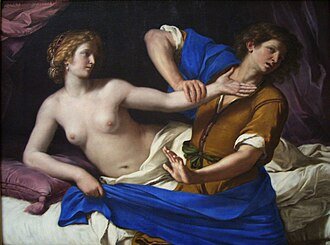
Guercino painted this canvas in 1649, showing a moment from the biblical story of Joseph, in which Potiphar's wife tries to seduce him. As a religious subject, it draws on a narrative familiar to viewers of the period, but beyond the scene itself, reliable details about its commission or reception are not documented here.

Guercino painted this work in 1654, depicting the Gospel episode of the return of the prodigal son, a subject widely treated in Baroque religious painting. It is held at the Timken Museum of Art and was executed in oil on a large canvas. The available information does not allow us to determine with certainty its commission or other details of its history.

Painted by Guercino in 1618 on copper, this religious work shows Jesus of Nazareth dead, with two angels mourning over his body. The smooth metal support probably encouraged the polished finish of the paint. Today it is held in the National Gallery in London.

This 1617 oil on canvas by Guercino belongs to religious art and takes its subject from the Book of Daniel. It shows Susanna, a virtuous woman, surprised in a garden by two elders who spy on and harass her. The painting relies on strong contrasts of light, which fall on the heroine's body while shadow surrounds her aggressors, heightening the dramatic tension of the scene.

Guercino painted this work in 1655, and it is now held in the Basilica of the Holy Trinity in Kraków. It shows Saint Dominic at Soriano, the place named in the title. The available information does not clarify the commission or the circumstances of its making, so our reading stays with what the image itself presents.

Aurora, the goddess of dawn in classical mythology, is depicted here in a mythological scene painted by Guercino in 1622 using fresco and tempera. In ancient tradition, Aurora heralds the arrival of the sun, a theme Baroque painters often used on ceilings and vaults. The work is held at the Casino of Villa Boncompagni Ludovisi.

Guercino's painting, dated 1627 and held in the Galleria Borghese, depicts the return of the prodigal son, an episode from the Gospel parable about a young man who had left his father's house. Its theme invites reflection on forgiveness and family reconciliation.

This 1617 painting by Guercino illustrates the parable of the prodigal son, a story told in the Gospel of Luke. As a religious subject, it shows the moment of the son's return home after squandering his inheritance. Today it is held at the Galleria Sabauda in Turin, where visitors can see it.

This work by Guercino, dated 1619, shows the moment when Saint Irene tends to the martyr Saint Sebastian, wounded by arrows. The large-scale figures are set against a dark background, with light picking out their bodies, a feature typical of Baroque painting from Emilia. Since the available information is limited, it is best read as an example of the painter's early style, focused on drama and strong contrasts of light.

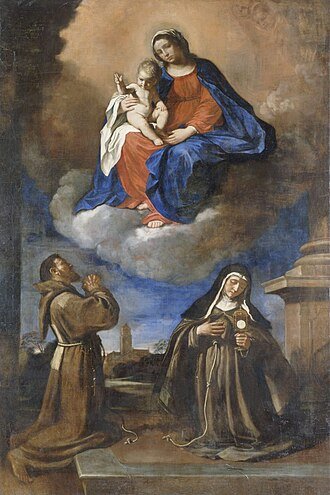
A work by Guercino showing the Virgin and Child, a subject widely treated in Italian Baroque religious painting. The available information says nothing about its date, commission or technique, so it is best to describe the scene cautiously: Mary holds the Christ Child in an intimate setting, with the composition focused on the bond between mother and son. It is kept in the civic gallery named after the artist in Cento.


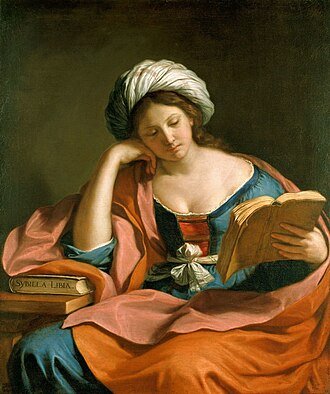
Sibyl is a painting by Guercino dated around 1620, showing a female figure in quiet concentration, her gaze directed beyond the edge of the canvas. The handling of light and the contrast between shadow and warm tones are typical of the artist. Beyond this, the record offers no details about its commission or history.

Work by Guercino, an oil on canvas of large scale, depicting Jesus of Nazareth and the Virgin Mary. The available information does not allow the date or commission to be established with certainty, so any claims about its context should be treated cautiously. Its precise composition cannot be described without direct examination of the painting.

Guercino painted this panel in 1611 in oil on poplar. It depicts the mystic marriage of Saint Catherine of Alexandria, in which the saint receives a ring from the infant Christ, alongside a figure of Saint Charles Borromeo. No further details about its commission or later history are recorded.
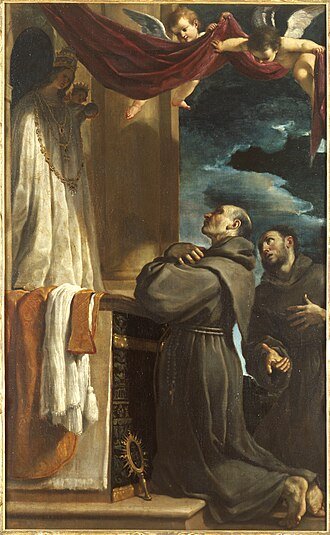

This painting by Guercino depicts William I of Toulouse, the figure named in its record. No reference texts are available, so its date, commission and specific compositional details cannot be stated with confidence. It is held at the Pinacoteca Nacional in Bologna, where visitors can view the portrait as a whole.

The record only identifies Guercino as the painter of this work, with no title, subject, date or commission given. Without reference texts, it is not possible to describe its composition, technique or context with confidence. To learn more about it, it is best to consult the full documentation held by the collection that keeps the painting.

Salome Receives the Head of John the Baptist shows Salome at the moment a tray brings her the severed head of the prophet. Around her stand an executioner, a soldier, a woman and a household servant, while a sword, a key, a door and a fountain suggest a prison setting.

Painted by Guercino in 1620, this large oil on canvas shows Saint Francis of Assisi in ecstasy, accompanied by Saint Benedict of Nursia and an angel. Beside a pilaster, a violin holds a prominent place in the scene, and its symbolic meaning should be read with caution. The blend of devotion, grouped figures and strong light gives the religious subject a dramatic, almost theatrical presence.

In this large religious canvas, Guercino gathers the Virgin and Child with four saints: Peter of Verona, John the Baptist, George and Geminianus. Geminianus holds a model of Modena, the city he is associated with. The scene is framed as a beatific vision, with an angel and a column structuring the space.

Painted on copper in 1619 by Guercino, this small panel shows Saint Jerome in a vision. Beside the saint lie a skull and an open book, pointing to meditation and human frailty, while an angel appears before him. The trumpet probably evokes the Last Judgment. The compact format concentrates, in one intimate scene, the contrast between the hermit's contemplation and the fear the apparition seems to provoke.

Self-portrait by Guercino dated 1620 and held in the Louvre, painted in oil on canvas. The painter appears half-length, looking out toward the viewer and holding a palette, an attribute that underlines his identity as an artist. Without additional documentation about its commission, it is best to stay with what the work itself shows: a direct, intimate image of the creator at his craft.

This portrait shows Pope Gregory XV, painted by Guercino in 1622 in oil on canvas. As a portrait, the work focuses on the pontiff himself, whose identity gives the painting its purpose. It is held today at the J. Paul Getty Museum, where it can be seen as an example of Guercino's portraiture of a papal sitter.

Large oil on canvas by Guercino, dated 1650, with a religious subject. It depicts Saint Aloysius Gonzaga at the moment of his vocation, with a cross and an angel as the central elements of the episode. The record identifies the scene and its main symbols, though it offers no further details about its commission or history.


Guercino painted this oil on canvas in 1624. The scene shows Semiramis at the moment she receives word of the revolt of Babylon, an episode named directly in the title. The sources available do not settle the commission or the circumstances of its making, so the picture is best approached through that narrative alone.

Guercino painted this oil-on-canvas scene in 1650, showing the Virgin and Child appearing to Saint Jerome. The subject belongs to religious art and presents a heavenly encounter in which the saint receives the vision of Mary and the Christ Child. With few further details recorded here, the work is best read as an image of devotion.

This painting by Guercino, dated 1640 and executed in oil on canvas, depicts the meeting of Christ and the Samaritan woman at the well, a passage from the Gospel of John. It belongs to the religious painting genre and is now held at the Museo Nacional Thyssen-Bornemisza in Madrid. The record offers no further details about its commission or reception, so it is best to stay with what the work itself shows.

Religious painting by Guercino, dated 1645 and executed in oil on canvas on a large scale. Its subject is the glory of all the saints, with Jesus of Nazareth among the figures depicted. The available information does not establish its commission or detailed composition, so it is best to rely on what the title and date suggest: a collective celebration of the saints, a subject common in seventeenth-century religious painting.

In the foreground, the painting shows a beheading, while above, the Virgin Mary and the Christ Child appear on a cloud in a heavenly vision. Among the figures are also John the Apostle and Paul of Tarsus. Guercino painted this large oil on canvas in 1632, contrasting earthly martyrdom with heavenly glory.

Guercino painted this oil on canvas in 1650. It shows Saint Luke the Evangelist presenting a painting of the Virgin Mary on an easel, with Jesus of Nazareth also present. The subject, a saint displaying his own image of the Virgin, invites viewers to consider the sacred image and its making. Few details about the commission or original setting are recorded here.

Guercino painted this scene of Elijah fed by ravens in 1620. It shows the prophet receiving food from the birds, an episode recounted in the Old Testament in which ravens bring him bread and meat during his retreat. The prophet occupies the foreground, accompanied by the birds, in a restrained composition.


Guercino painted this large oil on canvas in 1650, almost three metres wide, showing Erminia finding the wounded Tancred. The title pins the scene to the moment of their meeting, and the wide landscape format gives the figures room to play out the encounter. It is now held by the National Galleries of Scotland.


Saint Cecilia sits before a pipe organ, framed by a curtain that focuses attention on the figure. Painted by Guercino in 1642, this oil on canvas is a religious work in which the saint, traditionally linked to music, appears beside the instrument that identifies her.

This mythological painting by Guercino, dated 1649, shows Mars, the Roman god of war, accompanied by Cupid, the god of love. It is an oil on canvas of large dimensions, held by the Cincinnati Art Museum. No further information about its commission or original setting is available, so the scene is best read with caution.

Painted in 1615 by Guercino, this oil on canvas shows Saint Matthew, one of the four Evangelists, and belongs to the category of religious art. It is held in the Staatliche Kunstsammlungen in Dresden. Without further documentary sources, the commission and the specific circumstances of its creation cannot be established.
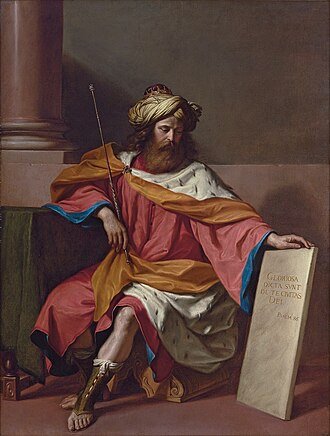
This 1651 oil on canvas by Guercino depicts David, the biblical king of Israel, within the religious art tradition. Its large upright format gives the figure considerable scale. The painting is held by the National Gallery in London, which counts it among the Italian artist's works in its collection.


Painted by Guercino in 1645 in oil on canvas, this work depicts Saint John the Baptist, a recurring subject in religious art. Details about its commission, original location or composition are not documented here, so any reading should stay close to its subject and technique. It is now held in the Capitoline Museums.

A religious painting by Guercino, held at the Pinacoteca Nacional in Bologna, centred on Saint Peter of Verona, the figure after whom the work is named. The available information does not allow a secure dating, commission history, or detailed account of its composition and symbolism, so any reading of the scene should be approached with caution.

A work by Guercino dated 1641, painted in oil on canvas in a tall vertical format within religious art. It depicts the guardian angel, a protective figure accompanying a human being. The record offers no further details about its commission, original location or specific context, so it is best to limit the description to the scene itself.


Guercino painted this mythological scene in 1632, showing a nude Venus beside Cupid, who holds a bow and carries a quiver of arrows. The figures sit in a landscape with a tree and a cloudy sky, while a cushion is visible nearby. The work combines plaster and fresco, later transferred to canvas.

Painted in 1618 by Guercino, this Baroque work from the Bolognese school shows the martyrdom of Saint Peter at the moment of his crucifixion, with an angel present in the scene. Executed in oil on canvas on a large vertical format, it is a religious painting now held in the Galleria Estense.

This 1638 work by Guercino shows Cleopatra at the moment of her death, a subject often taken up in Baroque painting for its dramatic power. The available information says nothing more about its commission or origin, so it is best to focus on what the image conveys: a female figure facing a tragic end, rendered with the expressive intensity associated with the artist.
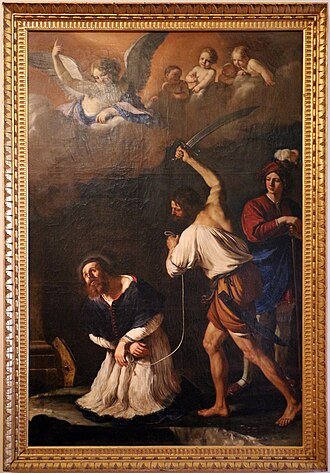
Painting by Guercino depicting the martyrdom of Saint Maurelius, a figure linked to the town of Voghenza. Without reference texts to broaden its context, the commission date and original location cannot be stated with certainty. The scene shows the saint's martyrdom, a subject of local devotion that the painter treated in a dramatic manner.

This oil on canvas from 1648 shows Saint Joseph, the figure from the Old Testament, in a calm devotional portrait. Guercino painted it during his Bolognese period, when he often used warm tones and soft light to bring saints close to the viewer. The record gives no further details about its commission or history, so a cautious reading is best.

Guercino painted this work in 1662 in oil, placing it within religious art. It shows Thomas Aquinas at the moment of writing the hymn for the Holy Sacrament, the subject named in the title. No further details about its commission, composition or history are available, so it is best to stick to what the title and technique indicate.

The painting shows the moment Erminia finds the wounded Tancred, as its title indicates. Guercino painted it in 1618 in oil on canvas, at a large scale. It is held in the Doria-Pamphili Gallery. The available information does not allow us to say more about its commission or meaning.

Guercino painted this work in 1615, showing the Virgin and Child in glory alongside Saint Pancras and a holy nun. Its tall, large format suggests a picture made for a sacred setting, although its original location is not known with certainty.


This 1617 work by Guercino depicts an episode from the Old Testament involving Lot and his daughters, a story that links Lot to the destruction of Sodom. As a biblical subject, its meaning relies on the religious context of the period. Today it is kept at the Royal Monastery of San Lorenzo de El Escorial.

The record identifies only the author of this work, Guercino, an Italian Baroque painter. No title, date, subject or technique is given, so its composition and original context cannot be described with confidence. To learn more about the painting, it is best to consult the collection that holds it and the artist's catalogue raisonné.

This large canvas, dated 1652, depicts the martyrdom of Saint Sebastian, the saint shot with arrows. The scene includes a landscape and a small putto, a childlike figure that offers a gentle counterpoint to the harshness of the episode. The work is held at the Palatine Gallery and belongs to the Bolognese school, to which Guercino is associated.


The record only identifies the author, Guercino, and gives no title, date or commission for this work, so its subject and context cannot be specified here. Its composition, technique and meaning would require the original source or a catalogue of the artist's output. Any more detailed reading would currently lack documentary support.

The painting depicts the mythological episode in which Apollo punishes Marsyas, the satyr who had challenged the god to a musical contest, by flaying him. The nude figure of the satyr occupies the centre of the scene, while Apollo and the drapery frame the violent act in this large oil canvas from 1618.

The painting, titled The Martyrdom of Saint Lawrence, is attributed to Guercino. Without reference materials to place it, its date, commission, and specific compositional choices cannot be confirmed here. The title points to a religious subject showing the death of the saint. For details of its history and technique, specialised studies are the best guide.

Painting by Guercino dated 1620, executed in oil on canvas and classified as religious art. The available information does not specify the scene depicted or the circumstances of its commission, so its iconography and original purpose cannot be stated with confidence. It is now held at the Rouen Museum of Fine Arts.

A religious work by Guercino, the Italian Baroque painter, dealing with the Assumption of the Virgin Mary, the moment when, according to Christian tradition, Mary rises into heaven. Without further references available, its date, original commission and compositional details cannot be stated with certainty.

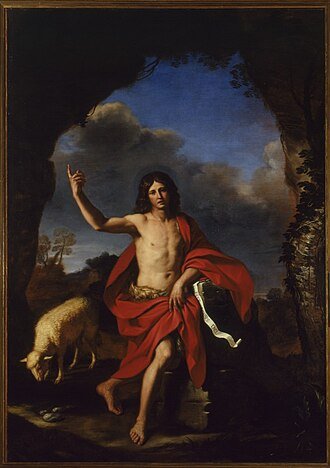
This painting by Guercino, dated 1653 and held in the Pinacoteca Civica in Forlì, shows John the Baptist in a rugged landscape with a rock, ivy, and a cave. A lamb, the saint's usual attribute, and a cartouche also appear. No further information about its commission or context is available, so it is best to stick to what is visible: the Baptist set within wild nature, typical of depictions of Saint John in the wilderness.


This canvas by Guercino, dated 1644, depicts Saint Paul the Apostle, identifiable by the sword and the beard traditionally associated with him. The record offers no further information about its commission or background, so we can only describe the painting through its visible elements: a sober, devotional half-length figure typical of seventeenth-century religious art.

Painted by Guercino in 1625, this portrait depicts Cardinal Francesco Cennini, a member of the Church hierarchy. Executed in oil on canvas, it belongs to the portrait genre, where the emphasis falls on the sitter's identity and presence. Without further reference material, the commission and original setting cannot be stated with certainty, so the reading stays with what the painting itself presents.

This painting by Guercino depicts the biblical episode in which Samson, after killing a lion, finds a honeycomb inside its carcass. The artist focuses on the moment of discovery, with a calm mood and careful handling of light and gesture. The record offers no further details about its commission or history, so it is best to stick to what the scene shows.

The painting depicts the burial of Jesus of Nazareth, the moment in the Passion when his body is laid in the tomb after the crucifixion. It was a frequent subject in religious art, allowing the painter to convey restrained grief and quiet reverence. Dated 1656, it is an oil on canvas now held by the Art Institute of Chicago.

Painted by Guercino in 1648 in oil on canvas, this work presents Erminia among shepherds, as its title indicates. The available information does not clarify who commissioned it or where it originally hung. It is now held by the Minneapolis Institute of Art, where visitors can view this pastoral scene.

Around 1620 Guercino painted Saint Francis of Assisi in a bare setting, surrounded by ruins and with an open book, while an angel plays the violin beside him. The scene sets the saint's silent contemplation against heavenly music, a contrast the painter conveys in a restrained, quiet mood. The work is held at the National Museum in Warsaw.

This oil on canvas by Guercino, dated 1649, depicts Saint Cecilia of Rome, a subject of religious art. Tradition associates her with music, a link that often shapes how her images are read. The painting is held by the Dulwich Picture Gallery, where visitors can see it today.

Painted in 1621, this oil on canvas by Guercino belongs to religious painting and depicts the woman taken in adultery, the Gospel episode in which she is brought before Christ to be judged. The picture concentrates on the accused woman and on the figures gathered around her, guiding the viewer toward the moment of accusation.

Guercino painted this 1623 work in oil on copper, a smooth metal support that tends to give paintings a fine, even surface. Its subject is the Presentation of Jesus in the Temple, a religious scene from the Gospel tradition. The painting is held at the National Gallery in London.

Christ shows Saint Thomas the wound in his side and invites him to touch it, at a moment of doubt about the Resurrection. Guercino painted the scene in 1621. The halo above Jesus's head signals his sacred nature, while the viewer's eye is drawn to the hands gathered around the wound.

Mythological painting by Guercino, dated 1651, showing the Cumaean Sibyl accompanied by a putto. Without further documentation, it is best to stay with what is visible: a large-scale female figure painted in oil on canvas, now held by the National Gallery in London, offering an example of seventeenth-century Italian Baroque classicism.

Oil on canvas by Guercino, dated 1622 and held at the Museo del Prado. It shows Saint Peter freed by an angel, a subject drawn from Christian tradition, and Peter appears in armour within the scene. As a religious easel painting, it belongs to the devotional production of its time, and its interest lies mainly in how the painter shapes the saint's figure and the moment of his release.

Guercino painted this religious scene in oil on canvas in 1636. It shows Saint Augustine of Hippo lost in thought about the Trinity, seated at a desk surrounded by books and study objects. Beside him is a child, a figure that refers to the legend in which the saint, walking along the seashore, meets a little boy trying to empty the sea into a hole with a shell. The composition focuses attention on the contemplative pose of the saint and on the contrast between shadow and the light falling on his face.

This Penitent Magdalen, painted by Guercino in 1645 in oil on canvas, belongs to the religious painting genre. Mary Magdalene appears beside a crucifix, a common emblem of her repentance and devotion to Christ. The record does not specify the commission or the precise circumstances of its creation, so it is best to stay with what the painting itself shows. It is held in the Museo del Prado in Madrid.

This work by Guercino, dated 1654 and held in the Museo del Prado, belongs to mythological painting. Its subject is Cupid, shown beside a globe, a purse and scattered coins, objects that suggest wealth. The Spanish title, El Amor desinteresado, points to the theme: love that cannot be bought or sold. The record offers no further details about its commission or history.

Painted in 1639, this canvas shows Saint Peter in penitence, a subject common in Baroque religious art. Guercino, the Italian painter, worked in oil on canvas, and the picture is now held by the National Galleries of Scotland. Beyond this, the available record says little about its commission or original setting, so it is best described cautiously.

This painting by Guercino, dated 1641, depicts Saint John the Baptist, a common subject in religious art. The available information does not specify who commissioned it or the circumstances of its making. It is held at the Kunsthistorisches Museum in Vienna, where its large upright format can be seen.

Guercino painted this oil on canvas in 1649, measuring about 262 by 160 centimetres, showing Saint Francis of Assisi in adoration before the crucifix. It belongs to the religious art genre and is held in the cathedral of Pescara. Beyond these details, the composition and commission cannot be described with more certainty here.

This 1639 work by Guercino takes as its subject, as its title suggests, the meeting between Cleopatra and Octavian. Reliable information about the scene, its commission and its composition is lacking, so any reading of the moment shown should be considered tentative. It is held in the Capitoline Museums.

This painting by Guercino, dated 1619 and executed in oil on canvas, depicts the encounter described in the Gospel of John between Jesus and a Samaritan woman beside a well. As a religious subject, its interest lies in how the artist sets the scene in an everyday setting, focusing attention on the exchange between the two figures.

Large oil on canvas by the Italian painter Guercino showing Saint Jerome, one of the Fathers of the Latin Church. Dated 1649, it belongs to the painter's religious output and is now kept in the church of Saint-Laurent in Nogent-sur-Seine. Beyond its subject and date, little further detail is documented here.


Guercino's painting, dated 1615, shows Saint Mark, one of the four evangelists, depicted as an elderly man absorbed in writing. Without further references, it can be described cautiously as an oil-on-canvas religious work on an evangelical theme, whose composition focuses attention on the figure of the writer and his contemplative gesture.

This 1615 work by Guercino shows Saint Luke, one of the four Evangelists, painted in oil on canvas and classed as religious art. No information is available about its commission or original setting, so the reading is limited to identifying the subject and the medium.

This 1621 painting by Guercino depicts the Betrayal of Christ, one of the episodes of the Passion recounted in the Gospels. Executed in oil on canvas, it belongs to the field of religious art. Held at the Fitzwilliam Museum, it offers an example of the painter's devotional output from that period.

A work by Guercino dated 1617, painted in oil on copper, a small support that suits fine detail. It shows Saint Sebastian being tended by two angels, a religious subject in which the saint appears in a moment of relief and comfort. The record offers no further information about its commission or history, so it is best to limit the description to what the painting shows.

Painted by Guercino in 1642, this oil on canvas belongs to religious art. It shows the flagellation of Jesus of Nazareth, the moment he was scourged before the crucifixion. Its tall, narrow format suits a devotional subject within the Passion tradition, though no further details about its commission or composition are available here.

Small oil painting on copper, dated 1621 and attributed to Guercino, showing the head of Christ wearing the crown of thorns. As a religious subject, the image focuses entirely on the head, without any setting. The small copper support, smooth and compact, suits a careful treatment of detail and of light and shadow.

This allegory by Guercino brings together Venus, Mars and Cupid with a figure of Time, a mythological subject common in Baroque painting. Dated 1625 and executed in oil on canvas, the work probably invites viewers to read the meeting of these figures as a reflection on love, war and the passing of time.

Painted by Guercino in 1624, this oil on canvas belongs to the mythological genre and shows Mars, the Roman god of war. Without further reference material, nothing can be said with certainty about its commission, composition or early reception, so this description is limited to its subject and its materials.

Painting by Guercino dated 1655, depicting Absalom and Tamar, figures from the biblical narrative in the Second Book of Samuel. Available information does not clarify its commission, original location or composition, so only the subject and date of execution can be stated with confidence.


Guercino's Pietà, an oil on canvas dated 1638. It depicts the moment after the crucifixion when the Virgin Mary holds the body of Jesus, accompanied by John the Apostle, with the cross behind them and the burial shroud as a central element. It is a religious work, and the record offers no further details about its commission or composition.
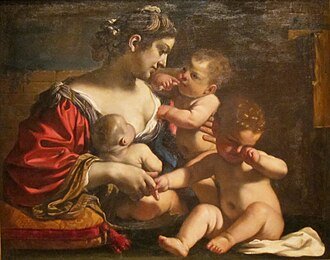
Guercino's painting is known in English as Christian Charity, a title that points to one of the theological virtues and offers a key for reading the scene. It is an oil on canvas now held by the Dayton Art Institute. From the available information, its exact date, commission and original setting cannot be stated with confidence, so it is best looked at carefully and read through what the image itself shows.


This painting by Guercino, dated 1637, shows Saint Joseph holding the Christ Child, one of the most familiar devotional subjects of the Baroque. The composition is simple and restrained: the figures fill much of the canvas, and attention settles on the tender closeness between the foster father and the child, a religious theme recorded in the artwork's documentation.


Oil on canvas by Guercino, dated 1645, belonging to mythological painting. Its subject is Semiramis, a woman who, as the title indicates, receives word that Babylon has fallen. The title places the scene at the moment of hearing the news rather than in the battle itself, though the available record says little about the commission or the composition.


This painting by Guercino depicts Saint Sebastian, one of the most frequently portrayed saints in religious art. It is an oil on canvas and belongs to the painter's religious works. The record does not provide details about its date, commission or composition, so this description is limited to its subject and technique. The work can be seen at the Princeton University Art Museum.
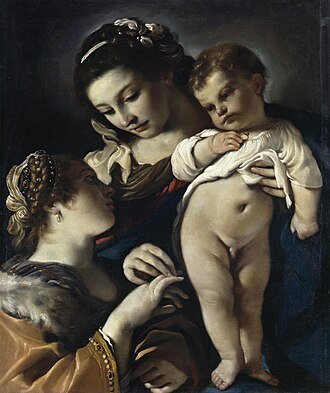

Painted by Guercino in 1622, this large oil-on-canvas work is now held in the Vatican Picture Gallery. The available record does not describe its subject or commission, so its context cannot be confirmed here. Its generous scale suggests it was probably intended for a spacious setting, while oil on canvas allowed the painter soft gradations of light and colour.
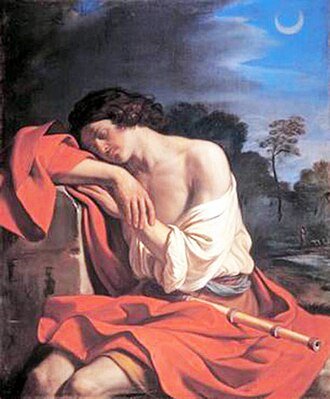
A mythological painting by Guercino, dated 1646, showing Endymion asleep in a quiet landscape. He is the figure from myth who, according to tradition, received an eternal sleep. The work relies on a calm atmosphere and on the relationship between the reclining body and the surrounding nature, with a treatment of colour and light typical of the artist.

Guercino painted this Immaculate Conception in 1650, during the Baroque period. The Virgin stands on a crescent moon, accompanied by God the Father and an angel, a familiar iconography for expressing the doctrine that Mary was conceived without original sin. It is a large oil on canvas.

This painting by Guercino depicts Sofonisba, a figure from ancient history remembered through tradition for her composure in moments of great hardship. The record offers no information on the date, commission or specific composition, so it is best read as a historical and literary subject whose theme and format are the only details that can be stated with confidence.

This large oil on canvas, dated around 1650 and attributed to Guercino, belongs to religious art and brings together Saint Teresa of Jesus and Christ. The record gives no further details about its commission, original setting or composition, so any detailed reading of the scene should be approached with caution.

Oil on canvas by Guercino, dated 1640, depicting Jesus of Nazareth. It is held in the Musée des Beaux-Arts de Rennes and belongs to the category of religious painting. The available records do not specify its commission or original setting, so any reading of the work should rest mainly on the image itself and on the painter's handling of oil across this large canvas.

Guercino painted this Saint John the Baptist in 1661 in oil on canvas, on a large scale and with a religious theme. The saint stands beside a lamb, an animal that Christian tradition commonly links with him. Nothing is recorded about the commission or reception of the work, so the reading rests on what the painting itself shows.

Guercino painted this oil on canvas in 1619, showing Saint Francis of Assisi absorbed in meditation, a subject within religious art. The work is held at the Musée Fabre. With little contextual information available, its meaning rests mainly on the image itself: a withdrawn saint, detached from his surroundings and lost in inner contemplation.
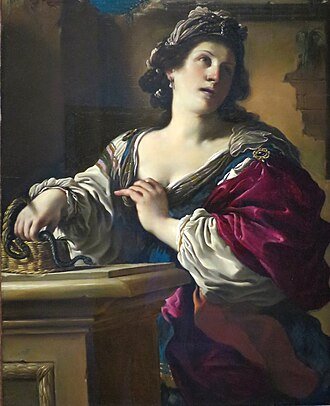
Guercino painted this oil on canvas in 1621, showing the suicide of Cleopatra, a figure from ancient history whose death was a recurring subject in painting. It belongs to the history painting genre, which dealt with episodes from the past. Today it is held at the Norton Simon Museum.

Mythological painting by Guercino, dated 1634 and executed in oil on canvas. It shows Venus alongside Cupid, familiar figures from classical mythology associated with love. With the information available, the commission and the precise context of the work cannot be established, so it is best read mainly as an example of seventeenth-century mythological painting.


Study of the head of an elderly man painted in oil on canvas by Guercino, the nickname of Giovanni Francesco Barbieri. The figure is shown in three-quarter view, with a face marked by wrinkles and a pensive gaze. It is held at the Ashmolean Museum in Oxford, within its collection of Italian painting.


The painting shows Saint Chrysogonus rising alive into heaven, accompanied by angels who lift him. Guercino painted this large oil on canvas in 1622, a work of religious subject typical of Italian Baroque painting. Its monumental scale and upward movement of the figures seem meant to convey the force of the heavenly vision.

Painted in 1616 by Guercino, this religious work shows a donor being presented to the Virgin, a scene in which the person who likely commissioned or sponsored the painting appears before the sacred figure. It is held by the Royal Museums of Fine Arts of Belgium.

This oil on canvas by Guercino belongs to religious art and depicts the Gospel scene of the supper at Emmaus, where the disciples recognise Christ as he breaks bread. No details about its commission or date are available, so the reading focuses on its subject and technique.

Vanitas by Guercino, a small oil on canvas still life. The vanitas genre gathers everyday objects and symbols that remind viewers of life's brevity and the emptiness of worldly goods. The record offers no further details about its commission, date or specific composition, so the work is best approached cautiously, paying attention to the objects depicted.

Guercino painted this Madonna and Child in Glory in 1647, with Saint Bruno at their side. The scene is devotional, placing Mary and the Christ Child in a heavenly realm, as the title itself indicates. Reliable information about its commission and original reception is lacking, so the reading remains limited to what the painting shows.

This work by Guercino depicts the expulsion of the merchants from the Temple, the gospel episode in which Christ rebukes those trading within the sacred precinct. It belongs to religious painting and is held in the Museo di Strada Nuova in Genoa. With the available information, its date and original commission cannot be specified, so attention is best directed to the scene itself and its dramatic handling of the confrontation.

Only the artist is known here: Guercino, with no title, date, subject or technique given for the work. Without these details, its composition, symbolism and original context cannot be described reliably. Explaining the painting would require its title or a fuller description of the canvas.


Only the artist's name, Guercino, is recorded for this painting, with no title, date or subject given, so its content cannot be described reliably. To explain the work properly, one would need its title, chronology and the scene it depicts, along with its composition and technique.

A work by Guercino, the Italian Baroque painter, held at the Pushkin Museum in Moscow. Its religious subject places the scene within devotional painting, whether for altarpieces or private worship. Without further reference material, the specific episode depicted and its original commission cannot be identified with certainty.

The record names only the painter, Guercino, and gives no title, date, commission or subject. Without further reference material, its composition, technique or meaning cannot be described with confidence. To learn more, consult the collection's catalogue or a specialist publication that confirms the title and context.


This canvas by Guercino depicts Saint John the Baptist, a subject frequently treated in religious painting. Dated 1644, the work is oil on canvas and belongs to the genre of religious art. No further details about its commission, composition or symbolism are recorded, so it is best to limit the description to the identification of the figure and the medium used.


This painting by Guercino, dated 1645, shows the Crucifixion with the Virgin Mary, Mary Magdalene and Saint John the Evangelist. Its upright format and large size suggest a devotional altarpiece or a major religious work. The record offers no further details about its commission or original setting, so it is best described without assigning it a specific destination.


Flora is an oil on canvas by Guercino, dated 1642 and held in the Palazzo Pallavicini-Rospigliosi. The record offers no further details about its commission or context, so it is best to stay with what the work and its date allow us to say: a female figure linked to the Roman goddess of flowers, painted with the loose brushwork and warm light associated with the artist's mature period.

This painting by Guercino, dated 1647 and executed in oil on canvas, depicts the Virgin with the Christ Child asleep. The record offers no further details about its commission, provenance or interpretation, so any additional reading should be treated with caution. The scene invites quiet contemplation of motherhood, with a calm treatment of the infant figure.
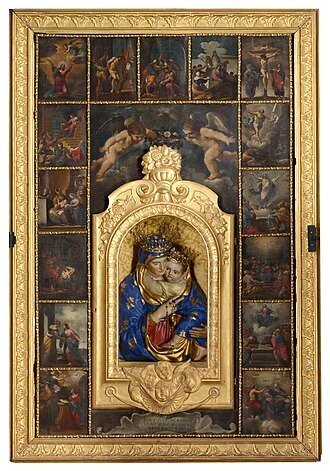

This painting is attributed to Guercino and held at the National Gallery of the Marche. The available information does not allow us to determine with certainty its subject, date of execution or original commission, so any reading of the scene should be checked against the museum's catalogue. Its upright format, slightly taller than wide, gives it a vertical presence.
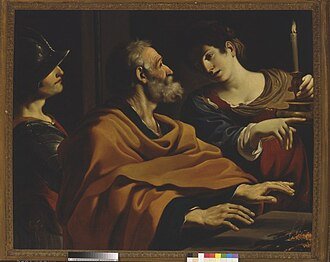
Painted around 1650 by Guercino in oil on canvas, this work depicts the gospel episode in which Peter denies knowing Jesus. Without reference texts to expand its context, our reading remains limited to what is visible: a religious scene whose narrative focus is the moment of denial.

Painted by Guercino in 1610, this landscape shows a horseman beside the bank of a river. The record describes it as oil on canvas or panel, leaving the support unclear. With no further documentation available, it is best to read the scene at face value, without assigning the painter intentions that cannot be verified.


Religious painting by Guercino dated 1616, executed in oil on copper, a support suited to small formats and fine detail. It shows Tobias with the angel within a landscape that carries much of the composition, the human figures set comparatively small in the scene. Given its modest size, it was probably meant for private devotion rather than a large public setting.

Mural by Guercino, dated 1621 and executed in tempera, depicting Rinaldo and Armida, a couple at the center of an episode from a well-known literary tradition. As a wall painting, it was conceived to be seen as part of the architecture that houses it, now the Palazzo Costaguti. The available information does not clarify its commission or composition.

Portrait of Bernardino Spada painted by Guercino in 1630, now held in the Galleria Spada in Rome. Executed in oil on canvas, the work presents its sitter with a restrained treatment that draws attention to the face and bearing. The available information does not clarify the commission or the precise circumstances of its making, so a cautious description of the painting as it survives is the most reliable approach.

Painted by Guercino in 1621 on a copper plate, this small work is held at the Pushkin Museum in Moscow. The available information does not describe its subject or commission, so what it depicts cannot be stated with certainty. Copper gave a smooth, sturdy surface that allowed fine, detailed brushwork, a quality often associated with small panels.


This portrait, dated 1617 and held in the Uffizi Gallery, depicts the theologian Giulio Gagliardi and is attributed to Guercino. As a portrait, it concentrates attention on the sitter rather than on a narrative setting. No further details about its commission or context are recorded here.
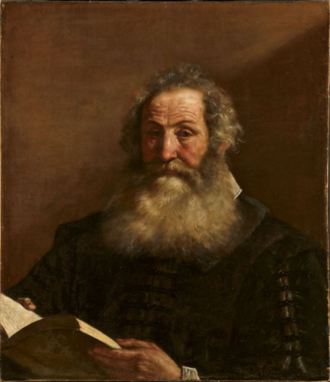

Painted in oil on canvas in 1615, this religious work by Guercino depicts the Holy Family, a subject common in devotional art. No information about its commission or history is available, so it is best approached through what the image itself shows: a scene centred on Jesus and his family.


This painting by Guercino, dated 1624, is kept in the Church of Sant'Agostino. Reliable information about its subject, commission and context is not available here, so any interpretation of its imagery would be speculative. To learn about its iconography and history, visitors can consult the church itself or specialist studies on the artist.

This oil on canvas, dated 1623 and attributed to Guercino, depicts Saint Peter in an intimate, devotional register typical of religious painting of the period. The record offers no details about its commission or original context, so it is best to stay with what can be seen: the apostle's figure, rendered with restrained chiaroscuro that focuses attention on the face and the solemnity of the gesture. It is held at the Uffizi Gallery in Florence.

The painting depicts an episode from the life of Samson, the biblical hero of the Old Testament, bringing honey to his parents. Guercino completed it in 1625 in oil on canvas, and it is now held by the Chrysler Museum. The available information says little about its commission or reception, so the best approach is to look closely at how the artist arranges the figures in the scene.

Guercino painted this oil-on-canvas work in 1624. Information about its subject, commission and context is not sufficient to state anything with certainty, so it is best viewed without assumptions. It is now held at the Blanton Museum of Art, where visitors can examine its paint surface and composition up close.

This 1622 oil on canvas by Guercino depicts a classical mythological subject: Venus at her toilette, the goddess of love in a private moment of getting ready. Nothing is known here about its commission or original setting, so the scene is best read through its subject and handling rather than through intentions that cannot be documented.


Guercino painted this large canvas in 1646, depicting the biblical moment when King Saul attacks David. The figures are set in a tense, dramatic arrangement, with light falling sharply across the scene to heighten the confrontation. Made in oil on canvas, the work reflects the Baroque taste for emotional intensity in religious subjects.


A painting by Guercino held at the Galleria Estense. The available record offers no details about its subject, date, commission or technique, so its composition and context cannot be described with confidence. For reference, Guercino was an Italian Baroque painter active in the Emilia region.
Where to see the work
- Louvre Museum Paris · 11
- National Gallery London · 8
- Pinacoteca Nazionale di Bologna Bologna · 8
- Pinacoteca Civica "il Guercino" Cento · 7
- Capitoline Museums Rome · 6
- Museo del Prado Madrid · 5
- Galleria Nazionale d'Arte Antica Rome · 4
- Musei di Strada Nuova Genoa · 4
- Galleria Estense Modena · 4
- National Gallery of Ireland Dublin City · 4
- Staatliche Kunstsammlungen Dresden Dresden · 4
- Uffizi Gallery Florence · 3
- Metropolitan Museum of Art New York City · 3
- National Trust · 3
- Pinacoteca di Brera Milan · 2
- Hermitage Museum Saint Petersburg · 2
- Galleria Spada Rome · 2
- Bavarian State Painting Collections Munich · 2
- Galleria nazionale di Parma Parma · 2
- Royal Palace of Naples Naples · 2
Teachers and pupils
Studied with
- Benedetto Gennari 1563–1610
Pupils
- Domenico Maria Canuti 1626–1684
Curiosities
A lazy eye and a strong sense of depth
Guercino is thought to have had almost monocular vision, since his right eye was “lazy”. Even so, his works convey depth with remarkable skill, perhaps because the healthy eye compensated with a sharper perception of light and shade. Other artists with different kinds of strabismus include Rembrandt, Dürer, Degas and Picasso, and possibly Leonardo da Vinci.
A painting family's accounts
Guercino and his brother Paolo Antonio, a notable painter of still lifes, kept an account book, the Libro dei Conti di Casa Barbieri, which survives. It documents the details of his career from 1629 onward. For the earlier years, his early output is known largely from 67 engravings made by Giovanni Battista Pasqualini between 1618 and 1631, which are not recorded in that book.
A visit from Velázquez
During his first journey to Italy, between 1629 and 1631, Velázquez visited Guercino in Cento. It was one of several visits by distinguished figures to the painter during his lifetime, when his fame was already considerable. It shows the prestige he enjoyed among his contemporaries, well before later critics questioned the sweetness of his figures.