
Guido Reni (Bologna, 1575–Bologna, 1642) was an Italian painter and printmaker trained in the Bolognese School, which carried forward the classicism that the Carracci had established in Bologna. His calm lines and luminous colour made him the dominant figure of the school for nearly three decades, and he remained one of the most admired Italian artists of his age. His religious and mythological paintings shaped later Baroque practice and, especially, eighteenth-century taste.
Training in Bologna
Born in Bologna into a family of musicians, he was apprenticed at nine to the studio of Denys Calvaert, where he was soon joined by Albani and Domenichino. Around the age of twenty, the three pupils moved to the rival Accademia degli Incamminati led by Ludovico Carracci, which became the nucleus of the Bolognese school that followed Annibale Carracci to Rome.
Rome and the Borghese patronage
By late 1601 Reni had gone to Rome to work alongside Annibale Carracci on the fresco decoration of the Farnese Palace. Between 1601 and 1604 his main patron was Cardinal Sfondrato, and soon afterwards he received an independent commission for an altarpiece of the Crucifixion of St Peter. Under Pope Paul V he became one of the artists most favoured by the Borghese family between 1607 and 1614.
His best-known work from this period is the fresco in the great central hall of the Casino dell'Aurora, in the grounds of the Palazzo Pallavicini-Rospigliosi, a pavilion commissioned by Cardinal Scipione Borghese. Apollo drives his chariot ahead of Dawn, who brings light to the world. The figures draw on poses from Roman sarcophagi and the scene is far more restrained than Annibale Carracci's crowded Triumph of Bacchus and Ariadne in the Farnese Palace. Records show he was paid 247 scudi and 54 baiocchi on completing it on 24 September 1616. His vibrant colour also stood apart from the tenebrism of Caravaggio's followers.
In Rome he also frescoed the Paoline Chapel in Santa Maria Maggiore and the Aldobrandini wings of the Vatican Palace. A rumour holds that he was assigned the pontifical chapel of Montecavallo, but feeling underpaid by the papal ministers he returned to Bologna, leaving Domenichino as the leading artist in Rome.
Return to Bologna and sacred commissions
From about 1614 he settled more or less permanently in Bologna, where he ran a busy and productive studio. Between 1613 and 1615 he decorated the dome of the Dominican chapel in the basilica of San Domenico with the luminous fresco Saint Dominic in Glory, which is often compared with the Arca di San Domenico beneath it. For the Rosary Chapel in the same church he painted a Resurrection, and for the cathedral of Ravenna, The Israelites Gathering Manna.
His style in these years was varied. His Saint Sebastian of around 1615 is probably the most recognisable of the six versions he painted of the subject. His altarpiece of Samson Victorious has stylised poses that recall Mannerism, whereas the Crucifixion and Atalanta and Hippomenes use dramatic diagonals and chiaroscuro that show the influence of Caravaggio. His Massacre of the Innocents, painted in 1611 for San Domenico, takes its compositional cues from Raphael.
In 1630, during a plague, the Senate of Bologna commissioned the Pallion del Voto, with Saints Ignatius of Loyola and Francis Xavier and the Virgin and Child with the city's patron saints. By the 1630s his brushwork had become looser and his palette lighter.
Workshop and pupils
Reni ran one of the largest workshops of his time, with close to two hundred pupils across two studios in central Bologna. His most distinguished pupil was Simone Cantarini, called il Pesarese, who painted a portrait of his master. Giovanni Andrea Sirani was his principal assistant, and the father of Elisabetta Sirani. According to his biographer Carlo Cesare Malvasia, Reni's gambling debts pushed him to rush commissions and to have his workshop produce repeated copies of his pictures.
Style and legacy
Reni extended the prestige of the Bolognese school for three decades more and influenced Lanfranco and Guercino, whom he accused of plagiarism. His subjects are mainly biblical and mythological. He painted few portraits, the best known being those of Sixtus V and Cardinal Bernardino Spada. His etchings, light in line and built from fine dots, are also highly regarded. His accessible classicism, with rapt gazes and saints in ecstasy or agony, was much sought after in the eighteenth century and anticipated features of Neoclassicism. His reputation declined in the nineteenth century but revived after the major Bologna retrospective of 1954. He was admired in eighteenth-century Spain, and the Prado holds around eighteen of his works, including Hippomenes and Atalanta and a Saint Sebastian.
Works (90)


The painting shows the abduction of Deianira beside a river, a scene involving Nessus and Heracles. Guido Reni completed it in 1620 in oil on canvas, and it is now held in the Louvre. The large vertical canvas focuses on the violent moment of the seizure, with the river as the setting. Further details of its composition and commission cannot be confirmed from the record alone.

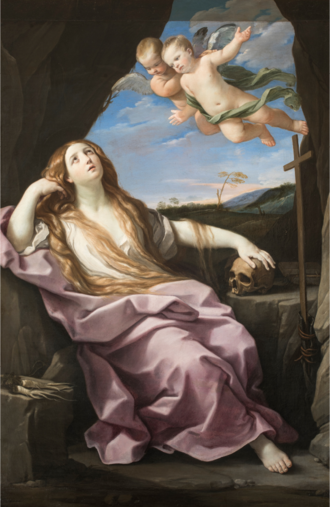
Painted in 1631, this canvas shows Mary Magdalene in penance within a landscape, beside a cross and a skull, traditional emblems of repentance and mortality. An angel and a putto accompany the scene, whose arrangement invites viewers to read the work as a meditation on contrition.

This large painting by Guido Reni, dated 1618 and held in the Museo del Prado, depicts the mythological episode of Atalanta and Hippomenes. According to the record, it shows both figures, and it belongs to the mythological and nude genres. With the available information, little more can be said about its commission or reception, but its large oil-on-canvas format places it among the painter's most ambitious works.


This mythological painting by Guido Reni, dated 1617, shows Heracles in the midst of combat with the Hydra of Lerna, the many-headed serpent of Greek myth. The hero is depicted nude, placing the scene within the tradition of the heroic nude. Painted in oil on canvas, the work is held at the Louvre Museum.

A religious painting showing the archangel Michael overcoming Satan, the figure of evil that Christian tradition identifies as God's adversary. Dated 1630, it was painted in oil on silk, an unusual support for a work of this large format, which sets it apart within Guido Reni's output.

Work by Guido Reni dated 1620 and held at the Musée des Beaux-Arts in Dijon. It belongs to religious art and, judging by its subject, treats the biblical story of Adam and Eve. The available record offers no further details about its commission or composition, so any additional reading should be approached with caution.

Religious painting by Guido Reni, dated 1605, showing David holding the severed head of Goliath, the biblical scene of their confrontation. A column also appears in the composition. Part of Italian Baroque painting, it is held at the Uffizi Gallery in Florence.

This oil on canvas, dated 1624, shows Moses, a figure from the Hebrew Bible, in a religious subject by the Bolognese painter Guido Reni. It is held at the Galleria Borghese in Rome. Its tall format suggests it was probably designed for a devotional or public setting, though its original destination is not known with certainty.


Lucretia is an oil on canvas by Guido Reni, dated 1636 and held at the National Museum of Western Art. As a history painting, it shows Lucretia, the figure from ancient Rome associated with virtue and honour. The available information does not clarify the commission or the details of its composition, so it is best viewed with caution.

Guido Reni painted this oil on canvas in 1615, showing a moment from the Book of Genesis: Lot and his daughters leaving Sodom, the city condemned for its wickedness. The picture is held at the National Gallery in London and belongs to religious painting. Its subject, drawn from the Old Testament, shows the family's escape.

This work by Guido Reni depicts Saint Sebastian, a Christian martyr linked to the tradition of Milan, in a devotional painting dated 1619. It is an oil on canvas held at the Museo del Prado. Without further sources, it is best to stay with what the record supports: a religious painting on a hagiographic subject.

Painted by Guido Reni and dated 1640, this oil-on-canvas work shows Saint Joseph holding the Christ Child, a subject common in religious art of the Baroque period. It is now held by the Museum of Fine Arts, Houston. The available information does not allow us to determine who commissioned it or how it was originally displayed.

Painting by Guido Reni dated 1640 and held in the Capitoline Museums, classified as religious art. The available information does not specify the scene depicted, the commission, or the original setting, so detailed readings of its iconography or composition cannot be confirmed. The title Blessed Soul hints at a devotional theme, though this remains tentative without further documentation.

Mythological painting showing Apollo and Marsyas, the moment when the god of the lyre defeats the satyr piper and flays him. Marsyas appears nude, his skin already partly opened, a motif known as ecorché, while the lyre and a wind instrument recall the musical contest that leads to his punishment.

Guido Reni painted this oil on canvas in 1604, showing the young David holding the severed head of Goliath, drawn from the biblical episode of their combat. The work is held at the Louvre in Paris and belongs to the genre of religious painting. The available information does not allow us to say more about its commission or reception.

Mythological painting by Guido Reni, dated 1620, showing nude figures locked in combat: Heracles and Achelous, with a bull included in the scene. The bodies and the tension of the struggle dominate the large vertical canvas. The work is held at the Louvre, where it illustrates the painter's handling of heroic subjects from classical myth.

The painting shows John the Baptist, recognizable by the lamb he gently caresses, an animal that in Christian tradition is linked to innocence and Christ's sacrifice. The attribution to Guido Reni and the date of 1650 should be treated with caution. The canvas is held in Nantes.

Guido Reni, a painter active in Bologna during the seventeenth century, produced this work, now held in the Diocesan Museum in Milan. The available record does not allow us to establish with certainty the specific subject, the date of execution or the original commission, so it is wise to approach the painting cautiously and focus on its composition, palette and handling, the most visible features of the artist's style.

Oil on canvas from 1604, held at the Vatican Pinacoteca, depicting the crucifixion of Saint Peter, an episode from the saint's martyrdom according to Christian tradition. It is a religious painting of large vertical format, roughly three metres tall. The available information does not allow details of its commission or composition to be specified.

Mythological painting by Guido Reni dated 1639 and executed in oil. It depicts Ariadne, a figure from Greek mythology, in a nude rendered in a classical manner. No further details about its commission or context are available, so any reading of the scene must rest on the image itself.

This painting shows Salome holding the head of Saint John the Baptist, a subject the record classifies as religious art. Guido Reni completed it in 1638 in oil on canvas, in an upright format nearly one and a half metres tall. Its date places it in the later years of the artist's career, and it is now held at the National Gallery of Ancient Art.

The painting depicts the flagellation of Jesus, one of the episodes of Christ's Passion, and belongs to religious painting. It was made by Guido Reni and is held in the Pinacoteca Nazionale. Details about its date, commission and composition cannot be established with certainty, so it is best viewed as a scene from the Passion treated by the artist.

This 1606 oil on canvas shows Saint Cecilia, patron saint of music, in a moment of quiet devotion. The record offers no further details about its commission or composition, so any deeper reading should rest on direct examination of the painting. Guido Reni made it within his religious output.
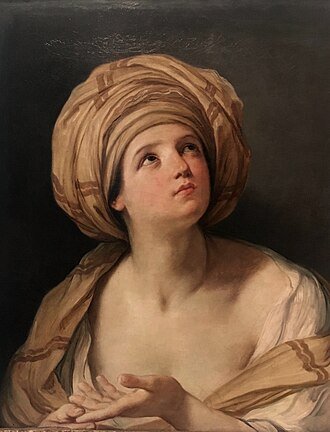
This Sibyl by Guido Reni, painted in 1636, shows a woman to whom ancient tradition attributed prophetic gifts, a figure common in Baroque art. The available information does not specify its commission or compositional details, so it is best to focus on the image itself, now held at the National Picture Gallery in Bologna.

This large oil on canvas shows Salome holding the severed head of John the Baptist, a biblical episode that places her at the centre of the scene. Dated 1639 and conceived as religious art, Guido Reni's painting captures a dramatic moment from the Gospel account.


Guido Reni painted this oil on canvas around 1600, depicting a familiar biblical scene: David, having defeated the giant, holds up Goliath's severed head. The sling in the picture recalls how the young shepherd brought the Philistine warrior down. It is a work of Italian Baroque painting on a religious subject.

Oil on canvas dated 1640 and attributed to Guido Reni, the painting shows Saint John the Baptist in the wilderness, a setting linked in Christian tradition to his withdrawal and preaching. The available details do not specify its commission or history, so the reading focuses on its religious subject.

Guido Reni painted this oil on canvas in 1618, and it is now held by the Museo del Prado in Madrid. It depicts Saint James the Greater, one of the apostles, as a solemn figure rendered in restrained tones. The available record offers no further information about its commission or history, so any reading should rest on what the image itself shows and on its date of execution.

This canvas, dated 1630 and attributed to Guido Reni, shows a young woman half-length holding a rose, in a simple treatment of the figure. The record offers no further details about its commission or setting, so any reading of its purpose should be approached with caution. Its interest lies mainly in the delicacy of its tones and in how the flower becomes the element that guides the viewer's gaze.

This Cleopatra by Guido Reni, dated around 1640 and painted in oil on canvas, shows the Egyptian queen in a moment of melancholy stillness, with lowered gaze and restrained gesture. The record offers no information about its commission or history, so the reading rests on the image itself: a serene female figure, a soft palette and an intimate atmosphere that contrasts with the dramatic character of the historical figure.

This composition by Guido Reni shows the young Virgin Mary surrounded by women, with Saint Anne as the central figure of her instruction. The scene is painted in oil on canvas, dating from around 1640. It belongs to religious art, where an everyday domestic episode serves to convey an ideal of devotion and quiet piety. Beyond these basic facts, the available information does not allow us to say more about its commission or reception.

This oil on canvas by Guido Reni, dated 1623, depicts the moment when John the Baptist baptizes Jesus of Nazareth in the River Jordan. It is a large-scale religious painting, conceived to make a strong presence in the space it occupied. The record offers no further details about its commission or reception, so it is best described without assuming facts that are not documented.

This canvas by Guido Reni depicts Saint Jerome, a recurring figure in religious painting thanks to his work as translator and scholar of the Scriptures. The record describes an oil on canvas of large format, dated 1634, now held in Vienna. Without further documentation, any reading of its composition or commission context should be treated as provisional.

Guido Reni painted this portrait of a crowned young woman in 1640. The available information does not clarify who the sitter was or who commissioned the work, so any reading of the crown as a sign of rank, celebration or allegory would be speculation. The figure and her headpiece draw the viewer's attention.

This religious work by Guido Reni bears the title The Triumph of Job, referring to the biblical figure who, after enduring long trials, sees his faithfulness rewarded. Its large format, about four metres tall on canvas, suggests a piece probably conceived for a monumental setting. It is now kept at Notre-Dame Cathedral in Paris.

The painting shows Apollo and Marsyas, figures from classical myth linked to a famous musical contest between the god and the satyr. The available record offers no details about its commission, composition or technique, so any close reading should rest on the image itself. Dated 1633 and painted by Guido Reni, it is a work of considerable size.

This canvas shows Christ crowned with thorns, his face wounded and his gaze lowered, at the moment Pilate presents him to the crowd with the words "Ecce homo". The figure stands almost isolated against a dark background, which focuses attention on the restrained suffering of the man. Guido Reni, a painter from Bologna, worked here in a calm and delicate manner typical of his mature years, where pain is conveyed more through expression than through the violence of the scene.

The painting shows the Presentation of Jesus in the Temple, the moment when the Virgin Mary, after childbirth, fulfils the rite of purification. A hen appears beside the child, probably alluding to the ritual offering. Executed in oil on a tall vertical canvas, the work dates from 1636 by Guido Reni and is now held in the Louvre.

Allegory by Guido Reni, dated 1620, showing two figures joined in an embrace. One, seated, holds a sheet of paper and a stylus, the tools of drawing, while the other carries a brush and paint, linked to colour. The title points to the union of the two arts, though its exact meaning should be read cautiously.

Small copper panel painted in oil by Guido Reni in 1606. It shows the Virgin seated beside a cradle with the Christ Child, joined by the young John the Baptist. Nearby stand a vase of flowers and a window set in the background. Its modest scale on copper suggests close viewing.

Guido Reni painted this Immaculate Conception in 1627 in oil on canvas. The scene shows the Virgin Mary alongside an angel, a common pairing in this religious subject. The work is now held by the Metropolitan Museum of Art in New York. Its large vertical format gives the central figures a commanding presence.

Painted by Guido Reni around 1630 as an oil on canvas, this work depicts the biblical story of Joseph and Potiphar's wife. Potiphar's wife tries to seduce the young Joseph, who refuses her advances. The composition centers on the contrast between her persistence and his steady resistance, a moment of moral tension.

Guido Reni's painting, dated around 1620, depicts the mythological moment when Hippomenes outruns Atalanta in a footrace, a contest she had set for her suitors. The scene concentrates on the competition itself, with intertwined figures caught in motion and a bright, polished handling typical of Reni's classicizing Baroque style.


Mythological painting by Guido Reni, dated 1637, showing Venus reclining on a bed with Cupid beside her. The available record offers no further details about its commission or history, so it is best to stick to what is visible: the goddess of love, the winged boy as a symbol of desire, and a sensual treatment of the female nude typical of mythological painting of the period.


The Circumcision of Christ is an oil painting by Guido Reni dated 1636, depicting the Jewish rite of circumcision performed on the infant Jesus. The scene brings together a priest, a woman, a man and the baby, while an angel adds a solemn, sacred note to the moment. The available information does not allow us to say more about the commission or the circumstances in which it was made.

This small oil on copper panel depicts the martyrdom of Saint Apollonia of Alexandria, a Christian martyr recognised here by the pincers used to grip her jaw. Dated 1600, the panel is of modest size, suggesting a piece for private devotion rather than a large altarpiece. The smooth, polished copper support favours fine detail and luminous colour. Its interest lies in Guido Reni's economy of means and in the way it concentrates the religious drama into an intimate scene.

This small oil painting on copper shows Saint Apollonia of Alexandria, recognisable by the pincers she holds, the instrument associated with her martyrdom. She is depicted in prayer, with a calm and concentrated expression. Dated 1600 and attributed to Guido Reni, it is painted on a smooth, sturdy copper support that allows a polished surface and fine detail, typical of intimate devotional pictures.


This painting by Guido Reni, executed in oil on canvas, depicts the conversion of Saul, the episode from the Acts of the Apostles in which a persecutor of Christians is struck down on the road to Damascus and changes his life completely. It is a large-format religious work meant to move viewers through a strongly dramatic scene. For its precise commission history and later path, specialized documentation is the best place to check.

Oil on canvas by Guido Reni, dated 1627 and classed as religious art. The record does not specify the subject, the commission or the original setting, so the scene depicted and its intended patron cannot be identified with confidence. It is held at the Musée des Beaux-Arts in Quimper, France.


Oil painting of the Holy Trinity, a frequent subject in Catholic religious art. The work is attributed to Guido Reni, but the date given, 1700, falls well after the period when the painter was active, so it is probably a later copy, a late version, or a cataloguing error.
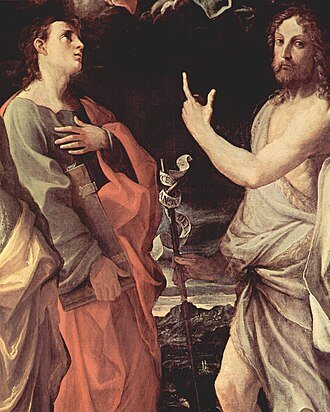

Guido Reni painted this Crucifixion in 1619, now held by the National Picture Gallery of Bologna. Christ hangs beneath a night sky, with Mary Magdalene, the Virgin and John the Apostle at the foot of the cross, and the INRI inscription above his head. A skull lies near the base of the cross, referring to Golgotha, the place of the skull.

Guido Reni painted this Christ Crucified in oil on canvas, on a large scale. The scene shows Jesus of Nazareth on the cross, wearing the crown of thorns, with the INRI inscription above his head, on Calvary under a cloudy sky. The work is classed as religious art and is held at the Galleria Estense.

The available information only identifies Guido Reni as the author of this work, without giving its title, date, technique or subject. For that reason, it is not possible to say with confidence what it depicts or under what circumstances it was painted. Explaining the painting properly would require its title or a more detailed description of the scene.

Oil on canvas dated 1624 by Guido Reni, depicting the biblical episode of David and Goliath, a subject common in religious painting. The work is held at the Musée des Beaux-Arts d'Orléans. Its large vertical format suggests a monumental presence of the figures, though the available information does not allow a fuller account of its composition or commission.

A large canvas depicting the episode of the manna, with Hebrews, an angel, a jar and Moses as its main figures. Guido Reni painted it in oil in 1619, and it is now kept in the cathedral of Ravenna. As a religious work, it recalls the biblical account of the food sent in the desert, though little is known about its commission or original setting.
Where to see the work
- Louvre Museum Paris · 13
- Museo del Prado Madrid · 7
- Pinacoteca Nazionale di Bologna Bologna · 6
- Capitoline Museums Rome · 4
- Hermitage Museum Saint Petersburg · 3
- Pinacoteca Vaticana Vatican City · 2
- National Gallery London · 2
- Picture gallery of the Girolamini Naples · 2
- Metropolitan Museum of Art New York City · 2
- Dulwich Picture Gallery London Borough of Southwark · 2
- Bavarian State Painting Collections Munich · 2
- Galleria Nazionale d'Arte Antica Rome · 2
- Los Angeles County Museum of Art Los Angeles · 2
- Pinacoteca Nazionale Ferrara · 2
- Kunsthistorisches Museum Vienna · 2
- Staatliche Kunstsammlungen Dresden Dresden · 2
- Palazzo Pallavicini-Rospigliosi Rome · 1
- Auckland Art Gallery Auckland Region · 1
- Musei di Strada Nuova Genoa · 1
- MUŻA Valletta · 1
Teachers and pupils
Studied with
- Denys Calvaert 1540–1619
Curiosities
A portrait with a doubtful attribution
For a long time a portrait known as Beatrice Cenci was attributed to Reni and admired by generations of viewers. It is now regarded as a doubtful attribution, since Beatrice Cenci was executed in Rome before Reni ever lived there and therefore could not have sat for it. The attribution persists in popular memory despite the lack of documentary support.
A legend about a hidden face
According to an old legend, Reni painted Satan crushed beneath the foot of Saint Michael with the features of Cardinal Giovanni Battista Pamphilj, as revenge for a slight. The painting, commissioned by the Barberini family and completed in 1636, gave rise to the anecdote, though there is no evidence that it happened that way.