
Hans Baldung Grien
1484–1545 · German Renaissance painter, engraver and draughtsman, pupil of Dürer
Hans Baldung, known as Grien or Grün, was a German Renaissance painter who also worked as an engraver, printmaker, illustrator and designer of stained glass. Born in Schwäbisch Gmünd in 1484 or 1485 and dying in Strasbourg in September 1545, he is considered the most gifted pupil of Albrecht Dürer. His art sits between the German Renaissance and Mannerism, and it is marked by strong colour, expressive figures and a vivid imagination that led him to allegory, mythology and witchcraft. His importance rests as much on his prints, which far outnumber his paintings, as on the panels themselves.
Childhood and first training
The son of Johann Baldung, a university-trained jurist who from 1492 served as legal adviser to the bishop of Strasbourg, Hans was the first male in his family not to attend university, although he came from an educated household. His earliest artistic training began around 1500 in the Upper Rhine with a Strasbourg artist. The nickname Grien, meaning green in German, probably comes from his fondness for wearing that colour, though it may also echo grienhals, an old word for witch, one of his recurring themes. It also distinguished him from two other Hanses in Dürer's workshop.
Apprentice in Dürer's workshop
Around 1503, during the years of travel expected of artists at the time, Baldung joined Dürer's workshop in Nuremberg, where he worked until 1507. In those years he made prints in a style very close to his master's, partly because the workshop needed a uniform look. Three woodcuts, The Virgin and Child, Saint Barbara and Saint Catherine of Alexandria, are thought perhaps to have formed a triptych. Dürer left him in charge of the workshop during his second stay in Venice, a sign of the trust between them. When the master returned, Baldung chose to set up on his own, on cordial terms that kept their friendship alive until Dürer's death in 1528, when a lock of the master's hair was sent to his former pupil.
Strasbourg and his own workshop
In 1509 he went back to Strasbourg, where he became a citizen and won important commissions. The following year he married Margarethe Herlin, a local merchant's daughter, and they had a daughter. He joined the Zur Steltz guild, opened a workshop and began signing his work with the HGB monogram he would use for the rest of his career. His style grew more deliberately individual, a tendency historians link to Mannerism. Between 1513 and 1516 he worked in Freiburg im Breisgau on the high altar of the cathedral, regarded as his most ambitious religious work: an eleven-panel altarpiece on the life of the Virgin that survives intact. The commission gave him lasting financial security.
Allegories, witches and Death
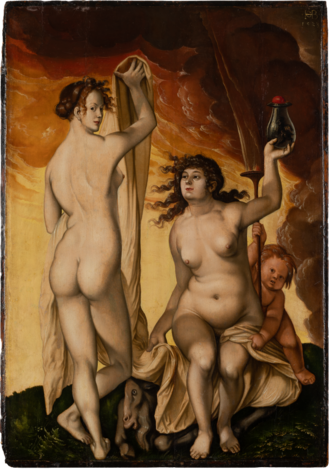
The side of his output most admired today is his allegory and witchcraft scenes, in which sensual nude women are set alongside Death and demonic creatures. He was the first German artist to bring witches, witchcraft and erotic themes heavily into his work. Many of these pieces are small drawings in pen and ink with white bodycolour on primed paper. Among the best known are Death and the Maiden (Basel, 1517), The Three Ages of Man and Death (Museo del Prado), Adam and Eve (Museo Thyssen-Bornemisza) and Two Witches (Städel, Frankfurt, 1523), set before a stormy sky. The prevailing view is that his treatment of witches echoed the playful attitude of Strasbourg's humanists, although it is hard to tell where irony ends and more serious intent begins.
Portraits, prints and stained glass
Baldung was also a portraitist, whose sitters are defined more by personality than by the meticulous detail of Dürer. A portrait of a lady in the Thyssen-Bornemisza Museum is the only signed portrait known by him, and a self-portrait is in the Musée des Beaux-Arts in Strasbourg. His output of some 550 woodcuts, more than 400 of them book illustrations, was more important than his painting. His prints are highly prized today, and in 1511 he made a chiaroscuro woodcut of Adam and Eve. His support for the Lutheran Reformation shows in a print of Luther protected by the Holy Spirit and, in 1543, a portrait of the reformer Caspar Hedio.
Legacy
Baldung combined Dürer's inheritance with a language of his own, far from his master's Renaissance calm. His influence can be seen in the way German art of the sixteenth century approached allegory, sensuality and the fantastic. Much of his work survives today in Freiburg's Augustinermuseum and in collections in Nuremberg, Basel, Munich and Madrid.
Works (43)


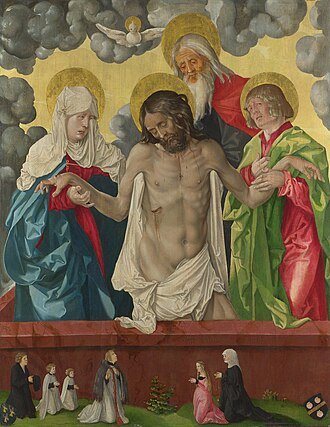


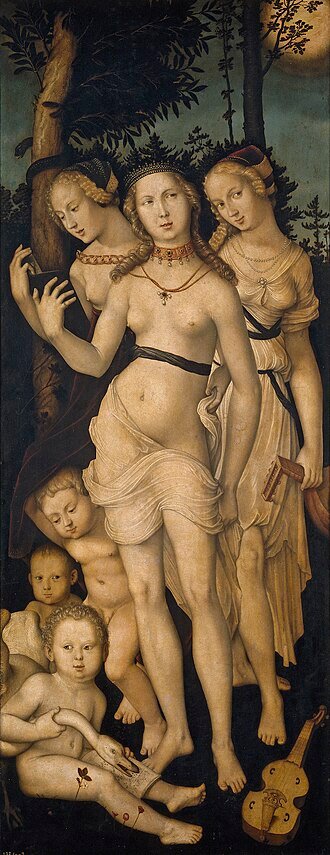


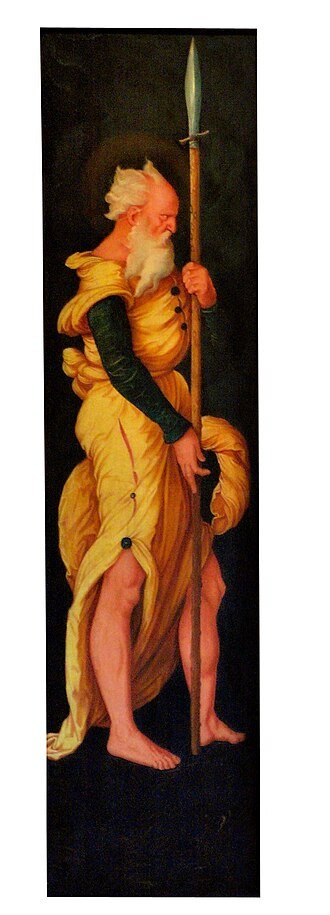

This 1511 oil painting by Hans Baldung shows Saint John on Patmos, a figure also identified with John the Evangelist, who appears writing. Above, the Virgin and Child appear on a crescent moon, and an eagle accompanies the saint. A religious subject, the work is now held at the Metropolitan Museum of Art.

The painting shows Mucius Scaevola, a figure from Roman history who, according to tradition, burned his right hand to prove his courage before an enemy. Hans Baldung painted it in 1531 on a lime panel. It belongs to his history paintings, a genre that retells episodes from the past with moral purpose.
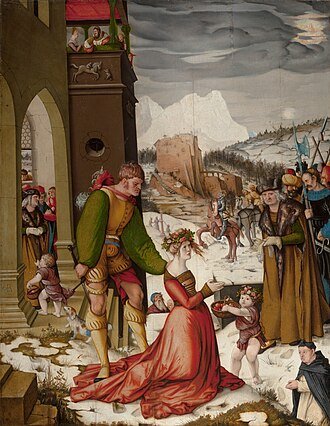
This 1516 panel by Hans Baldung shows the beheading of Saint Dorothea, as its title indicates. It is a religious painting done in tempera on a lime wood panel. Available information says nothing about who commissioned it or how it was composed, so this description keeps to its subject and technique.

Mercury is an oil painting on panel by Hans Baldung, dated 1530, and its tall, narrow format shows the messenger god of classical mythology. The upright shape probably suggests it was made for a specific setting, though little is known about who commissioned it. It is now held at the Nationalmuseum in Stockholm.
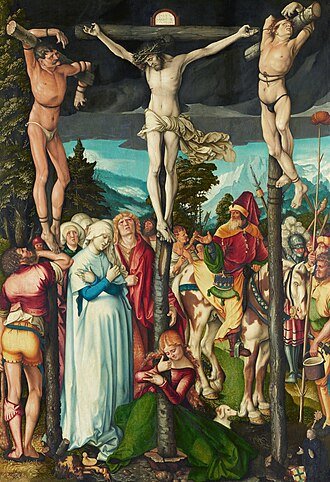
This panel by Hans Baldung, dated 1512, depicts the crucifixion of Jesus of Nazareth within religious art. It is oil on lime wood, a support common in German painting of the period. The upright format and the central figure of the crucified Christ give the scene a clear, direct structure. Without further documentary references, it is best to confine ourselves to what the work shows: a devotional subject handled with a restrained composition.

A nude woman with reddish hair stands beside a cat and a tree in a rural setting. The scene also includes a music score and a musical instrument, details that suggest an allegorical reading, though the exact meaning is unclear from the available information. Painted in 1529 on panel, the work is held in Bavaria.

Portrait of Louis I of Löwenstein, painted by Hans Baldung in 1513 on a lime panel, a support that suggests the small scale typical of the artist's portraits. The record offers no details about the commission or the sitter's life, so it is best to stay with what can be seen: a three-quarter bust and a direct gaze that draws the viewer's attention to the face.
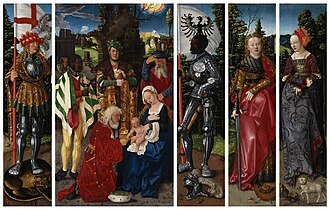
This religious painting, dated 1506 and made on a lime wood panel, is the work of German artist Hans Baldung. Its title points to the Three Kings, or Magi, a subject widely depicted in the art of the period. The narrow, elongated format suggests a devotional purpose, though the original setting of the work is uncertain.
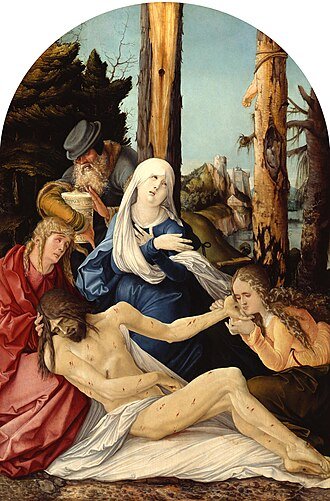

This panel by Hans Baldung, dated 1530 and painted in oil on lime wood, depicts the mythological story of Pyramus and Thisbe, the Babylonian lovers whose tragic end is told by Ovid in the Metamorphoses. The record offers no further details about its commission or its specific composition, so it is best described cautiously. The subject belongs to mythological painting, a genre that in the late Renaissance allowed artists to explore love, death and fate through classical tales.

This oil-on-panel work by Hans Baldung, dated 1531, depicts Adam and Eve, the central figures of the biblical account in Genesis. It is a religious painting in a tall, vertical format. Without further reference material, it is best to stay with what is visible: two nude figures set against a background, rendered with the precise drawing and light associated with early sixteenth-century German painting.


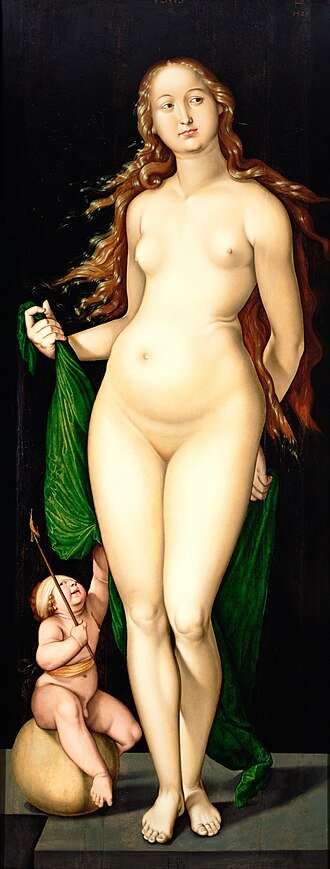
This oil on panel shows Venus in a mythological nude, a subject the record classifies as both mythological and nude painting. Its elongated format, over two meters tall and narrow in width, concentrates attention on a single figure. Without reference texts, the commission and the circumstances of its creation cannot be specified with certainty.

A portrait of Philip, Duke of Palatinate-Neuburg, painted by Hans Baldung in 1517 on a lime wood panel. The English title points to his warlike character, an epithet the record does not elaborate on. The work is held by the Bavarian State Painting Collections, in Munich. Without further documentation, it is safest to read the portrait as an example of early sixteenth-century German court painting.

A 1529 allegorical painting by Hans Baldung, executed in oil on panel. A nude female figure appears with a mirror, a serpent, a stag and a hind, motifs that are probably associated with vanity and temptation. The narrow, upright format emphasizes the figure's elongated presence. The work is held in the Bavarian State Painting Collections.

Hans Baldung painted this religious work in 1511, and its title points to the Mass of Saint Gregory, a sacred subject. The available information does not establish who commissioned it or the circumstances of its making, so it is best read as a devotional image, without assuming details that cannot be confirmed.

Painted by Hans Baldung in 1533 on a lime wood panel, this religious work shows the Virgin Mary nursing the Christ Child, accompanied by a putto and a parrot. The bird and the winged child suggest a symbolic reading, though its exact meaning is hard to pin down with certainty. It is held in the Germanic National Museum.


A religious painting narrating the creation account in Genesis, showing the making of humans and animals. Painted in oil on panel in 1533, it has a very tall, narrow format that probably suited a specific vertical setting. Its Genesis theme places it within the religious art of its time.

Painted by Hans Baldung in 1513, this small oil-on-panel work shows Death pursuing a naked young woman. Its allegorical theme points to the fragility of life and the inevitability of time passing. The compact format and the figure's direct gaze invite close viewing. The painting is held in the Bargello, Florence's museum.

Mythological painting dated 1530 and credited to Hans Baldung. Its central figure is Cupid, recognizable by the arrow he carries, a common subject in the mythological repertoire of the period. The work combines tempera and oil on a lime panel, a mix of techniques that allows subtle colour and precise finish. It is held at the Augustinermuseum.
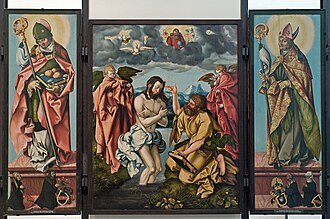
Religious altarpiece painted by Hans Baldung in 1510 using tempera on fir panel. It is dedicated to Saint John, a central figure of Christian tradition whose name gives the work its title. Today it belongs to the collection of the Historical Museum in Frankfurt, where it is kept.
Where to see the work
- Musée des Beaux-Arts de Strasbourg Strasbourg · 4
- Gemäldegalerie Berlin Berlin · 4
- Bavarian State Painting Collections Munich · 4
- Museo del Prado Madrid · 2
- National Gallery London · 2
- Kunstmuseum Basel Basel · 2
- Germanisches Nationalmuseum Nuremberg · 2
- Augustiner Museum Freiburg im Breisgau · 2
- Museum der bildenden Künste Leipzig · 1
- National Gallery of Canada Ottawa · 1
- Uffizi Gallery Florence · 1
- Hessen Kassel Heritage Kassel · 1
- Kunsthistorisches Museum Vienna · 1
- Staatliche Kunsthalle Karlsruhe Karlsruhe · 1
- Louvre Museum Paris · 1
- Metropolitan Museum of Art New York City · 1
- Staatliche Kunstsammlungen Dresden Dresden · 1
- National Gallery Prague · 1
- Nationalmuseum Stockholm · 1
- Thyssen-Bornemisza Museum Madrid · 1
Teachers and pupils
Studied with
- Alberto Durero 1471–1528
Curiosities
A nickname in colour
The nickname Grien, meaning green in German, is probably linked to his fondness for wearing that colour. Another suggestion is that it comes from grienhals, an old German word for witch, which would fit his interest in witchcraft. Neither explanation is certain, and the name later appeared in his monogram.
Witches in chiaroscuro
In 1510 he produced a chiaroscuro woodcut known as The Witches' Sabbath, one of the earliest images of witchcraft by a German artist. His interest in the subject lasted to the end of his career and went beyond painting, appearing in drawings, prints and oil paintings alike.