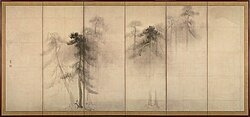
Hasegawa Tōhaku (1539-1610) was a Japanese painter and founder of the Hasegawa school, active during the Azuchi-Momoyama period. He is regarded as one of the great painters of his age, and his work offers a quiet counterpoint to the decorative style that dominated the period.
Born in Nanao, in the province of Noto in what is now Ishikawa Prefecture, he began his career painting Buddhist works in his home region. In his thirties he moved to Kyoto, where he trained within the Kanō school, then led by Kanō Shōei. There he worked on the large decorative formats, on white paper or gold leaf, made for castles and palaces. Later he developed his own ink style, drawing on Song and Yuan masters and on the Muromachi tradition, especially Mu Qi and Sesshū Tōyō.
His rivalry with Kanō Eitoku for the favour of Oda Nobunaga and Toyotomi Hideyoshi shaped much of his career. After Eitoku died in 1590, he stood as the leading living master of his time and became Hideyoshi's official painter. His major works include the Shōrin-zu byōbu, regarded as one of the first screens of its scale to show only pine trees, and the maple painted in 1593 for Chishaku-in, which survives. Late in life he was summoned to Edo by the shōgun Tokugawa Ieyasu, who granted him the priestly title hōgen, and he remained there until his death in 1610. His school was small, made up mostly of himself and his sons, but it preserved a restrained aesthetic often linked to Sesshū and to Sen no Rikyū.
Works (3)
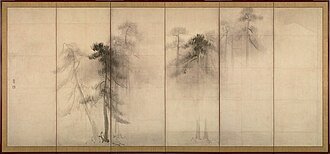
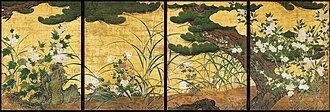
The work brings together a pine tree and plants associated with autumn, a recurring subject in Japanese painting of nature. The available record offers no further detail on composition or technique, so the title is the main guide. The contrast is suggestive: the pine keeps its needles through the seasons while the autumn plants mark change. The painting is attributed to Hasegawa Tōhaku.
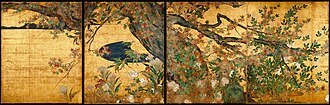
This work by Hasegawa Tōhaku, dated 1593, depicts a maple tree painted on fusuma, the large sliding doors used in Japanese interiors. Because the support belongs to domestic architecture, the composition is conceived to work within the room it occupies. No further details about its commission or composition are available, so it is best to describe only what the work itself shows.
Where to see the work
- Tokyo National Museum Tokyo · 1
Curiosities
A dispute over a succession
Tōhaku admired Sesshū Tōyō's technique so much that he tried to claim the right to be Sesshū's fifth successor. He lost the court battle to Unkoku Togan, who also claimed that inheritance. The episode shows how much Sesshū's reputation mattered in the art world of the time and how fiercely his legacy was contested.
An inherited surname
Tōhaku was born Okumura Tōhaku, into a local family of cloth dyers in Nanao. He was adopted into the Hasegawa family, and it is under that name that he became known. The sources note that the change of surname came early in his life, while he was establishing himself as a professional painter.