Pine Trees
Hasegawa Tōhaku, 1580
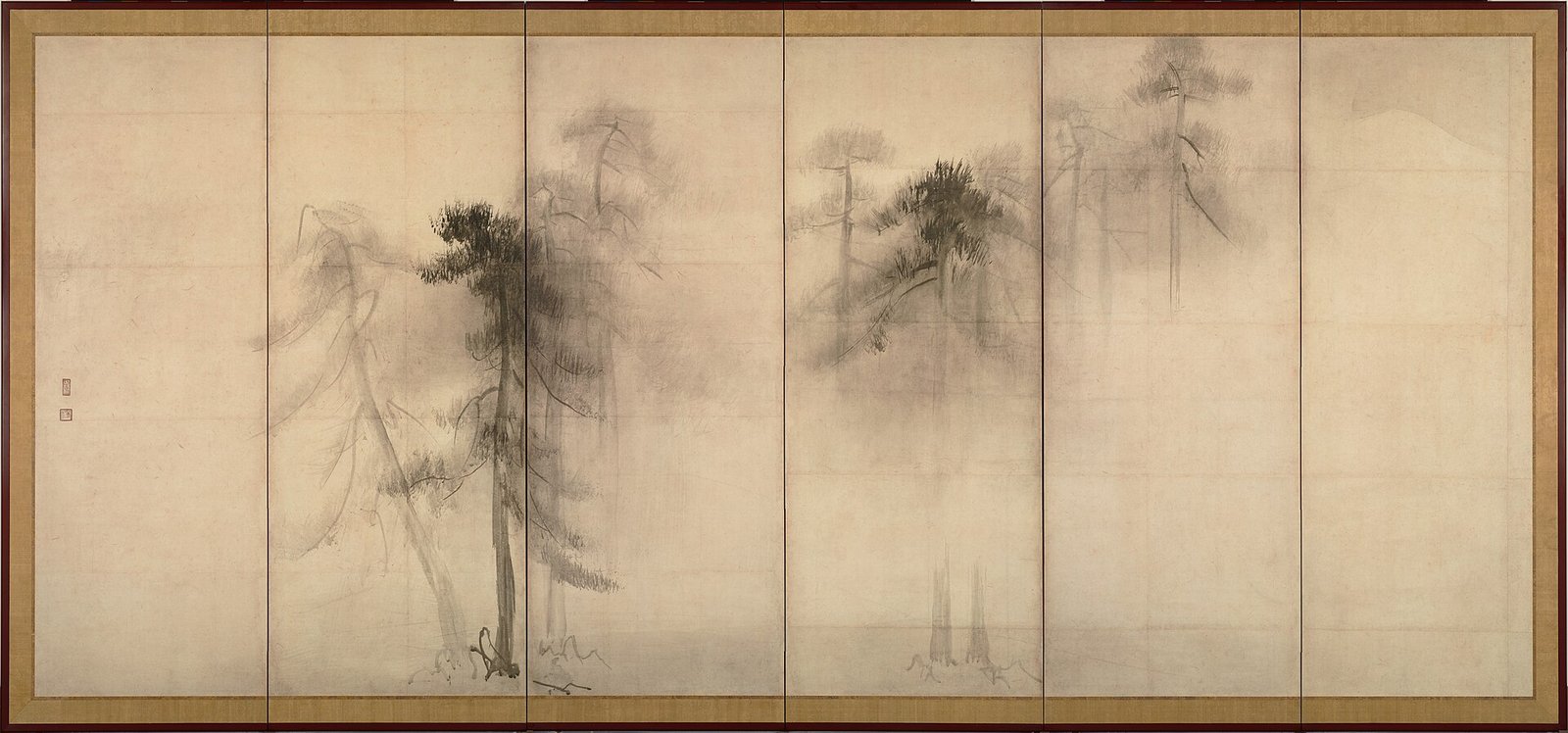
The Pine Trees screens, by Hasegawa Tōhaku, show a stand of pines drifting in mist, painted in ink on paper. They are usually dated to around 1595, late in the sixteenth century during the Momoyama period, though the exact date is unknown. The work is a pair of six-panel folding screens, and the folds are part of the composition: branches lean toward or away from the viewer, creating a sense of depth. Sharply defined trees sit alongside softer forms blurred by haze, so the empty paper carries nearly as much weight as the ink. Ideas such as the Zen notion of ma and the rustic simplicity of wabi help explain this economy of means. Blending Chinese ink traditions with the Japanese yamato-e landscape theme, it is regarded as a Japanese innovation, since monochrome ink painting on this scale had no precedent in China. Some details, such as the slightly mismatched papers and the cropped trees at the far right, hint that it may have been a preparatory work. It is designated a National Treasure of Japan.
- Painter
- Hasegawa Tōhaku
- Date
- 1580
- Medium
- wood, paper, ink
- Dimensions
- 157 × 356 cm
- Museum
- Tokyo National Museum, Tokyo
- Movement
- Hasegawa school
- Genre
- byōbu-e, ink wash painting
- Depicts
- Pinus, fog
More works by Hasegawa Tōhaku