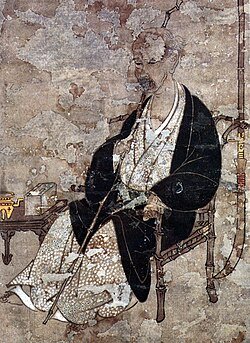
Iwasa Matabei (1578-1650) was a Japanese painter of the early Tokugawa period, known for genre scenes of historical events, illustrations of classical Japanese and Chinese literature, and portraits. His importance lies in his personal style and in the debate over his role in the origins of ukiyo-e.
He was the son of Araki Murashige, a Sengoku-period daimyō who was made to commit suicide, and he was raised under his mother's family name, Iwasa. He trained with Kanō Naizen, but the Tosa school tradition influenced him more. His figures have large heads and delicate features, and he worked with both colour and monochrome ink.
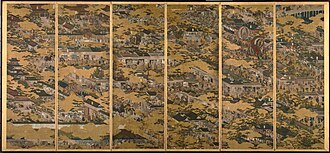
His oeuvre is hard to date, since he worked before print engraving had fully developed. His Rakuchu Rakugai Zu, Funaki version (1615), which depicts Kyoto, is the only work by him designated a National Treasure, and it is held by the Tokyo National Museum. The MOA Museum of Art holds three narrative picture scrolls by him, including the Yamanaka Tokiwa Monogatari Emaki.
In Japan he is often regarded as the originator of ukiyo-e, though another theory places him as an independent Tosa school painter and holds that he is confused with a painter of the same name who appears in Chikamatsu's plays. His son Katsushige was also a painter.
Works (1)
Where to see the work
- Tokyo National Museum Tokyo · 1
Teachers and pupils
Studied with
- Kanō Naizen 1570–1616