
John Singer Sargent
1856–1925 · American painter, society portraitist
John Singer Sargent (Florence, 1856 – London, 1925) was an American painter trained in Paris and based in London, widely regarded as the leading portrait painter of his generation. Born in Florence to American parents, he spent most of his life in Europe. His work records travel from Venice to the Tyrol, Corfu, Spain, the Middle East, Montana, Maine and Florida, and his importance lies in combining remarkable technical facility with a keen reading of his sitters.
Itinerant childhood
His father, an eye surgeon from Philadelphia, and his mother, an amateur artist, settled abroad after the death of an older child and never returned to live in America. The family moved each season between France, Germany, Italy and Switzerland, and repeated attempts at formal schooling for John failed. His mother gave him sketchbooks, and he eagerly copied ship images from The Illustrated London News. At thirteen he took watercolour lessons from Carl Welsch, a German landscape painter.
Training in Paris
An attempt to study at the Academy of Florence failed because the school was being reorganised. In Paris he joined the studio of Carolus-Duran, a young portraitist with a bold technique who taught alla prima painting, working directly on the canvas in the manner of Velázquez rather than relying on careful underdrawing. Sargent passed the entrance examination to the École des Beaux-Arts at his first attempt and also took lessons from Léon Bonnat and Adolphe Yvon. His friendship with Paul César Helleu brought him into contact with Degas, Rodin, Monet and Whistler.
Early portraits and the Spanish journey
Landscapes were his early preoccupation, but portraiture brought him recognition. His first major portrait, of his friend Fanny Watts (1877), earned him a place at the Salon. In 1879 he painted his teacher Carolus-Duran, and Henry James praised a talent with nothing left to learn at its threshold. After leaving the studio he visited Spain, studied Velázquez with great devotion and rediscovered his love of music, which remained a major part of his life. That journey led to El Jaleo (1882).
The Madame X scandal
In 1884 he showed the Portrait of Madame X, of Madame Pierre Gautreau, at the Paris Salon. He later considered it among his best work, yet it provoked such hostility that he reportedly contemplated giving up painting. Afterwards he moved to London, and by 1886 he had settled permanently in Chelsea, encouraged by commissions and by the persistence of Henry James.
Success in London and New York
In London, critics at first faulted his French-influenced handling of paint, but he soon won the admiration of patrons and reviewers. Carnation, Lily, Lily, Rose (1887) was his first major success at the Royal Academy and was promptly bought by the Tate. His first professional trip to New York and Boston, in 1887–1888, produced more than twenty important commissions, among them one for Isabella Stewart Gardner. His method was methodical: he visited the sitter's home, chose the wardrobe and typically needed eight to ten sittings, working without assistants. His fees were high, yet he could turn clients away.
Maturity, landscapes and watercolours
Around 1900 he was at the height of his fame, although he began to travel more and to devote less time to portraits. An Interior in Venice (1900) was a notable success, and Lord Ribblesdale (1902) was among his last major portraits in his bravura style. In 1907 he officially closed his studio, declined a knighthood and kept his American citizenship. From then on he concentrated on landscapes, more informal portraits of family and friends, and watercolours. He made more than two thousand watercolours, many of Venice, sometimes painted from a gondola, with very intense colour.
Legacy
Modernist critics, who saw him as remote from modern life, diminished his reputation for decades. From the late twentieth century historians reassessed his work, and his sensitivity, his friendships with women and his interest in other cultures are now read as forward-looking. Sargent died in London in 1925, and his works are held in major museums in Europe and the United States.
Works (143)


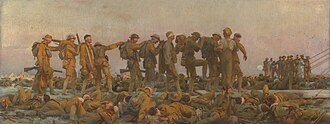


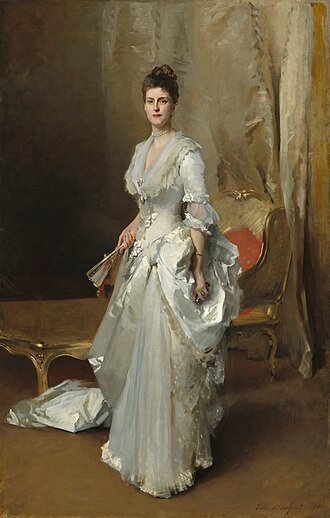


Painted in oil on canvas in 1880, this work belongs to Orientalism and to the genre of figure painting. Its title refers to the smoke of ambergris, an aromatic substance, so the scene probably centres on perfume or incense. The available information does not clarify its context or who commissioned it.

Painted by John Singer Sargent in 1884, this oil on canvas is held at the San Francisco Museum of Fine Arts. The available information says little about its subject or any commission, so it is not possible to specify what the scene shows. The title points to port wine, although that connection cannot be confirmed.


Portrait of Nancy Astor by John Singer Sargent, painted in 1908 in oil on canvas. The available information does not establish the commission or the circumstances of its creation, so the painting is best approached through what it shows: a vertical figure that fills the canvas and draws the viewer's attention.

Portrait of Édouard Pailleron painted by John Singer Sargent in 1879, in oil on canvas and a vertical format. The available information does not record who commissioned the work or the circumstances of its making, so it is best approached through its composition and palette. It is now held by the Musée d'Orsay in Paris.

A portrait of the sitter Carmencita, painted by John Singer Sargent in 1890 in oil on canvas and now held at the Musée d'Orsay. Records about its commission are scarce, so the most useful approach is to look closely at what is visible: the brushwork, the handling of color, and the sitter's presence on the canvas.

Portrait painted by John Singer Sargent in 1883, in oil on canvas, showing a woman identified by the title as the Vicomtesse de Poilloüe de Saint-Périer. Among the elements depicted is a rose. The work is held at the Musée d'Orsay in Paris. Available information does not clarify the commission or how the painting was received at the time.


Portrait of a woman painted by John Singer Sargent in 1876 in oil on canvas. The title, Gitana, suggests the sitter belonged to the Romani community, although no further information is available about her identity or the circumstances of the commission. The work is held at the Metropolitan Museum of Art.

A landscape by John Singer Sargent, painted in 1908 in Majorca, focused on a hillside covered in thistles and low vegetation. The available information does not specify a commission or the circumstances of its making, so the picture can only be described as it appears: a close view of the ground and its plants, executed in oil on canvas.


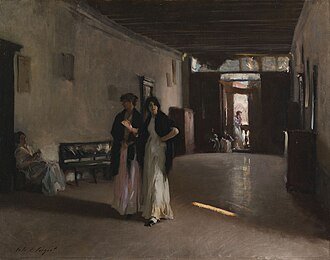

Oil on canvas portrait of Vernon Lee, painted by John Singer Sargent in 1881. It is a small-scale work, and the available information does not establish its commission, composition, or reception. Its main interest lies in documenting Sargent's early portraiture, though specialist sources would be needed for fuller details.


Portrait of Judith Gautier painted by John Singer Sargent in 1883, oil on canvas. The sitter is caught in a moment of motion, with the wind shaping the composition, and the title makes clear that the gust is the true subject of the scene. The work is held by the Virginia Museum of Fine Arts.

Oil on canvas from 1878 by John Singer Sargent, a small work showing a man crowned with laurel leaves. The available record does not identify the sitter or the circumstances of its making, so any reading of the image should remain tentative. It is held at the Los Angeles County Museum of Art, where visitors can see it in person.

Portrait of Millicent Leveson-Gower, Duchess of Sutherland, painted by John Singer Sargent in 1904. The sitter stands in a tall, large-scale vertical format, and the composition focuses attention on her silhouette. Sargent works in oil on canvas, using broad brushstrokes and a restrained palette that gives weight to the gown and her posture. The available information does not allow us to say more about the commission or its reception.


A portrait painted by John Singer Sargent in 1884 in oil on canvas, depicting Kate A. Moore. No documentation on the commission or the circumstances of its making has been found, so any reading remains tied to the painting itself and its title. It belongs to Sargent's extensive output of portraits, a genre he practised throughout his career. Today the work is held at the Hirshhorn Museum and Sculpture Garden.


A portrait of the composer Gabriel Fauré painted by John Singer Sargent in 1889 in oil on canvas. It belongs to the portrait genre and is now held at the Musée de la musique. The available information does not clarify who commissioned it or the circumstances of its making, so it is best to read the work cautiously and focus on what the image itself shows.

Double portrait of Édouard and Marie-Louise Pailleron, painted by John Singer Sargent in 1881. This large oil on canvas places both children within a single pictorial space, so the viewer's eye moves between two figures held in one composition. It is held at the Metropolitan Museum of Art in New York.

Portrait of Arsène Vigeant, an oil on canvas of small, nearly square format, painted by John Singer Sargent in 1885. The picture concentrates all attention on the sitter. The available information does not establish the commission or the relationship between painter and model, so the composition and the handling of the figure are the best points to look at.

Portrait of Paul César Helleu, painted by John Singer Sargent in 1880 in oil on canvas. The work belongs to the collection of the Musée Bonnat. Sargent shows the sitter with a direct gaze against a restrained, dark palette. The available information does not allow us to say more about its commission or reception.


Oil on canvas by John Singer Sargent, dated 1879, taking as its subject the Court of the Myrtles in the Alhambra. The title names the setting: a courtyard within the Alhambra complex in Granada, recognisable by its myrtle hedges. Without reference texts, its composition, the painter's intention and reception cannot be stated with certainty.

A portrait painted by John Singer Sargent in 1880, using oil on canvas and board. It depicts Ramón Subercaseaux Vicuña posing in a gondola, a setting that places the sitter on the water and suggests a leisurely outing. As a portrait, the painting focuses on the figure and on his relationship with the watery surroundings. It is held by the Dixon Gallery and Gardens.

Venetian Street is an oil on canvas by John Singer Sargent, dated 1882. The record offers no further information about its commission or exhibition history, so it is wiser not to assume who it was made for or where it was shown. The work belongs to a period in which the American painter handled urban scenes and shifting light with ease, an interest the title itself suggests.

This 1882 oil on canvas by John Singer Sargent is classed as an urban landscape. Available records give no title, commission or specific location, so any reading of the scene should remain cautious and rest on what is visible in the painting itself.


A 1884 study by John Singer Sargent, made in graphite and watercolour on paper. It depicts Henrietta Reubell and belongs to the portrait tradition Sargent practised with remarkable command of drawing. Precise lines define the face and figure, while light touches of colour suggest a quick, confident way of capturing the sitter's presence.


Painted by John Singer Sargent in 1885, this oil on canvas is classed as a portrait. Its title points to a birthday celebration, though the available information does not clarify who appears or the precise circumstances of the scene. It is held by the Minneapolis Institute of Art, where visitors can see it in person.
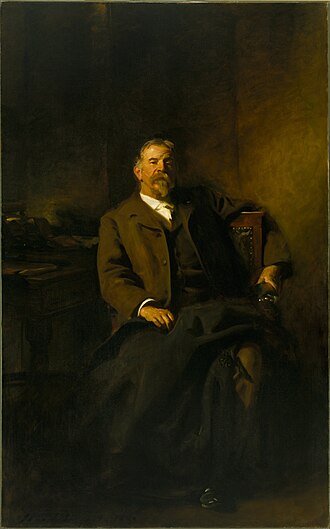
Portrait of Henry Lee Higginson by John Singer Sargent, painted in 1903 in oil on canvas, measuring roughly two and a half metres in height. The work is held at the Fogg Art Museum. No information is available about the commission, the setting or the circumstances of its making, so further understanding would require specialised studies of Sargent's portraiture.


Painted by John Singer Sargent in 1879, this small oil on panel probably belongs to the quick studies made directly from observation. Its title, Moorish Buildings in Sunlight, announces the subject: architecture in a Moorish style bathed in strong light. The painting's main interest lies in the contrast between sunlit surfaces and areas of shadow.

A study of a nude male model standing beside a stove, painted by John Singer Sargent in 1875. The figure stands in a plain pose, while the stovepipe and the background divide the space into restrained masses of shadow. Rather than a narrative scene, the work seems to be an exercise in observing the body and the light on the skin, typical of the academic training the painter received at the time.


Portrait painted by John Singer Sargent in 1879 in oil on canvas. Its tall, narrow vertical format, more than twice as high as it is wide, suggests a full-length figure and an upright bearing, though the available records do not specify the commission or the circumstances of the sitter.


Oil-on-canvas portrait dated 1901 by John Singer Sargent, depicting Ellen Peabody Endicott, identified in the title as the wife of William Crowninshield Endicott. Available records give no details about the commission or the composition, so further readings should be checked against specialist studies of the painter. The work is held by the National Gallery of Art.

A portrait of Mary Anthony, wife of Charles Gifford Dyer, painted by John Singer Sargent in 1880 in oil on canvas. The sitter appears in a restrained treatment and muted palette, typical of the artist's early portraits. The work is held at the Art Institute of Chicago, where it can be seen today.


Thistles is an 1885 oil on canvas in which John Singer Sargent turns his attention to thistle plants. Little is known with certainty about its commission or circumstances, so it is best to stay with what is visible: the painting seems focused on the shape and color of these wild plants, handled with a plain attentiveness that the title reflects. It is held by the Art Institute of Chicago.

Portrait of Elizabeth 'Elsie' Swinton, painted by John Singer Sargent in 1897 in oil on canvas. The tall, narrow composition presents the sitter in an elongated vertical format, and the work is now held by the Art Institute of Chicago. The title identifies her as Mrs. George Swinton, with Ebsworth given in parentheses as her family name.

A study of Virginie Amélie Avegno Gautreau, shown standing in an evening dress with a low neckline and one strap slipping from the shoulder. A table and a fan sit beside her, and her hair is pinned in a chignon. Painted in oil on canvas by John Singer Sargent in 1884, it is now held by the Tate.

Painted in 1908 by John Singer Sargent, this oil on canvas is held by the National Gallery in London. Its title, The Black Brook, seems to refer to its central subject, a stretch of dark running water, though the available information does not clarify the scene, its commission, or the painter's intentions.

Portrait of two girls, Ena and Betty, named in the title as the daughters of Asher and Mrs Wertheimer. John Singer Sargent painted it in 1901 in oil on a large canvas. It is now held by the National Gallery in London. The available information does not clarify the commission or the circumstances behind the picture.


Portrait of Theodore Roosevelt painted by John Singer Sargent in 1903 and held at the White House. It is an oil on canvas work in the portrait genre. Without reference texts, the origin, composition and reception of the painting cannot be specified, so this description is limited to the available data: artist, date, medium and sitter.


Large-scale portrait by John Singer Sargent showing Lady Warwick with her son Maynard Greville. Painted in oil on canvas, its size, close to nine feet tall, gives the scene a commanding presence. Dated 1905, the work offers little information beyond its image, so details about its commission remain unknown.

This full-length oil portrait, painted by John Singer Sargent in 1882, shows a standing woman in a dark dress with a calm expression. The title points to Venice, a city Sargent knew during these years, though the available information does not establish who the sitter was or the circumstances of the commission. The painting is now held by the Cincinnati Art Museum.

Oil on canvas dated 1898, portraying Lisa Colt Curtis by John Singer Sargent. Its tall, narrow vertical format, over two metres high, probably gives the sitter an upright, formal presence. The painting is held by the Cleveland Museum of Art. No details about its commission are available here.

This large oil painting by John Singer Sargent, dated 1922, depicts the Danaids, female figures from Greek mythology. Its extended horizontal format, more than six metres long, makes its impact rest on the breadth of the scene rather than a single protagonist. Today it is held at the Museum of Fine Arts, Boston.

Portrait of Helen Sears painted by John Singer Sargent in 1895, in oil on canvas. Its title indicates that the work depicts this woman, though reliable details about the commission or her life are not available here. The painting is held by the Museum of Fine Arts, Boston, where it is kept in its tall vertical format.

Painted in 1879 in oil on canvas, this large work takes its title from the Luxembourg Gardens, the Parisian park that forms its setting. Its generous scale shows the breadth with which Sargent approached an open-air space. The surviving record is limited, so reading the painting relies mainly on its title and the place it names.


Portrait of Grace Curzon, Marchioness Curzon of Kedleston, painted by John Singer Sargent in 1925. The work is an oil on canvas in upright format, and the available information does not establish the commission, the context of its making or further details of its composition. It is therefore best read simply as a portrait of its sitter.

Painted by John Singer Sargent in 1907, this seascape in oil on canvas takes a rock as its main subject. The Italian title, roughly "sweet idleness," points to a mood of carefree rest that the scene seems to suggest rather than spell out. Beyond its subject and date, the available record offers few details about the work's composition, commission or early history.


Portrait of Pauline Astor painted in 1898 by John Singer Sargent, oil on canvas in a tall, narrow format. Beyond the image itself, there is little reliable information about who commissioned it or how it was received, so any reading of its meaning should be approached with caution. It is held at the Huntington Library.

A portrait of Dennis Miller Bunker at work at Calcot, as the title indicates. Sargent shows his fellow painter absorbed before an easel outdoors, and the picture seems to focus less on a formal likeness than on an artist in the act of painting. Its modest size suggests an intimate study rather than a grand commission.


A portrait of Dorothy painted by John Singer Sargent in 1900, in the usual medium of oil on canvas. The work presents its sitter in a restrained, direct manner, with attention centred on the face and expression. With no further context available, it is best described cautiously as a medium-sized portrait held at the Dallas Museum of Art.


Painted by John Singer Sargent in 1879, this oil on canvas shows several children bathing outdoors in a bright setting. The title points to a Neapolitan location, but little is documented about the commission, the exact site, or the circumstances of its making. It is held today at the National Museum in Stockholm, where it can be seen.

Oil on canvas dated 1880 by John Singer Sargent, held by the Hispanic Society of America. Its title points to a scene built around a Spanish dance, though the record offers little detail about its composition, sitters or symbolism. Looking closely at the painting itself is the best way to appreciate its colour and handling.

Sargent painted this large oil on canvas in 1901, showing Alexander McCulloch on his holidays in Norway, as the title suggests. It belongs to the genre scene tradition, which depicts everyday life and leisure rather than a formal portrait. Its generous size invites viewers to linger over the sitter and the setting around him.

Painted by John Singer Sargent in 1876, this oil on canvas is known as Atlantic Storm, and its title points to a scene of rough sea. Little is recorded about its commission or composition, so visitors are best served by looking closely at how the sky, water and light are handled. It is now held in the Myron Kunin Collection of American Art.


This 1877 oil-on-panel study depicts a bust catalogued under the name 'Tête Wicar'. The title points to a sculptural piece linked to the Lille collection, though available information does not establish further details about its origin. As an exercise, the painting concentrates on the observation of volumes, light and shadow across a modelled form rather than on a narrative subject.

Portrait of Jacques Émile Blanche, a French painter and critic, made by John Singer Sargent in 1886. The work shows the sitter with a restrained treatment and a subdued palette, in a modestly sized upright format. Sargent was known for his loose brushwork and figure portraiture, and this piece belongs to that body of work. It is held at the Musée des Beaux-Arts in Rouen.


Portrait of the painter and draughtsman Albert de Belleroche by John Singer Sargent, the American artist trained in Europe. The record only allows us to describe it as an oil on canvas by his hand. Sargent was known for portraiture, combining a fluent handling of paint with close attention to the sitter's pose and expression.


Painted by John Singer Sargent in 1878 in oil on canvas, this work presents a young man lost in thought, as its title suggests. The available record does not clarify the circumstances of its commission or its early reception, so any reading of the sitter's mood must rest on the image itself and be held with some caution.

Atlantic Sunset is an oil on canvas that John Singer Sargent painted in 1878. The title points to a seascape at dusk, with open water and the reddish light of the setting sun carrying the scene. The available information does not pin down the exact location or any commission, so it is best read as a study of light on the sea.

An oil on canvas dated 1877 by John Singer Sargent, classified as a portrait. It shows a young boy on the beach, a simple subject in which the figure holds the viewer's attention. No available information identifies the sitter or explains the circumstances of the commission, so the work is best approached through what is visible: the boy standing by the sea and the outdoor setting the title suggests.

Oil on canvas by John Singer Sargent, dated 1877 and classed as a portrait. It shows a young woman on a beach, an outdoor setting the title Girl on the Beach makes plain. The available records do not establish the commission or the sitter's identity, so any reading should stay close to what the canvas itself shows.

This oil on canvas by John Singer Sargent, dated 1880, shows a courtyard in Tétouan, a city in northern Morocco. Little is documented about its commission or early reception, so the picture is best read through what it shows: an enclosed architectural space, with light and shadow shaping the scene.

Painted in 1879 in oil on canvas, this work by John Singer Sargent is titled Capri Peasant, which suggests a rural figure connected with the island of Capri. The available record does not document its commission, sitter or circumstances, so any reading of the scene should rest mainly on what the canvas itself shows.


Where to see the work
- Metropolitan Museum of Art New York City · 24
- Art Institute of Chicago Chicago · 7
- Galería Nacional de Arte Washington, D.C. · 6
- National Gallery London · 6
- Museum of Fine Arts Boston Boston · 5
- Musée d'Orsay Paris · 4
- Tate London · 3
- Nationalmuseum Stockholm · 3
- National Portrait Gallery London · 3
- Isabella Stewart Gardner Museum Boston · 2
- Philadelphia Museum of Art Philadelphia County · 2
- Clark Art Institute Massachusetts · 2
- Corcoran Gallery of Art Washington, D.C. · 2
- Brooklyn Museum New York City · 2
- Virginia Museum of Fine Arts Richmond · 2
- Worcester Art Museum Worcester · 2
- Terra Foundation for American Art · 2
- Imperial War Museum London London Borough of Southwark · 1
- National Galleries Scotland City of Edinburgh · 1
- Sheffield Galleries and Museums Trust Sheffield · 1
Teachers and pupils
Studied with
- Carolus-Duran 1837–1917
- Léon Bonnat 1833–1922
- Adolphe Yvon 1817–1893
Pupils
- Mary Foote 1872–1968
Curiosities
A portrait kept in the studio
The portrait of Thomas E. McKeller stayed in the painter's studio until his death and was not displayed permanently to the public until 1986, when the Museum of Fine Arts in Boston acquired it. McKeller, a young African-American elevator operator and First World War veteran, also posed for the mythological murals the museum commissioned and for the memorial murals in Harvard's Widener Library. It is an example of how Sargent worked with sitters of many kinds throughout his career.
Monet's verdict
Monet, who knew Impressionism well, said Sargent was not an Impressionist in the sense the group used the word, since he was too much under the influence of Carolus-Duran. British critics placed him in the Impressionist camp, but the Impressionists themselves disagreed. Sargent did sometimes use Impressionist techniques with great effect, as in his portrait of Monet painting outdoors.