
Juan de Juanes, born Vicente Juan Masip, was a Spanish Renaissance painter active mainly in Valencia and one of the most important artists of the Valencian school in the mid-sixteenth century. Sources place his birth in Fuente la Higuera around 1503 or 1505, although the record also gives 1510. He was the son of the painter Juan Vicente Macip, with whom he first worked in the family workshop.
After his father's death in 1550, Juanes worked independently. In 1534 he received the commission for the altarpiece of Saint Eligius at the church of Santa Catalina, now lost apart from The Consecration of Saint Eligius as Bishop of Noyon, held in Tucson and regarded as the first work fully by his hand. It is unclear whether he travelled to Italy, but his style shows the influence of Sebastiano del Piombo, whose works reached the Kingdom of Valencia through copies.
He devoted himself almost entirely to religious subjects: The Last Supper, eucharistic Salvators, Ecce Homos and Sorrowful Virgins, along with the Mystical Marriage of the Venerable Agnesio and The Immaculate Conception, considered his masterpiece. He also made cartoons for tapestries and, exceptionally, a Judgement of Paris with nudes, now in Udine. His style and iconographic types were repeated by followers such as Francisco Ribalta.
He died in Bocairente on 21 December 1579, having drawn up his will the day before. His son Vicente Macip Comes and his daughters continued the family workshop tradition. He is regarded as a key figure in Valencian painting, and his models influenced religious painting afterwards.
Works (8)
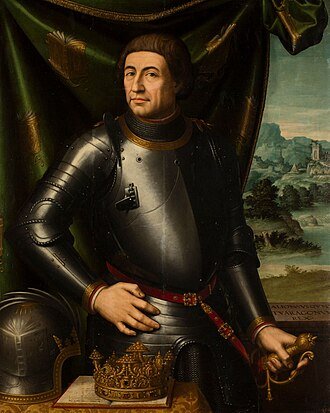
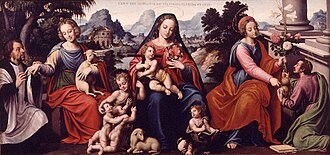
This panel by Juan de Juanes, painted in oil on wood, presents the Virgin in a restrained, quiet setting, with a balanced composition and a luminous palette of soft tones. It belongs to the collection of the Museo de Bellas Artes in Valencia, where it can be seen in person. With no further documentation available, it is best to focus on its craftsmanship and the delicacy of its figures.
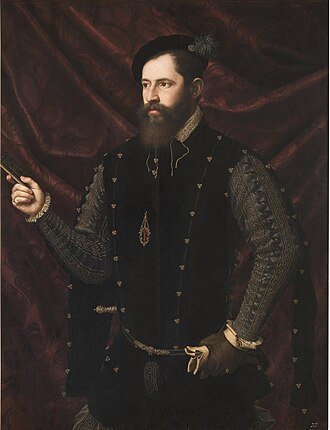
This portrait shows a standing man dressed in the insignia of the Order of Santiago, traditionally identified as the Valencian humanist Luis Castellá de Vilanova, lord of Bicorp and Quesa. Valencian painter Juan de Juanes drew on Venetian portraiture, especially Titian. A book in one hand and a dagger at the belt signal both his knightly status and his learning. The silver embroidery and lace cuffs are rendered with close attention.
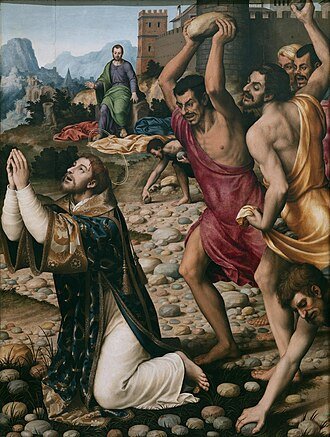
This oil on panel by Juan de Juanes, dated 1555 and held at the Museo del Prado, belongs to religious painting and depicts the martyrdom of Saint Stephen. The record offers no further information about its commission or composition, so any reading of the scene should stay with what the title indicates: the moment of the saint's martyrdom, a central figure in the early history of Christianity.


This small work, dated 1600, centers on a skull, a recurring subject in art that points to the fragility of life and the certainty of death. Although it is classed as a portrait, the exact subject of the painting is unclear from the available information. It is held at the Museo de Bellas Artes de Valencia.
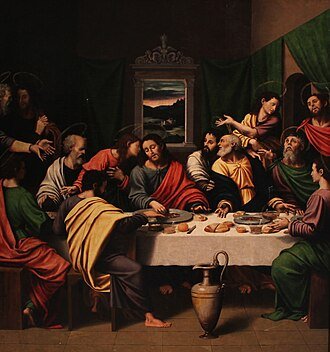
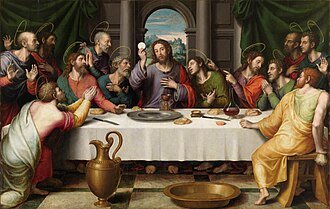
Juan de Juanes' Last Supper, dated 1534, depicts the moment when Christ shares bread and wine with his disciples, a central episode of the Gospel account. The available record confirms only the date, the dimensions and its holding at the Museo de Bellas Artes in Valencia, so any reading of its composition or commission should be approached with caution.
Where to see the work
- Museo del Prado Madrid · 3
- Museu de Belles Arts de València Valencia · 3
- Saragossa Museum Zaragoza · 1
- Goya Museum Castres · 1
Curiosities
A Latinized name
In Valencia during his lifetime, Juanes was the most prominent painter and kept close contact with the city's humanist circles. So much so that he himself latinized his name, a gesture that reflects his closeness to the educated milieus of the period.
Sonnets for a painter
His fame reached further than is usual for a painter. The priest Diego Ramírez Pagán wrote a sonnet comparing him to Apelles and lamenting the lack of a talented writer to praise his art. After his death, the poet Cristóbal de Virués also dedicated a sonnet to him.
A unique mythological nude
Devoted almost exclusively to religious themes, Juanes produced almost no secular works. His Judgement of Paris, held in Udine, is a unique case in his output, being a mythological subject with nudes. It is known to have been commissioned by Mencía de Mendoza.