
Marcello Bacciarelli
1731–1818 · Italian painter of the late Baroque and Neoclassical periods, active in Poland
Marcello Bacciarelli (Rome, 1731 - Warsaw, 1818) was an Italian-born painter who spent most of his career in Poland, moving between the late Baroque and Neoclassical styles. His career shows how an artist trained in Italy could find a place at the courts of central Europe. He studied in Rome under Marco Benefial and in 1750 was recruited to Dresden, where he was employed by Elected King Augustus III of Poland.
After the king's death he went to Vienna, where he painted portraits of the imperial family, and then to Warsaw. In 1766 King Stanislaus II Augustus appointed him director of the newly founded Royal Buildings and Estates. For the king he painted a set of portraits of Polish rulers, from Boleslaus I the Brave onward, and scenes from Polish history. His works in the Royal Castle in Warsaw include Strength, Reason, Belief, and Justice, the ceiling of the Old Audience Chamber, and Esther and Ahasuerus in the King's Bedroom. After the partitions of Poland and Napoleon's rise, he moved to the Duchy of Warsaw, where he painted Granting of the Constitution of the Duchy of Warsaw by Napoleon.
His legacy is tied to the Academy of Arts in Warsaw, a newly founded institution he directed. Alexander Kucharsky began training in his studio during Bacciarelli's early years in Warsaw, and Kazimierz Wojniakowski was another notable pupil. His court portraits and royal decorative commissions shaped Polish painting at the close of the eighteenth century.
Works (11)
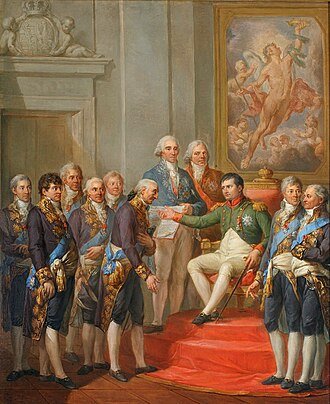
This oil on canvas, dated 1811 and attributed to the painter Marcello Bacciarelli, depicts a solemn moment in the creation of the Duchy of Warsaw in July 1807. Napoleon Bonaparte appears alongside several Polish and French dignitaries, including Talleyrand and Maret, gathered around the new duchy's constitution. The record classifies the work as history painting, a genre that aimed to fix public events with commemorative and ceremonial purpose.
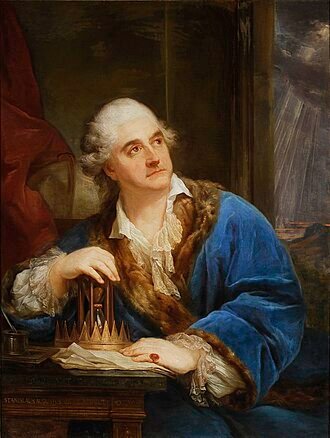
Portrait of Stanislaus II Poniatowski, the last king of Poland, painted by Marcello Bacciarelli in 1793. The sitter is shown wearing a crown and holding an hourglass, an object that points to the passing of time and the transience of power. No further information about its commission or reception is recorded, so the reading rests on what the image itself shows.
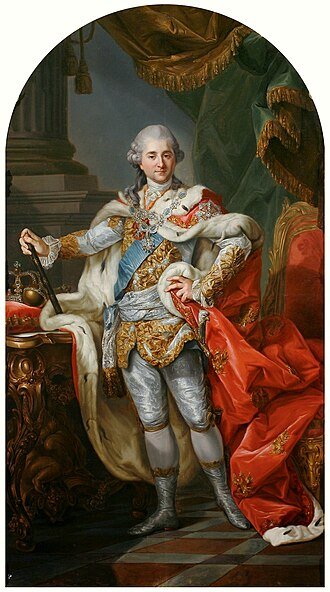
A portrait of Stanislaus Augustus Poniatowski, the last king of Poland, painted by Marcello Bacciarelli in 1764. The monarch stands full length in his coronation attire, rich garments that emphasise the dignity of his office. The vertical, solemn composition gives the figure a commanding presence within the space. Without further references, it is best to describe the work as it stands: an official portrait of state, designed to project authority.

Self-portrait by Marcello Bacciarelli, dated 1790, in which the painter shows himself wearing a rogatywka, a traditional Polish cap. Wearing this garment probably signals a national identity, though its exact intention is not known for certain. The work is held at the National Museum in Warsaw.

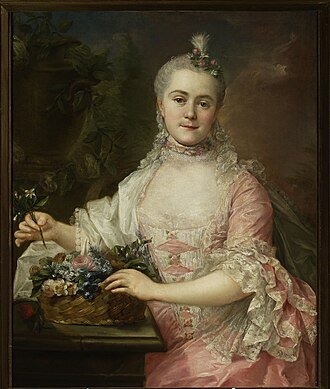
Portrait of Anna Szaniawska, née Scypion, painted by Marcello Bacciarelli in 1758 in oil on canvas. The sitter appears alongside a bouquet of flowers and a basket, details that place the scene in a carefully arranged domestic setting. Beyond what the painting itself shows, there is no further information here about its commission or reception.
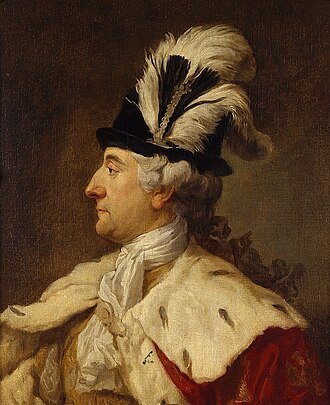
Portrait of Stanislaus Augustus Poniatowski, the last king of Poland, painted by Marcello Bacciarelli around 1780. The sitter appears half-length, wearing a hat with a feather, a detail that adds grace and movement to the composition. The painting is held at the National Museum in Warsaw and reflects the formal portraiture associated with the king's court.

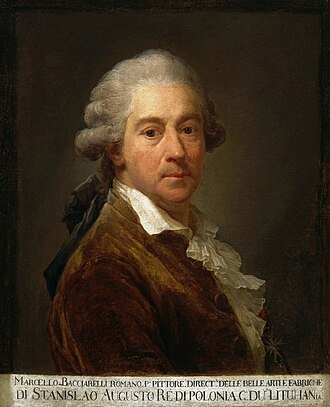
Self-portrait by Marcello Bacciarelli, dated 1793 and painted in oil on canvas. The title tells us the artist shows himself wearing a brown frock coat, a man's garment of the period. As a self-portrait, it belongs to a genre in which a painter depicts himself. The available record does not clarify its original context or commission.
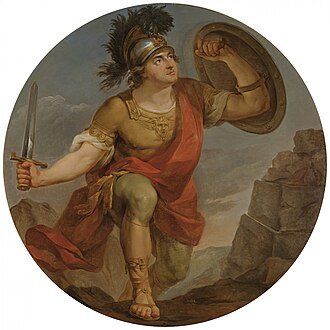

Portrait of Stanislaus Augustus Poniatowski, the last king of Poland, wearing his coronation robes. Marcello Bacciarelli painted it in 1792, in oil on a large canvas. The monarch stands at the centre, full length and in a solemn pose, surrounded by rich fabrics and details of royal dress. Without further references, the work is best understood as an image of monarchical power in the king's final years, when the sovereign was trying to assert his authority.
Where to see the work
- National Museum in Warsaw Warsaw · 7
- National Museum in Poznań Poznań · 2
- Royal Castle in Warsaw Warsaw · 1
- Łazienki Palace Warsaw · 1
Teachers and pupils
Pupils
- Jan Rustem 1762–1835
- Alexander Kucharsky 1741–1819
- Anna Rajecka 1754–1830
Curiosities
A miniaturist wife
In Dresden he married Friederike Richter, a woman painter known for her miniature portraits. It is one of the few references that place Bacciarelli within a family of artists, although the sources do not describe how their professional relationship developed or whether she worked in his studio.
A wedding portrait commissioned later
Izabela Lubomirska commissioned Bacciarelli to paint her in her wedding gown, but she ordered the portrait years after her marriage. The painting thus recalls a moment already in the past, presenting the ceremony through the eyes of a court painter.
Buried in Warsaw Cathedral
Bacciarelli died in Warsaw, the city where he spent much of his professional life, and was buried in St John's Cathedral. His grave in this church ties him to the Polish capital until the end, far from Rome, where his training had begun.