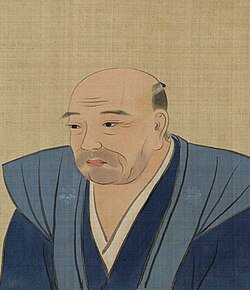
Maruyama Ōkyo
1733–1795 · Japanese painter from Kyoto, founder of the Maruyama school
Maruyama Ōkyo (1733-1795) was a Japanese painter active in Kyoto in the late eighteenth century. Born into a farming family in Ano-o, in what is now Kameoka, he is regarded as the founder of the Maruyama school, one of the most influential currents in early modern Japanese painting. His importance lies in blending a naturalism rooted in Western art with the decorative language of the Japanese tradition.
His training was mixed. He worked in a toy shop painting the faces of dolls and, through the European stereoscopes sold there, first encountered Western perspective. He then studied with Ishida Yūtei, of the Kanō school, and admired Chinese painting, especially Qian Xuan, from whose name he took the element 'kyo'. He was probably the first Japanese artist to draw from nude models.
His first major commission was The Seven Misfortunes and Seven Fortunes, three scrolls about 45 metres long made for a temple in Ōtsu. Ōkyo believed painting should show reality rather than imagined scenes. Some fellow painters criticised his close attention to physical appearance, but the public embraced his work, and he received commissions from merchants, the shogunate and even the emperor.
His style combines broad brushwork, few midtones and plain backgrounds with isolated subjects. In screens such as Pine Trees in Snow, from 1773, gold ground and ink coexist with bark and needles of a convincingly realistic appearance.
His legacy passed mainly through his pupils. Matsumura Goshun founded the Shijō school, Itō Jakuchū devoted himself to still life, and Nagasawa Rosetsu mastered perspective and chiaroscuro. His son, Maruyama Ōzui, was also a painter.
Works (5)
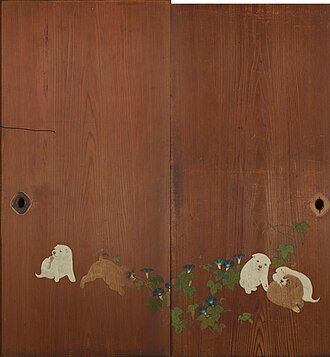
Painted in 1784 by Maruyama Ōkyo, this work shows morning glories, climbing flowers that open in the early hours, alongside a small puppy playing among them. Its recorded materials include iwaenogu, mineral pigments, and sugi. It is held at the Tokyo National Museum.
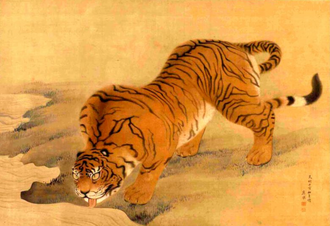
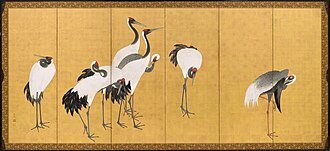
The painting shows cranes, birds that in Japanese painting are often associated with longevity and good fortune. Japanese artist Maruyama Ōkyo renders them with close attention to their shape and movement. The work is held at the Los Angeles County Museum of Art.
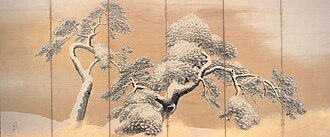
A folding-screen painting (byōbu-e) by Maruyama Ōkyo showing pine trees weighed down by snow. The work is held at the Mitsui Memorial Museum. The contrast between the dark evergreen branches and the white snow gives the scene its quiet wintry character, though little else about its commission or original setting can be stated with certainty here.
Where to see the work
- Tokyo National Museum Tokyo · 1
- Los Angeles County Museum of Art Los Angeles · 1
Teachers and pupils
Pupils
- Nagasawa Rosetsu 1754–1799
- Gen Ki 1747–1797
Curiosities
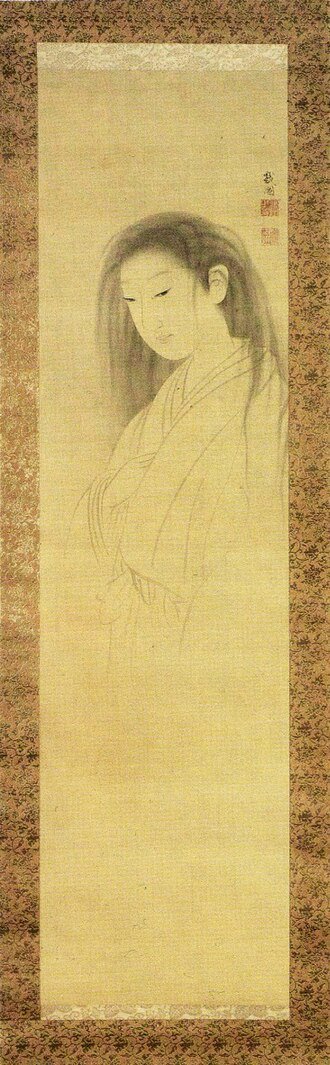
A ghost that flew away
According to a legend recounted by Van Briessen, a daimyō commissioned Ōkyo to paint a 'ghost image' of a lost family member. Once the work was finished, the figure supposedly came off the painting and flew away. The story shows how famous his realism had become among the public, although its origin is legendary and cannot be verified.
From toys to perspective
While working in a shop that sold European stereoscopes, Ōkyo mastered stereoscope images, known as megane-e or 'eyeglass pictures'. In 1767 he tried his hand at a small harbour view in single-point perspective. Though a modest anecdote, it marked his first serious contact with Western perspective.