The Annunciation
Sandro Botticelli, 1487
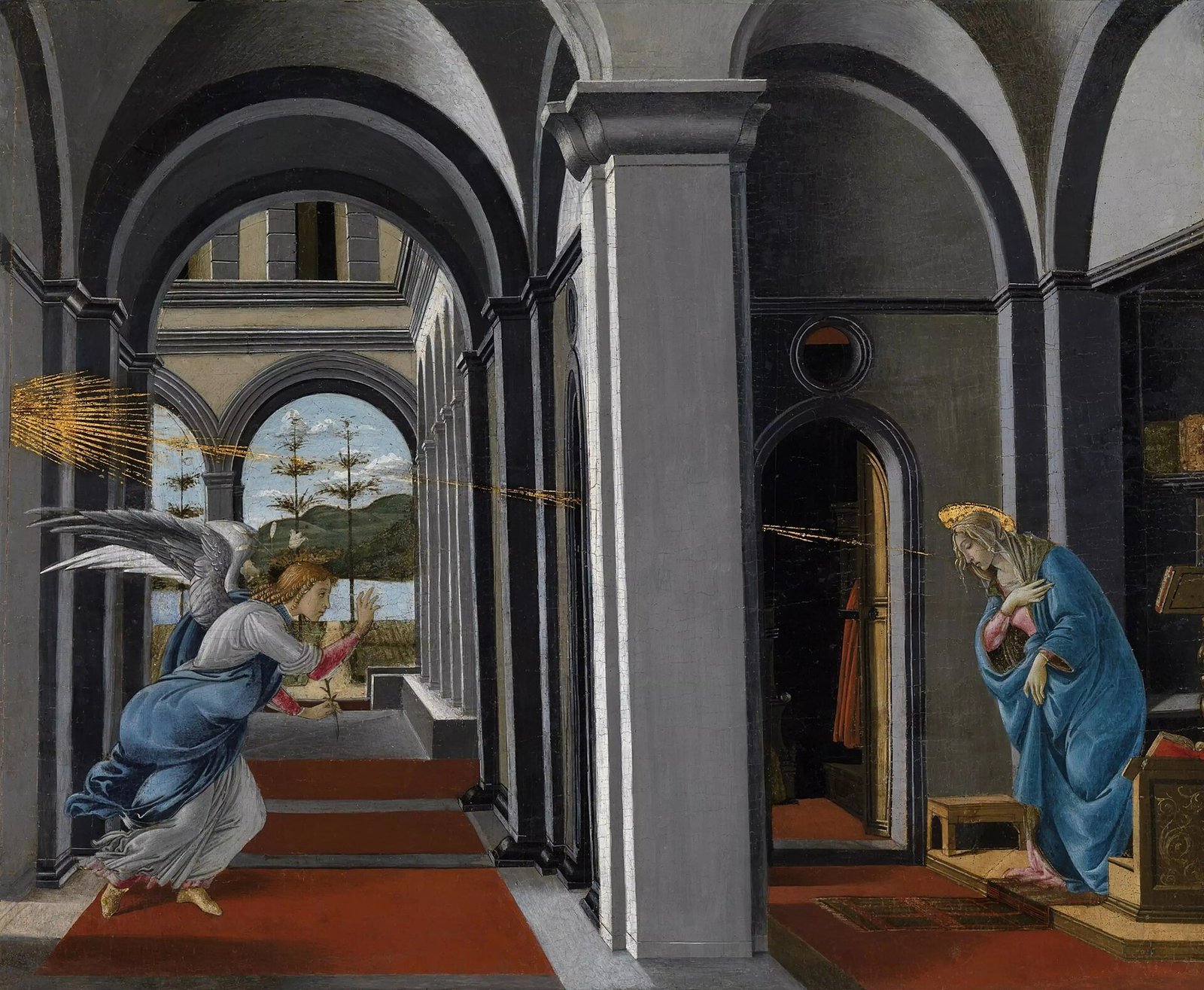
In this Annunciation, Botticelli depicts the moment when the Archangel Gabriel tells Mary of her future motherhood and the birth of Jesus. The scene unfolds within an orderly architectural setting: a loggia with columns opens onto a garden, and the floor of drawn tiles helps establish depth and the perspective scheme of the whole. This solemn architecture, built from very clear lines, dominates the small figures, which sit quietly within the frame. Mary, in a more enclosed space suggesting a bedroom, is shown in a composed attitude beside a lectern and a book, while the angel arrives from outside with a calm bearing.
The panel is small and painted in tempera on wood, a medium in which Botticelli worked with great precision in drawing and colour. Its date is uncertain. Most scholars place it in the early part of his career, citing features that recall the workshop of Verrocchio, while others date it closer to 1490, when the painter made a similar version of the same subject, now in New York. An inscription on the back of the panel records that it once hung in the Florentine church of San Bernaba, which places the work firmly within the religious life of Florence.
The architectural design has also been compared with the forms of Giuliano da Sangallo, prompting reflection on the exchange between painting and architecture in the fifteenth century. Beyond these hypotheses, the picture is a fine example of the early Italian Renaissance: a sacred scene resolved with spatial clarity, restraint and delicate figures that engage with their architectural frame.
- Painter
- Sandro Botticelli
- Date
- 1487
- Medium
- tempera, plaster, panel
- Dimensions
- 50 × 32 cm
- Museum
- Kelvingrove Art Gallery and Museum, Glasgow City
- Movement
- Early Renaissance
- Genre
- religious art
- Depicts
- garden, Annunciation, wing, bedroom, angel, Mary, window, lectern
More works by Sandro Botticelli