The Ballet Class
Edgar Degas, 1871
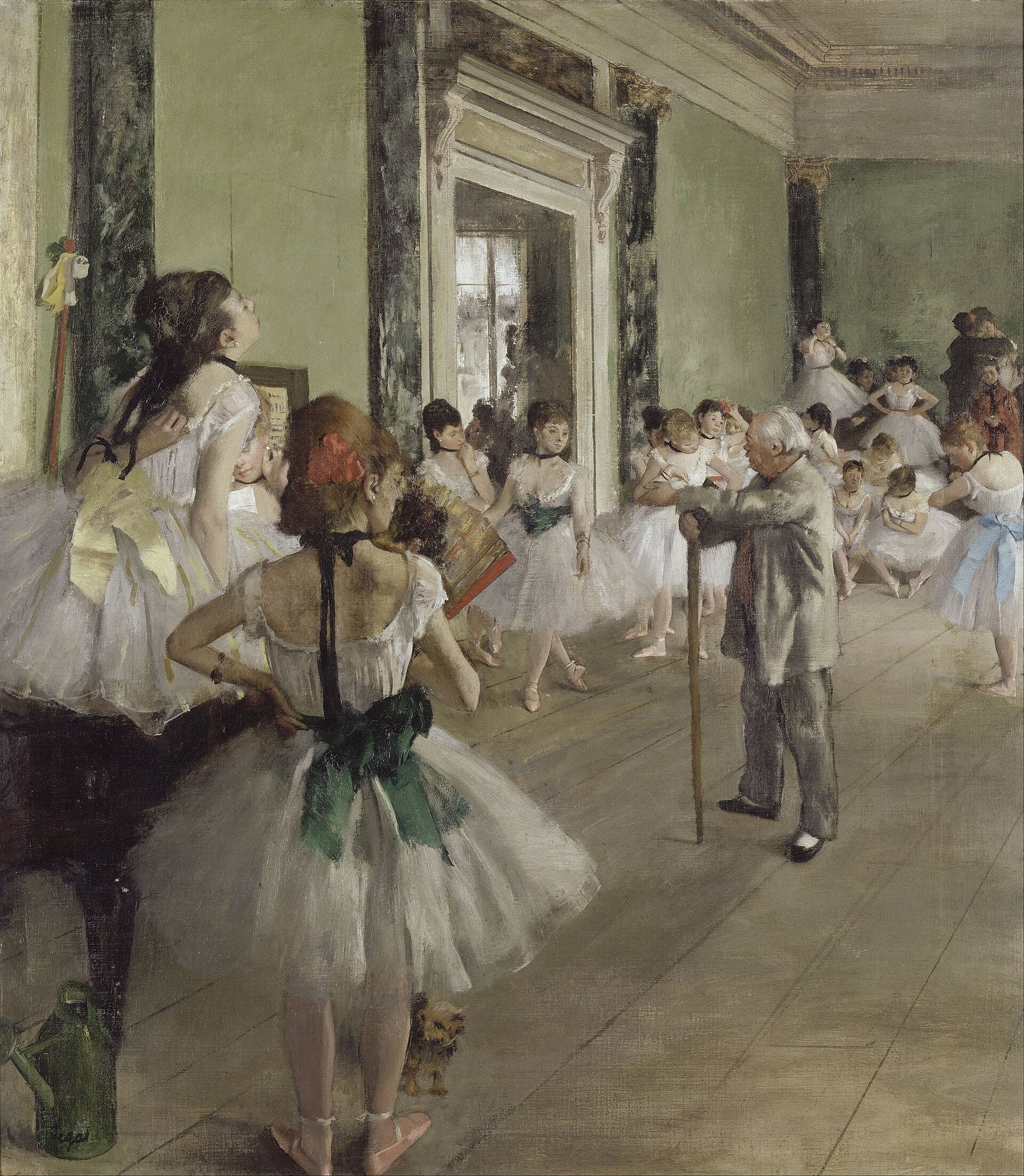
Degas painted this scene at a moment of change for ballet at the Paris Opéra, when the era of Romantic ballet had already ended and its master, Jules Perrot, belonged to an earlier period. Perrot, a celebrated dancer and choreographer in the 1830s and 1840s, stands in a flannel suit with an attentive gaze, watching a dancer perform a step at the centre. Around him, the young dancers are far from the discipline one might expect: some scratch their backs, others stretch, fiddle with an earring or adjust their clothes. The picture thus conveys the fatigue and boredom that come with training.
That almost furtive viewpoint is one of the key features of the work. Degas was less interested in a flawless performance than in the life of the rehearsal, what happens backstage and during the pauses. The mirror widens the room, and light from a window outside the frame moves across the bodies and the floor with a naturalness that anticipates Impressionism. The figures are individualised yet kept at some distance, and small details such as the little dog, the watering can used to dampen the dust on the floor, or the carefully painted black veined marble pilasters show painstaking attention.
The painting had a long genesis. Degas began it around 1873 at the commission of the singer Jean-Baptiste Faure, one of the very few commissions he accepted, and struggled with the composition. Part of the canvas was shown unfinished at the first Impressionist exhibition in 1874, and Degas kept working on it until 1876. Perrot's figure was added later, painted over another male teacher and replacing a girl adjusting her slipper. For this reason the exact date is debated, and some art historians place it between 1874 and 1875.
The related version of 1874 moves the class to the old opera house on rue Pelletier and shows a poster for Rossini's William Tell beside the mirror, a tribute to Faure. The painting is now held at the Musée d'Orsay in Paris and belongs to Degas's extensive series on dancers, a subject to which he devoted an estimated 1,500 works.
- Painter
- Edgar Degas
- Date
- 1871
- Medium
- oil paint, canvas
- Dimensions
- 85 × 75 cm
- Museum
- Musée d'Orsay, Paris
- Movement
- Impressionism
- Genre
- genre art
- Depicts
- form, mirror, teacher, ballet, dancer
More works by Edgar Degas