
Edgar Degas
1834–1917 · French Impressionist painter, draftsman and sculptor
Edgar Degas (Paris, 1834 - Paris, 1917) was a French painter, draftsman, sculptor and printmaker. He is regarded as one of the founders of Impressionism, although he rejected the term and preferred to be called a realist. His importance lies in the precision of his drawing, his capture of movement and a range of subjects, including dancers, racehorses, women at their toilette and portraits, treated with off-centre compositions that look almost like snapshots. More than half of his work is devoted to dance, and his portraits are admired for their psychological complexity and for the sense of isolation they convey. His paintings are held in museums and collections around the world, and his way of composing pictures influenced later artists.
Childhood and academic training
Hilaire-Germain-Edgar de Gas was born in Paris on 19 July 1834 into a moderately wealthy family. He was the eldest of five children. His mother, Célestine Musson, was a Creole from New Orleans, and his father, Augustin De Gas, was a banker. Later the painter adopted the simpler spelling of his surname, Degas, by which he became famous. He began his schooling at eleven at the Lycée Louis-le-Grand. His mother died when he was thirteen, and for the rest of his youth his father and several unmarried uncles were the main influences on him.
Degas began to paint early. By 1853, when he took his baccalauréat in literature at eighteen, he had turned a room in the family home into an artist's studio. After school he registered as a copyist at the Louvre, but his father expected him to study law. In November 1853 he enrolled at the Faculty of Law of the University of Paris, though he put little effort into it.
In 1855 he met Jean-Auguste-Dominique Ingres, whom he revered. He never forgot the older painter's advice: draw lines, and still more lines, from life and from memory. The same year he was admitted to the École des Beaux-Arts, where he studied drawing with Louis Lamothe and followed the style of Ingres.
Italy and the first major works
In July 1856 he travelled to Italy, where he stayed for the next three years. There he copied works by Michelangelo, Raphael, Titian and other Renaissance artists. Unlike conventional copyists, he usually chose a single detail that had caught his eye, often a secondary figure or a head, and treated it almost as a portrait. This habit of looking foreshadows much of his later painting.
In 1858, while staying with his aunt's family in Naples, he made the first studies for The Bellelli Family, one of his early ambitious works. Back in Paris in 1859 he took a studio large enough to work on the canvas, which he meant to exhibit at the Salon. It remained unfinished until 1867. In these years he also began several history paintings, including Alexander and Bucephalus and The Daughter of Jephthah (1859-1860), Semiramis Building Babylon (1860) and Young Spartans (around 1860).
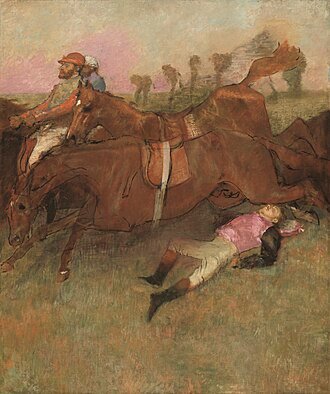
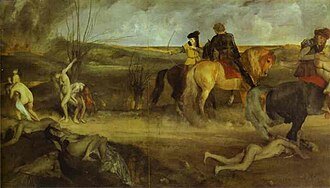
In 1861 he made his first studies of horses while visiting his childhood friend Paul Valpinçon in Normandy. He first exhibited at the Salon in 1865, when the jury accepted Scene of War in the Middle Ages, which drew little attention. Over the next five years he exhibited at the Salon every year, but none of those works was a history painting. His Steeplechase, the Fallen Jockey (Salon of 1866) marked his break with the traditional history painting and his growing interest in contemporary life.
A change of direction with Manet
The main influence behind this shift was Édouard Manet, whom Degas met in 1864. According to an anecdote that may be apocryphal, the two were copying the same Velázquez portrait in the Louvre when they first met. In the years that followed, both artists looked closely at the city and its everyday scenes.
When the Franco-Prussian War broke out in 1870, Degas joined the National Guard to defend Paris, and this kept him away from painting for a time. During rifle practice his eyesight was found to be defective, and for the rest of his life his eye problems were a constant worry. He later blamed them for the unfinished passages in many of his works, an explanation that some colleagues and collectors met with scepticism.
After the war, in 1872, Degas spent an extended period in New Orleans, where his brother René and other relatives lived. He stayed at the home of his Creole uncle on Esplanade Avenue and painted several works there, many of them family portraits. One of them, A Cotton Office in New Orleans, was the only work he sold to a museum during his lifetime, the museum in Pau.
Family crisis and the Impressionist group
Degas returned to Paris in 1873. His father died the following year, and Degas discovered that his brother René had accumulated enormous business debts. To protect the family's reputation he sold his house and an art collection he had inherited to pay them off. From then on he depended on sales of his own paintings for income for the first time in his life. Many of his best-known works date from this decade.
Disappointed with the official Salon, he joined a group of young artists who were organising independent shows, since the jury almost always rejected their work. The group came to be known as the Impressionists. Between 1874 and 1886 it staged eight exhibitions, and Degas took a leading part in organising them, although he had constant disputes with other members. He showed in all but one.
His differences with the landscape painters, especially Claude Monet, ran deep. Degas mocked painting outdoors and felt uneasy with the scandal and publicity his colleagues sought. He also disliked the word Impressionist, which the press had made popular, and he insisted that non-Impressionist artists such as Jean-Louis Forain and Jean-François Raffaëlli be included in the shows. These tensions contributed to the group's disbanding in 1886.
As his finances improved, Degas built a collection of works by artists he admired, among them El Greco, Manet, Pissarro, Cézanne, Gauguin and Van Gogh. Three names dominated the collection: Ingres, Delacroix and Daumier. The final inventory recorded twenty paintings and eighty-eight drawings by Ingres, and thirteen paintings and some two hundred drawings by Daumier, but no Monet.
Dancers, horses and new techniques
Changes in subject matter went hand in hand with changes in technique. His dark palette, which owed something to Dutch painting, gave way to brighter colours and bolder brushstrokes. His first major work featuring dancers was Mlle. Fiocre in the Ballet La Source, shown at the Salon of 1868, and from 1870 such subjects multiplied. Degas showed dancers rehearsing or backstage, as professionals doing a job rather than as decorative figures. These paintings sold well, which encouraged him to paint them more often after his family's ruin.
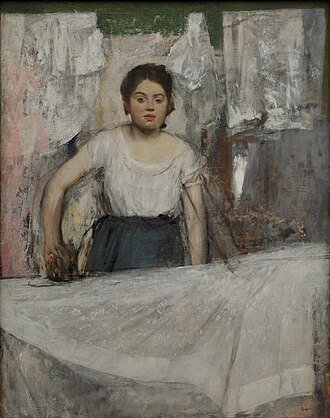
He also painted café life, as in L'Absinthe and Singer with a Glove, and women at work as milliners and laundresses. His pictures often hint at a story without telling it. Interior, also known as The Rape, has puzzled historians who have looked in vain for a literary source, although the scene may simply show a case of prostitution. His dancers have athletic, supple bodies, while his laundresses are heavy and solid, and the difference reflects the work each woman does.
By the late 1870s he had mastered both oil and pastel. The dry medium let him work out forms with ease and use colour freely, and he applied it in complex layers and textures. In the mid-1870s he returned to printmaking, which he had neglected for ten years. He learned from his old friend Ludovic-Napoléon Lepic, an innovator in the technique, and experimented with lithography and monotype. He made around three hundred monotypes in two periods, and often reworked the prints with pastel.
Photography was another stimulus. In the late 1880s he developed a real passion for it. He photographed friends, often by lamplight, and took pictures of dancers and nudes that served as references for his paintings and drawings.
Portraits, nudes and the last years of painting
Portraits, both individual and group, are a central part of his output. Interested in how a person reveals social standing through physiognomy, posture, dress and other attributes, he painted The Bellelli Family, portraits at the Stock Exchange and scenes from the courtroom. In Portraits at the Stock Exchange (1879) he showed a group of Jewish businessmen with features that modern experts regard as anti-Semitic. In 1881 he exhibited two pastels, Criminal Physiognomies, about young men convicted of murder in the so-called Abadie Affair, whose trial he attended with a sketchbook in hand.
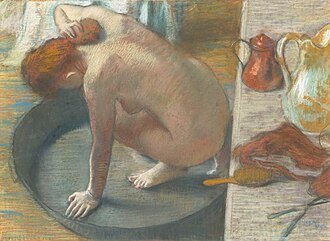
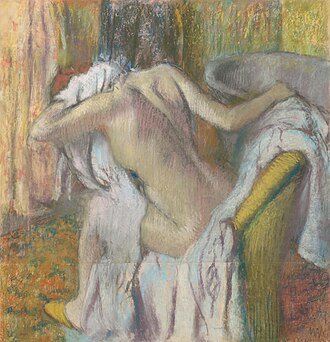
From the late 1880s and through the following decade, his pictures of women bathing, combing their hair or drying themselves became looser. The strokes that model the forms are more free, the backgrounds simpler and the meticulous naturalism of his youth gave way to greater abstraction. Even so, these works make strong use of the colour techniques of Impressionism.
His method was deliberate. He worked indoors, usually in his studio, from memory, photographs or live models. His few landscapes came from imagination or memory. He repeated subjects with variations in composition or treatment, and he said that nothing in art should look like chance. Andrew Forge described his works as prepared, calculated and developed in stages, with endless reflection on how each part fits the whole.
Sculpture and reputation
Degas did not limit himself to painting and drawing. By around 1880 sculpture had become one more field of experiment, though during his lifetime he showed only one piece in public, Little Dancer of Fourteen Years (1881). It was a nearly life-size wax figure with real hair and a cloth tutu. It caused a strong reaction: most critics admired its realism but condemned the ugliness of the girl. J.-K. Huysmans wrote that the statuette had overturned the traditions of sculpture, just as Degas had shaken the conventions of painting.
Its originality lay in turning away from the smooth surfaces of classical sculpture and adding real hair and clothing. These additions heightened the illusion but also raised questions about what counts as real in art. After his death, his heirs found around 150 wax sculptures in his studio. The founder Adrien Hébrard concluded that 74 could be cast in bronze. The Hébrard Foundry produced these bronzes from 1919 to 1936.
Degas's reputation fluctuated during his life. His paintings accepted at the Salon between 1865 and 1870 earned praise from critics such as Jules-Antoine Castagnary. Later, when he joined the Impressionists, the Salon rejected his change of direction, while critics valued his drawings and pastels above all for their graphic quality. The 1886 show of pastel nudes provoked a considerable body of criticism, mostly positive.
Today he is regarded as one of the founders of Impressionism, although his theories and some of his techniques clashed with those of the group. His sense of colour, of moving forms and of dynamic composition inspired other members. Degas had no formal pupils, but he influenced Jean-Louis Forain, Mary Cassatt and Walter Sickert, and Henri de Toulouse-Lautrec admired him greatly.
Private life, politics and death
Degas held that art should be kept apart from personal life. He never married and lived discreetly. He was known for his wit, which could be cruel. The novelist George Moore called him an old curmudgeon, and Degas himself cultivated the image of a misanthropic bachelor. Politically conservative, he opposed social reform and showed little interest in technological novelties such as the telephone.
His anti-Semitism grew stronger during the Dreyfus Affair, which divided France from the 1890s into the early 1900s. By the mid-1890s he had broken off relations with all his Jewish friends and refused to hire models he thought might be Jewish. He remained a member of the anti-Dreyfusard, anti-Semitic circles until his death.
His eyesight worsened after 1890, and in his last years he was almost blind. He worked in pastel until the end of 1907 and is believed to have continued making sculptures until 1910. In 1912 he effectively stopped working, when the planned demolition of his house on the rue Victor Massé forced him to move. He died alone in Paris in September 1917, wandering the city's streets.
Legacy
Degas's works are held in museums and private collections around the world, and he is one of the most sought-after artists in the international art market. Recent major retrospectives, including those devoted to his drawings and sketchbooks, to his treatment of the nude and to his friendship with Mary Cassatt, have reassessed his career. The asteroid 6673 Degas is named in his honour.
Timeline
- 1834
- Born in Paris on 19 July.
- 1845
- Begins schooling at the Lycée Louis-le-Grand at age eleven.
- 1853
- Takes his baccalauréat in literature and enrols at the Faculty of Law in Paris.
- 1855
- Meets Ingres and is admitted to the École des Beaux-Arts.
- 1856
- Travels to Italy, where he stays for three years.
- 1859
- Moves into a Paris studio and begins work on The Bellelli Family.
- 1861
- Makes his first studies of horses in Normandy.
- 1865
- Exhibits at the Salon in Paris for the first time.
- 1866
- Shows Steeplechase, the Fallen Jockey, a sign of his break with history painting.
- 1870
- Joins the National Guard during the Franco-Prussian War and is found to have an eye defect.
- 1872
- Spends an extended period in New Orleans with his family.
- 1874
- His father dies and the debts of his brother René come to light; he takes part in the first Impressionist exhibition.
- 1876
- Takes part in the Impressionist exhibition of that year and paints ballet and café-concert scenes.
- 1881
- Shows Little Dancer of Fourteen Years, the only sculpture he exhibits in his lifetime.
- 1886
- The Impressionist group disbands after its eighth exhibition.
- 1890
- His eyesight deteriorates markedly in the following years.
- 1907
- Works in pastel until the end of this year.
- 1912
- Effectively stops working when he is forced to move because his house is demolished.
- 1919
- The Hébrard Foundry begins casting bronzes from his wax sculptures.
- 1917
- Dies in Paris on 27 September.
Works (127)




















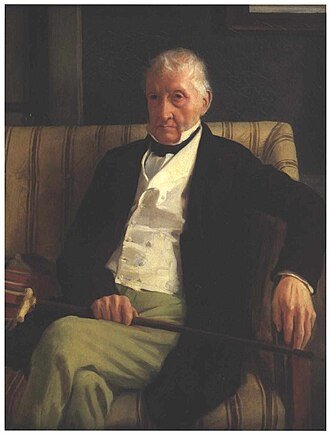


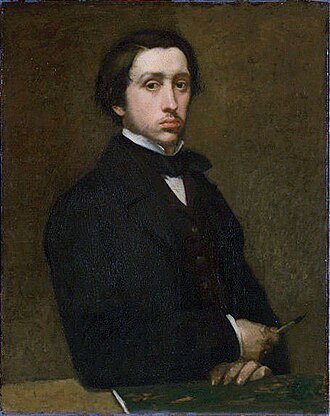
Edgar Degas painted this self-portrait in 1854, when he was still a young man. The painter appears beside a piece of charcoal, a detail that points to his work as a draftsman. The image is oil on paper, later mounted on canvas, a support that suggests a study rather than a large public work. It is now held at the Musée d'Orsay in Paris.

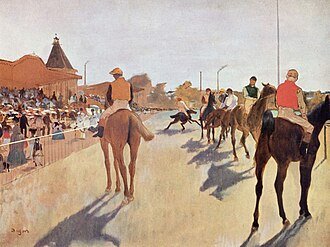
In 1874 Degas painted this racecourse scene, in which amateur jockeys gather beside a carriage. A woman in a hat, a sloping hill and, in the distance, smoke from a train give the picture its everyday, outdoor character. Now in the Musée d'Orsay, it shows an ordinary leisure moment rather than a heroic subject.
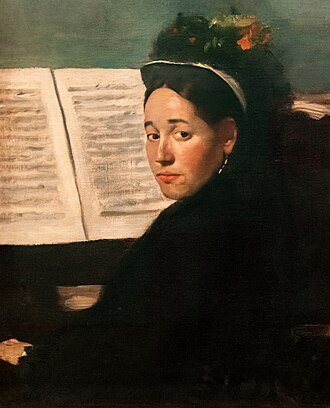
A portrait of Marie Dihau, a pianist, seated at the piano with an open score and a flowered hat. Degas concentrates on the figure and the sitter's concentrated gesture, while the instrument and the music fill the rest of the canvas. Painted in oil on canvas in 1869, this small work reveals his early interest in intimate portraiture of musicians.


Degas painted Eugénie Fiocre, a dancer shown in costume for the ballet La Source, in which she performed. Executed in oil on a large canvas, the work places the performer within a theatrical setting, a subject Degas returned to often. Like his other paintings of ballet, it joins the portrait of a specific figure with an observation of the stage.

Painted by Edgar Degas in 1899, this large oil on canvas shows, as its title states, four dancers. Dance was one of the painter's recurring subjects, which he returned to again and again. Based on the available information, the work fits within his wider interest in movement and the body on stage.

Portrait of Edmond Duranty, painted by Edgar Degas in 1879, combines pastel and gouache on canvas, a mixed-media approach in which both materials are layered on the fabric. Its large, almost square format, roughly 128 by 129 centimetres, gives the portrait a substantial presence. The work is held in the Burrell Collection.


Edgar Degas painted this oil on canvas in 1874. Its central subject is racehorses, which, as the title indicates, are set at Longchamp. Today the work is held by the Museum of Fine Arts, Boston. The available information does not clarify its commission or finer details of its composition.


Edgar Degas painted this large oil on canvas in 1861. It shows Semiramis, a legendary figure linked to Babylon, alongside a war chariot, a horse and the Euphrates river. A woman with a flower and a domestic worker also appear in the scene. The work is classed as religious art and is held at the Musée d'Orsay.


Portrait of Joseph-Henri Altès, painted by Edgar Degas in 1868 in oil on canvas. It is a small work, about 27 by 21.6 centimetres, showing a man. The available information says nothing about its commission or composition, so visitors are best served by looking closely at the painting itself and its handling of paint.

Self-portrait by Edgar Degas, dated 1857 and executed in oil on paper. Its large dimensions are notable for a paper support, and it is held at the J. Paul Getty Museum. The available information does not clarify the circumstances in which it was painted or the artist's compositional choices, so it is best approached cautiously, focusing on what the image itself shows.

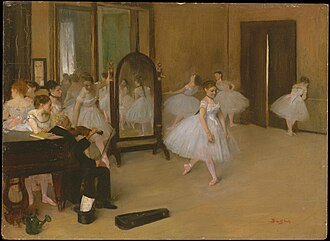
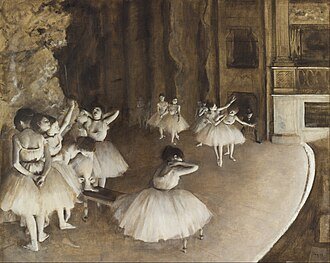
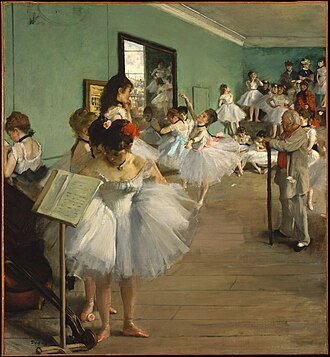
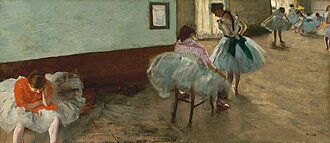
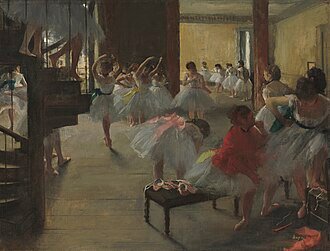
Degas painted this ensemble of a dance rehearsal around 1878, showing dancers resting or preparing beside the barre while a teacher watches over them. Working in oil on canvas, he arranged the figures in an off-centre composition with cropped bodies and a diagonal sense of space, giving the scene an almost snapshot-like immediacy of everyday rehearsal.

Oil on canvas portrait dated 1860 by Edgar Degas. The title, La Savoisienne, suggests a link to Savoy, an Alpine region in southeastern France, but the identity of the sitter and the circumstances of the commission are not known with certainty. Any broader reading of its composition or symbolism would therefore be speculative.


This work by Edgar Degas, dated 1882, belongs to the collection of the Alte Nationalgalerie in Berlin. Without reference texts at hand, its subject, commission and the circumstances of its making cannot be stated with certainty. What can be noted is that Degas, a central figure of Impressionism, often explored figures in motion, unexpected framing and artificial light, traits worth comparing with the image itself when viewing it.


Late work by Edgar Degas, dated 1905, showing ballet dancers. It is executed in pastel on paper, mounted on canvas, a medium the artist often used to capture movement and light on figures in performance. Its late date places it within the final stage of the painter's career.

Landscape at the Seashore is a work by Edgar Degas held at the Museo Soumaya. The available record offers little beyond that, so its date, commission and technique cannot be stated with confidence. Its title points to a coastal scene, with the shoreline as its main subject, though its composition and colour are best judged by looking at the painting itself.

This painting by Edgar Degas, made in oil on canvas in 1884, shows women busy with ironing, a domestic and laborious task. The picture focuses on the everyday gesture of work rather than on a dramatic action. Beyond its date and technique, the available record offers no details about its commission or reception.

A pastel on paper dated 1850, showing a man wearing an opera hat, a garment linked to formal dress and evening outings. The available information does not identify the sitter or explain the circumstances behind the commission, so the picture is best read through its medium and its restrained subject.

Oil sketch by Edgar Degas dated 1857, made on paper and mounted on canvas, which suggests a study or preparatory work rather than a painting intended for display. Its small format and quick brushwork offer a glimpse of how the artist explored composition and light in his early years.
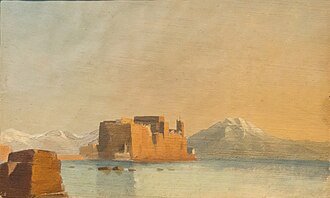
This small oil on cardboard, dated 1860, is attributed to Edgar Degas. Its modest size suggests a study or an intimate piece rather than a large composition. Without reference texts, the subject depicted and the circumstances of its creation cannot be confirmed at this time.

Portrait of Gustave Moreau, painted by Edgar Degas in 1860. The small canvas is an oil painting, and it belongs to the portrait genre. The available information is limited, so any reading of its pose, setting or purpose remains tentative. Its size and medium are the main facts we can state with confidence about this work.

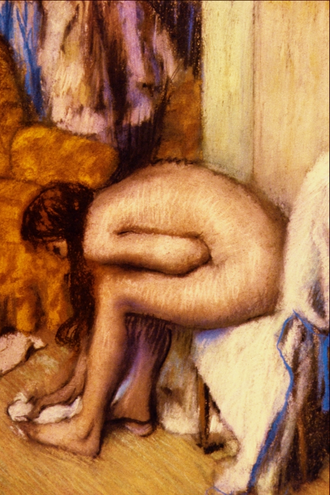
A seated nude woman dries the back of her neck with a towel, her back turned to us and her hair pulled into a ponytail. The scene captures an intimate, everyday moment after bathing, treated as a genre scene. Degas worked in pastel on cardboard, and the bathtub hints at the domestic setting.

Degas shows a woman seated in a bathtub, seen from behind, as she sponges one of her legs. The pastel creates an intimate atmosphere: the curtain, the window and the chest of drawers place the scene in a domestic space. Degas treats the nude as an everyday gesture rather than an idealized pose.

A pastel on paper and board dated 1887, in which Degas shows a nude woman seated on a sofa, absorbed in combing her light chestnut hair. She is seen almost from behind, her attention fixed on the comb moving through her locks, while her body is built up with quick strokes and warm tones. Degas returned often to intimate scenes of grooming, in which the viewer seems to catch the model unaware.

Portrait of Henri Rouart standing in front of his factory, wearing a tall top hat. Degas painted it in 1875 in oil on canvas, and it is now held at the Carnegie Museum of Art. By placing the sitter before an industrial building rather than in a private interior, the work probably emphasizes his connection to labour and business life.

Painted in oil on canvas in 1873, this genre scene shows a laundress, as its title indicates. The small format suggests a close view of everyday work, though the record says nothing about who commissioned it or where it was meant to hang. The subject places a routine domestic task at the center of the image, which may suggest the painter's attention to ordinary life and simple gestures.

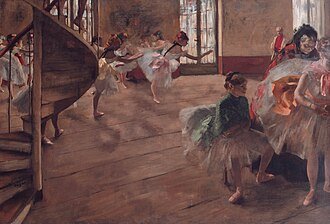
Edgar Degas painted this oil on canvas in 1874, showing a ballet dancer in a rehearsal setting. The artist returned often to the world of dance, and here he seems more interested in capturing movement and the preparation behind a performance than the performance itself.

Painted by Edgar Degas in 1890 on a small panel, this genre scene shows a harlequin and Columbine, stock characters of the commedia dell'arte, placed within the world of ballet. Its modest size and oil-on-panel technique suggest an intimate, studio-scale piece rather than a large public canvas. The work is now held at the Musée d'Orsay.

A ballerina in a tutu and low-cut bodice, her brown hair tied in a ponytail, fills the foreground of this ballet scene. Behind her, a group of figures and a painted stage flat seem to place the action on a theatre stage. Degas painted it in 1890 as a genre scene centred on people in the theatre.

Painted in 1865, this oil on canvas shows Edgar Degas seated and wearing a hat, in a restrained arrangement. The title also names Évariste de Valernes, but the available description covers only Degas, so his role in the scene cannot be confirmed. Classed as both portrait and self-portrait, the work suggests Degas depicted himself, though the circumstances behind it are not documented here.


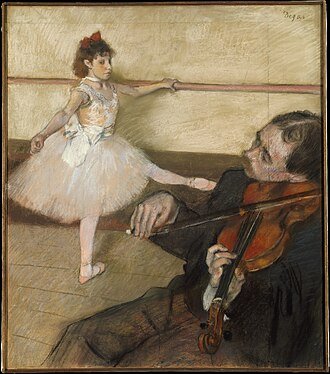
Edgar Degas painted this oil on canvas in 1877, showing dancers rehearsing beside the barre in a dance studio. Rather than a performance, the scene focuses on preparation: the figures stretch, lean on the barre and repeat training movements.
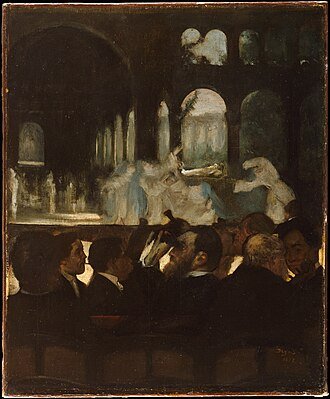
Edgar Degas painted this 1871 scene based on the ballet within Meyerbeer's opera Robert le Diable. The canvas focuses on dancing and the staging of the performance, with a male figure among the performers, and dwells on the movements and gestures of the dancers.
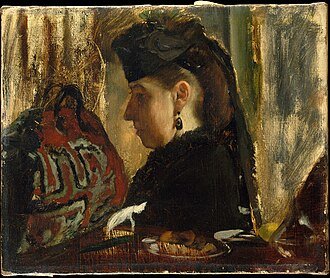
Portrait of Marie Dihau (1843–1935), painted by Edgar Degas in 1867 on a small canvas. The sitter is shown with a handbag, a detail the painter includes in the scene. The available information says little more about the commission or the circumstances in which the picture was made, so it is best viewed with caution.

Oil on canvas dated 1860 and attributed to Edgar Degas, classed as a portrait. A young woman appears beside an ibis, the bird that gives the work its name. Without further documentation, the commission and the meaning of the bird cannot be confirmed, so it is best read simply as a pairing of a figure and a bird.

The title suggests a person recovering from an illness, though the scene is not described. The work is an oil on canvas dated 1872 and is held by the J. Paul Getty Museum. With the available information, its composition and original context cannot be specified.

This view shows the town of Saint-Valéry-sur-Somme, a coastal settlement at the mouth of the Somme river in northern France. Dated 1896 and painted in oil on canvas, it is listed as a landscape with a town. Degas is best known for his figure scenes, so his landscapes form a smaller part of his output.

Portrait of Achille De Gas dressed in a cadet's uniform, painted in oil on canvas in 1856. Based on the available information, the work belongs to the portrait genre and presents the sitter through a garment that signals his military training. It probably dates from the early years of Edgar Degas's career, though details about its commission are limited.

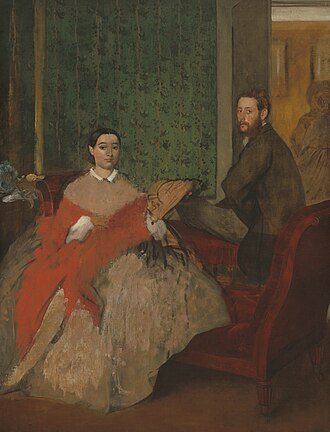
Double portrait in oil on canvas by Edgar Degas, painted in 1865. It shows Edmondo and Thérèse Morbilli together. The available information does not clarify the commission or the circumstances of its making, so the painting is best read mainly through what it depicts.

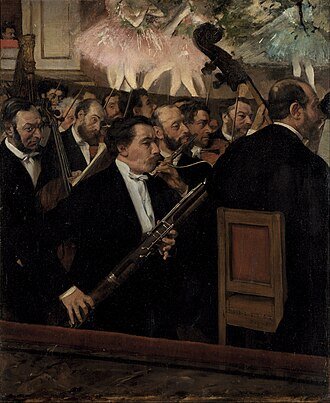
Degas places the viewer in an orchestra pit, with the musicians seen from close range and cropped at the edges. The title identifies Désiré Dihau, shown in the foreground, as the work's central figure. The painting stands out for its unconventional composition and its focus on the players' concentration as they perform.

Edgar Degas painted this oil-on-canvas portrait in 1868. Its title names two women, Madame Lisle and Madame Loubens, but little is known about their relationship to the artist or how the commission came about. The work is now held by the Art Institute of Chicago, where visitors can see it today.

Edgar Degas painted this work in 1860, showing young Spartan girls confronting boys, as its title indicates. Executed in oil on canvas, it appears to stage a scene of rivalry or challenge between the two groups, set within Spartan culture. The available records do not clarify the commission or its original reception.

Edmondo and Thérèse Morbilli, painted by Edgar Degas in 1865 in oil on canvas. It shows a young couple in an interior, with a restrained composition that keeps attention on the two figures. The record suggests a portrait of two specific people, though no further reliable details about its context are available.
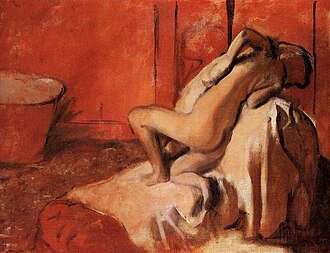
Degas painted this scene around 1896, when the figure of a woman seen from behind, drying herself with a towel, had become one of his recurring subjects. She is absorbed in the everyday act of washing, never looking at the viewer, which heightens the sense of intimacy observed from outside. The painting pairs a careful treatment of the figure with broad areas of colour and close attention to the movement of the body.
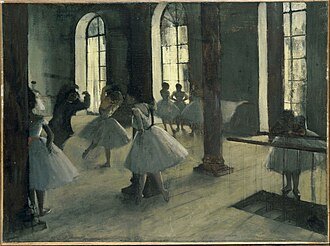
Dance Rehearsal, painted by Edgar Degas in 1870 in oil on canvas, takes its title from a rehearsal scene, a subject the artist returned to many times. Without reference texts documenting its commission, composition or meaning, any reading must stay cautious; it can be seen as a glimpse of the work behind a performance.

This pastel by Edgar Degas, dated around 1890, shows a harlequin caught mid-dance, a figure common in the theatre and circus scenes that the painter often observed. Made on paper with pastel, the work relies on quick strokes and layered colour to suggest motion and light. The record offers no further details about its commission or history, so it is best to focus on what is visible: the dancer's movement and the luminous overall effect.
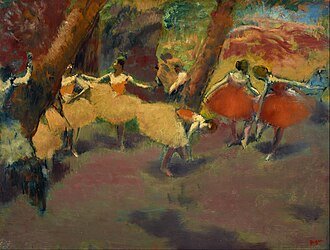

Edgar Degas painted this work in 1876. It shows a ballet drawn from Meyerbeer's opera Robert le Diable, with dancers on stage and the orchestra close by. Degas was drawn to theatres and their backstage worlds, and here he views the performance from a vantage point near the audience. The oil on canvas reveals his interest in light and the movement of bodies.


Portrait of Eugène Manet, an oil on canvas by Edgar Degas dated 1874. The available record identifies the sitter as Eugène Manet and says nothing about how the commission arose or where the picture was first shown. Its interest therefore rests mainly on its direct subject: a single named man painted by an artist associated with Impressionism, in a straightforward portrait format.

Painting by Edgar Degas dated 1864, made in oil on canvas and held at the Fitzwilliam Museum. Its subject comes from the Bible: the confrontation between the young David and the giant Goliath, narrated in the Old Testament. The available information does not allow us to say more about its commission or composition.


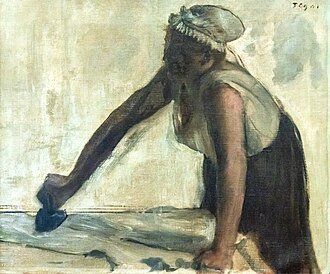
Oil on canvas by Edgar Degas, dated 1876 and held at the Musée Angladon. The available record does not specify its subject or the circumstances in which it was commissioned or made, so its content cannot be confirmed here. Its date places it in the 1870s, a central period in Degas's career.


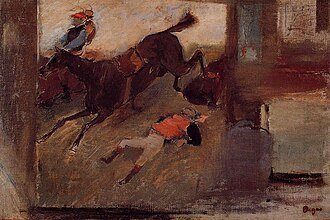
Painted in 1880 by Edgar Degas, this work presents a studio interior in which, according to its title, a steeplechase appears. Its technique is oil on canvas and wood. Without further references, it is best to describe only what is visible: an enclosed workshop space alongside an equestrian scene, though how they relate is unclear.

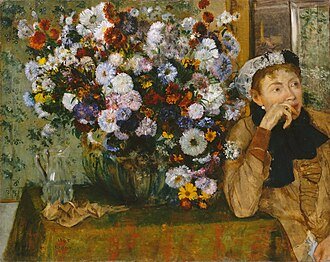
Portrait of a woman painted by Edgar Degas in 1892 in oil on canvas. The sitter is the sole focus of the picture, placed at its centre. Few details about its commission or early history are recorded, so the painting is best approached through its individual portrayal of a single woman and the handling of paint that Degas brought to the genre.

The title points to the biblical story of Jephthah and his daughter, told in the Book of Judges. The record describes an oil on canvas of very large format, dated 1859, when Degas was still in his twenties. Without reference texts, its commission, reception and original setting cannot be established, so it is best seen as an early, ambitious work in its scale.

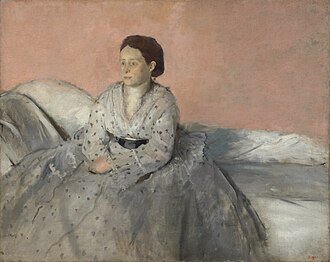
Portrait of Léontine De Nittis, wife of the Italian painter Giuseppe De Nittis, painted by Edgar Degas in 1872. The record does not describe how the commission or sittings came about, so it is best to focus on what is visible: a seated female figure rendered in a restrained palette, with attention to pose and expression typical of the period's portraiture.

This oil-on-paper work shows a woman at a window. Because paper is a lighter and less formal support than canvas, the piece may have been a study or a more private image, though the available record does not confirm this. It is held today at the Courtauld Institute of Art in London.
Where to see the work
- Musée d'Orsay Paris · 35
- Metropolitan Museum of Art New York City · 12
- Galería Nacional de Arte Washington, D.C. · 7
- National Gallery London · 5
- Art Institute of Chicago Chicago · 4
- Philadelphia Museum of Art Philadelphia County · 3
- Museum of Fine Arts Boston Boston · 3
- Museum of Fine Arts of Lyon Lyon · 2
- National Galleries Scotland City of Edinburgh · 2
- Harvard Art Museums Cambridge · 2
- Burrell Collection Glasgow City · 2
- The Phillips Collection Washington, D.C. · 2
- J. Paul Getty Museum Los Angeles · 2
- Musée Angladon Avignon · 2
- Norton Simon Museum Pasadena · 2
- Museum Langmatt Sidney and Jenny Brown Foundation Baden · 2
- Foundation E.G. Bührle Collection Zurich · 1
- Musée des Beaux-Arts de Pau Pau · 1
- Hermitage Museum Saint Petersburg · 1
- Walters Art Museum Baltimore · 1
Teachers and pupils
Studied with
- Hippolyte Flandrin 1809–1864
- Louis Lamothe 1822–1869
- Paul Flandrin 1811–1902
Curiosities
A piece of advice from Ingres
Degas kept for the rest of his life the advice Ingres gave him in 1855: draw lines, and still more lines, from life and from memory. He treated it as a rule of the craft. This discipline of drawing explains the precision of his figures and the firmness of their outlines, even in pictures that look spontaneous.
Copies of details
During his stay in Italy, Degas copied works by Michelangelo, Raphael and Titian, but he usually chose one detail that caught his attention, a secondary figure or a head, and treated it as a portrait. In this way he moved away from conventional copying and began practising the fragmentary way of looking that would later characterise his work.
A glance that looks like chance
Degas insisted that nothing in art should look like chance. Yet many of his scenes resemble snapshots taken on the fly, with figures cut off by the edge of the picture. The paradox reveals how he worked: from studies, memory and models, he carefully composed what the viewer perceives as a single moment.