Interior
Edgar Degas, 1868
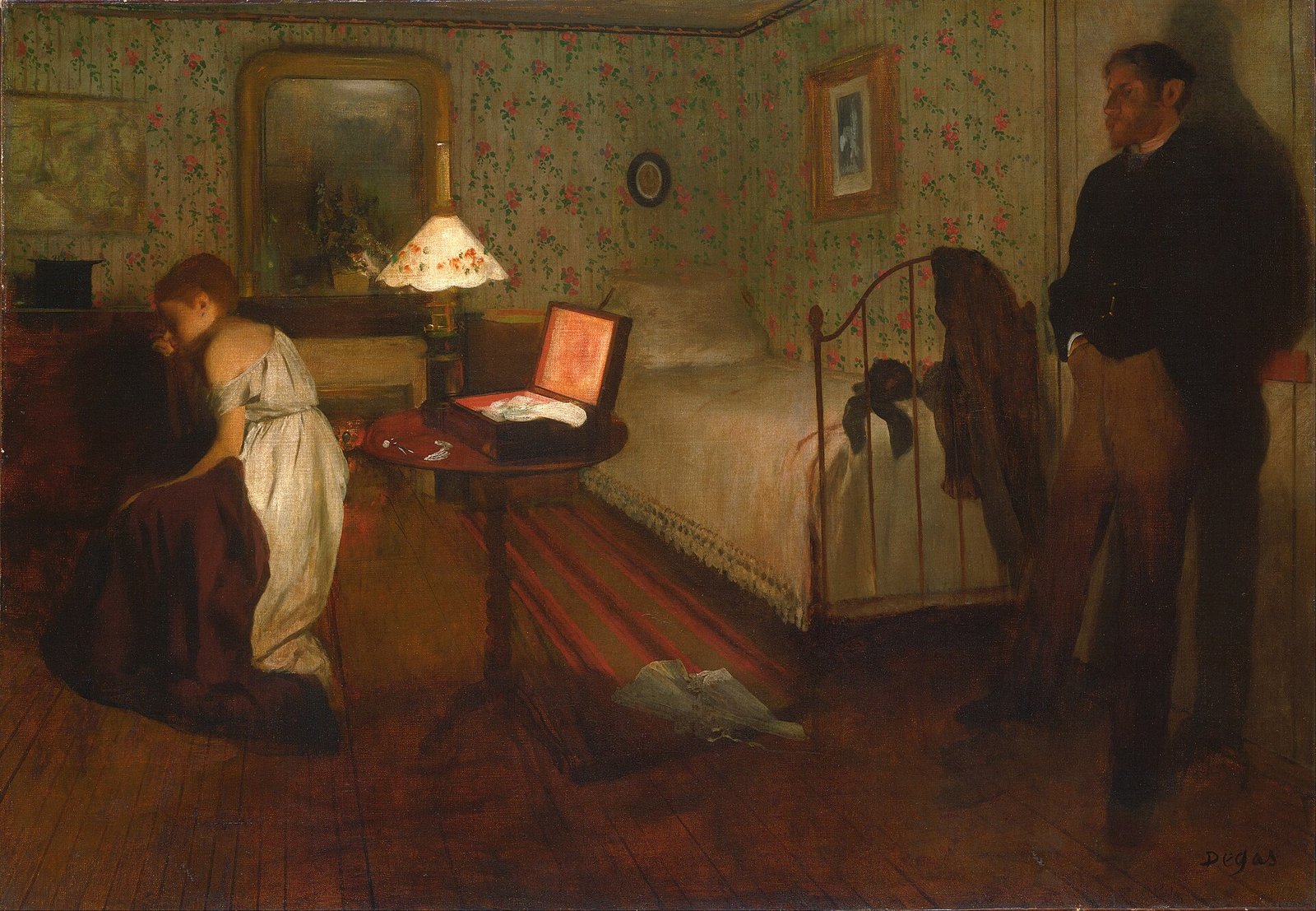
Interior, an oil on canvas by Edgar Degas painted around 1868-1869, is one of the artist's most puzzling scenes. In a bedroom lit by a lamp, a standing man leans against the door in the shadows while he watches a woman seated in her underclothes, turned away from the light and probably weeping. On the table, the silk lining of a sewing box and a necklace catch the glow; at the foot of the bed lie her hat and clothes, and a corset rests on the floor. Nothing is resolved openly: the tension hangs in the silence.
The arrangement has a stagey quality. The objects seem placed like props, and the dramatic light heightens the sense of watching a performance rather than a chance moment. That theatricality explains why historians long sought a literary source. Georges Rivière first proposed a novel by Louis Edmond Duranty, an idea that specialists on Duranty did not accept. A passage from Zola was later considered, and in 1976 Theodore Reff linked the scene to the opening of chapter 21 of Thérèse Raquin, an 1867 novel about an affair and a murder disguised as an accident. The identification won wide acceptance, although Reff admitted details the text does not mention, such as the sewing box or the corset.
In 2007 Felix Krämer challenged that reading. He noted that Zola's bedroom is a marital one, whereas here the bed is narrow, and that the man's top hat, placed at the back, suggests he has not quite entered the room. Krämer proposed instead an 1841 lithograph by Paul Gavarni from the Lorettes series, whose poses and objects resemble the painting. In his view, the sewing box and the traces of blood on the bed point to prostitution and the aftermath of sexual violence rather than to a marital quarrel.
The title is also uncertain. Friends of the painter called it Le viol, and Degas only showed it as Intérieur in 1905. He himself described it as "my genre painting", which suggests he saw it as different from his usual subjects. Its influence can be seen in his protégé Walter Sickert, in works such as the Camden Town Murder series and Ennui, where couples share a similar dramatic tension.
- Painter
- Edgar Degas
- Date
- 1868
- Medium
- oil paint, canvas
- Dimensions
- 81 × 114 cm
- Museum
- Philadelphia Museum of Art, Philadelphia County
- Genre
- genre art, interior view
- Depicts
- lamp, table, carpet, room, fireplace, painting, bed, woman
More works by Edgar Degas