Mystic Crucifixion
Sandro Botticelli, 1500

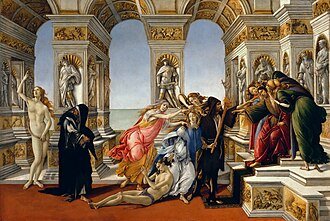
Mystic Crucifixion is a painting by Sandro Botticelli dated to around 1500, executed in egg tempera and oil on a panel later transferred to canvas, and now held in the permanent collection of the Fogg Art Museum at Harvard University. It belongs to the Florentine Renaissance and comes from the late phase of Botticelli's career, when he moved away from the mythological serenity of his earlier work toward a more symbolic and visionary idiom.
The scene pairs the traditional theme of the Crucifixion with a backdrop that unmistakably shows Florence, including the dome of Santa Maria del Fiore and Giotto's bell tower. Christ hangs at the centre, while Mary Magdalene, clinging to the base of the cross, cries out in anguish. To the left, God appears in a bright halo holding an open book and sends forth angels bearing cross-marked shields, who confront demons emerging from a dark cloud and hurling flames. An angel strikes a beast with a whip; it is probably the marzocco, the lion emblem of the city, and a second animal emerges from beneath the woman's robe.
The most common reading treats the picture as an apocalyptic allegory of the events surrounding the torture and execution of Girolamo Savonarola in 1498, which deeply affected Botticelli. Magdalene would stand for a penitent Florence which, through divine intervention, averts the dangers closing in on it. The work has also been linked to the threat posed by Cesare Borgia to the city in 1502, though that connection rests on historical context rather than explicit evidence in the painting.
Its significance lies in showing how Botticelli's religious painting became a vehicle for reflection on the city and its fate, through a dense composition, strongly contrasted colour and an elaborate symbolic charge.
- Painter
- Sandro Botticelli
- Date
- 1500
- Medium
- tempera, oil paint, canvas
- Dimensions
- 74 × 51 cm
- Museum
- Fogg Museum, Cambridge
- Movement
- Early Renaissance
- Genre
- religious art
- Depicts
- waist-length hair, Jesus Christ, woman, Mary Magdalene, man
More works by Sandro Botticelli