Echo and Narcissus
Nicolas Poussin, 1629

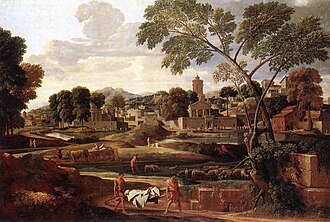
Echo and Narcissus is an oil on canvas that Nicolas Poussin painted between 1627 and 1628, during the years when he was developing the classical style for which he is known. The subject comes from Ovid's Metamorphoses and brings together two episodes of the myth: the nymph Echo, who wastes away with grief after being rejected by Narcissus until only her voice remains, and the young man who, punished by Nemesis, falls in love with his own reflection in a lake and dies beside the water.
Rather than showing the moment of transformation, Poussin depicts a quiet pause in an idyllic landscape. In the foreground lies Narcissus, his head already surrounded by the flowers that will carry his name. Behind him, to the right, stands Eros, the god of love, whose presence points to the cause of the tragedy. On the left, seated on a rock, is Echo, described as an elegiac and immaterial apparition, more fading presence than solid body, which deepens the melancholy of the scene.
The composition is orderly and balanced, with the figures arranged in clearly defined planes and a restrained palette, features typical of the classical painting Poussin cultivated in these years. More than a dramatic narrative, the picture offers a calm meditation on unrequited love, desire and loss, handled with a restraint that would become a hallmark of the artist.
The story of Echo and Narcissus had a long afterlife in European culture and also inspired Gluck's opera of the same name, a sign of the myth's enduring appeal. The painting is now held in the Louvre in Paris, where it stands as a fine example of how French seventeenth-century painting absorbed classical literature.
- Painter
- Nicolas Poussin
- Date
- 1629
- Medium
- oil paint, canvas
- Dimensions
- 74 × 100 cm
- Museum
- Louvre Museum, Paris
- Movement
- Classicism
- Genre
- mythological painting
- Depicts
- Narcissus
More works by Nicolas Poussin