Et in Arcadia ego
Nicolas Poussin, 1638

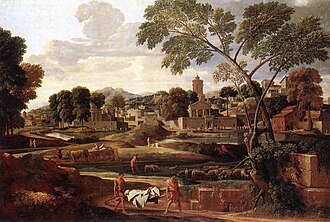
Et in Arcadia ego is one of the best-known works by Nicolas Poussin and a key example of French Classicism in the seventeenth century. Painted between 1637 and 1638, it shows three idealised shepherds and a woman gathered before a plain stone tomb set in a calm, luminous landscape. The inscription that gives the picture its title is carved on the tomb, and the figures read it with a meditative rather than alarmed air: one points at the letters while the others lean in to make them out.
The Latin phrase works as a memento mori, a reminder of death. Its exact meaning has been debated. One reading takes it as "I, Death, reign even in Arcadia," while Poussin's biographer André Félibien suggested that the person buried in the tomb had once lived in Arcadia, that is, had enjoyed the pleasures of earthly life. The first interpretation is the more widely accepted, and either way the effect is an ironic contrast: the shadow of death falls over a world of leisure and joy.
The theme comes from literature. Virgil placed the idealised rustic figures that Theocritus had introduced in his idylls within Arcadia, an imagined region, and the motif of a tomb bearing a commemorative inscription appears in his Eclogues. Centuries later, Sannazaro in the Renaissance and writers in England helped fix the image of a lost Arcadia remembered with nostalgia. Guercino had already painted a version with a skull visible, more explicit than Poussin's.
Poussin's painting is more restrained than Guercino's, and its figures, more contemplative, are arranged in a geometric and balanced composition. An earlier version, now at Chatsworth, shows the shepherds more active, with a more sensual pose and a style closer to the Baroque. The Louvre version, by contrast, is the most famous for its serenity and for the way it turns a meditation on death into a scene of calm.
- Painter
- Nicolas Poussin
- Date
- 1638
- Medium
- oil paint, canvas
- Dimensions
- 85 × 121 cm
- Museum
- Louvre Museum, Paris
- Movement
- Classicism
- Genre
- mythological painting
- Depicts
- broad-leaved tree, reading, woman, shepherd, man, mountain
More works by Nicolas Poussin