
Nicolas Poussin (Les Andelys, Normandy, 1594 – Rome, 1665) was a French painter who spent most of his working life in Rome and is regarded as the founder and leading exponent of French classical painting in the seventeenth century. His works, mostly on religious, mythological and historical subjects, are marked by clarity of expression, logic of composition and order. Preferring design to colour, he regarded drawing as the foundation of painting, and in his later years he gave growing prominence to landscape. His influence lasted into the twentieth century, when classically minded artists such as Jacques-Louis David, Ingres and Paul Cézanne took him as a point of reference.
Early Years in Normandy and Paris
According to his first biographer, Giovanni Pietro Bellori, Poussin was born near Les Andelys in Normandy and received an education that included some Latin, a skill that would serve him well later. His early drawings attracted the attention of Quentin Varin, a local painter, although his biographers do not mention formal training in Varin's studio. Some of his later works nevertheless show Varin's influence in their storytelling, the precise expression of faces, and finely painted drapery in rich colour. His parents seem to have opposed a painting career, and around 1612, at the age of eighteen, he set off for Paris.
He arrived in a city where art was flourishing, thanks to royal commissions from Marie de' Medici for the decoration of her palace and to wealthy Parisian merchants who bought pictures. Poussin was not a member of the powerful guild of master painters and sculptors, which held a monopoly over most commissions and took legal action against outsiders who tried to enter the trade. His early drawings nevertheless won him places in the studios of established painters. He spent about three months with the Flemish painter Ferdinand Elle, who worked almost exclusively as a portraitist, a genre that held little interest for him. He then probably spent a month with Georges Lallemand, whose lack of attention to precise drawing and to the articulation of figures displeased him. Poussin also did not fit well into the studio system, in which several painters worked on one canvas, and from then on he preferred to work very slowly and alone.
Little is known about his life in Paris. Court records show that he accumulated considerable debts that he could not pay. He studied anatomy and perspective, but the most important event of this first stay was his discovery of the royal art collections, thanks to his friendship with Alexandre Courtois, valet de chambre to Marie de' Medici. There he saw for the first time engravings after Giulio Romano and, above all, Raphael, whose work would have an enormous influence on his style.
Failed Journeys to Rome and the Friendship with Marino
He first tried to reach Rome in 1617 or 1618, but got only as far as Florence, from where, as Bellori reports, a mishap sent him back to France. On his return he began painting for Paris churches and convents. In 1622 he tried again and again stopped short, this time at Lyon. That same year he received his first major commission: the Jesuits asked him for a series of six large paintings to celebrate the canonization of their founder, Saint Francis Xavier. The originality and energy of these works, now lost, brought him further commissions.
Giambattista Marino, the court poet of Marie de' Medici, engaged him to make a series of fifteen drawings, eleven illustrating Ovid's Metamorphoses and four showing battle scenes from Roman history. These so-called Marino drawings, now at Windsor Castle, are among the earliest identifiable works by Poussin. Marino's influence brought further commissions, including decorations for the Luxembourg Palace and a painting of the death of the Virgin, now lost, for the family chapel of the first Archbishop of Paris, Jean-François de Gondi. The friendship with Marino, and his work illustrating the poet's verse, which drew him to Ovidian themes, are thought to have underpinned or at least reinforced the marked eroticism of his early work.
Marino took him into his household and, when he returned to Rome in 1623, invited Poussin to join him. Poussin first finished his outstanding commissions in Paris and reached Rome in the spring of 1624, at the age of thirty.
Rome: Difficult Beginnings and the Barberini Patronage
Rome was still the great artistic centre of Europe. The new pope, Urban VIII, elected in 1623, was determined to keep it that way, and artists from across Europe gathered there. Poussin could study Raphael and other Renaissance painters in churches and convents, as well as the work of the Carracci, Guido Reni and Caravaggio, whose painting he detested, saying that Caravaggio had been born to destroy painting. He attended the Academy of Domenichino to study the nude, and frequented the Accademia di San Luca, where the leading painters of Rome met. Its head in 1624 was another French painter, Simon Vouet, who first offered him lodging.
Through Marino he met Cardinal Francesco Barberini, brother of the new pope, and Cassiano dal Pozzo, the cardinal's secretary and a keen scholar of ancient Rome and Greece, who both became important patrons. The first years were hard, however. Marino left Rome for Naples soon after Poussin arrived and died there in 1625. Barberini was appointed papal legate to Spain and also left, taking Dal Pozzo with him. Poussin fell ill with syphilis and, refusing to enter a hospital where care was very poor, was unable to paint for months. He survived by selling the pictures he had for a few scudi.
He was taken in and cared for by the family of a cook named Jacques Dughet, and by about 1629 he had largely recovered. On 1 September 1630 he married Anne-Marie Dughet, the cook's daughter. His two brothers-in-law were artists, and Gaspard Dughet later took Poussin's surname. When Barberini and Dal Pozzo returned to Rome in 1626, their patronage brought him two major commissions. The first was The Death of Germanicus (1627–1628) for Cardinal Barberini, a painting that draws learnedly on textual and visual sources, including Tacitus's Annals and the Meleager sarcophagus. Its stoic restraint and pictorial clarity established his reputation as a major artist.
Public Commissions and the Turn to Private Patrons
The success of Germanicus led to a more prestigious commission: an altarpiece of the Martyrdom of Saint Erasmus for the chapel of St Erasmus in St Peter's Basilica, now in the Vatican Pinacoteca. The Fabbrica di San Pietro had first given the commission to Pietro da Cortona, who had produced only preliminary designs before being moved to another project. Thanks to Dal Pozzo's influence, Poussin was chosen to paint the altarpiece following Cortona's original design. With its plunging diagonal composition and strong narrative drama, the Martyrdom is Poussin's most openly Baroque work. Yet for reasons that remain unclear, it did not please officials and brought him no further papal commissions, making it his only one.
The disappointment, together with the loss of a competition for a fresco cycle in San Luigi dei Francesi, persuaded him to give up large public commissions and their competitions, content restrictions and political manoeuvring. He turned instead to private collectors, for whom he could work more slowly and with greater control over subject and style. His early private patrons included, besides Barberini and Dal Pozzo, the canon Gian Maria Roscioli, Cardinal Giulio Rospigliosi, for whom he painted a second version of Et in Arcadia ego, and Cardinal Luigi Omodei, who received the Triumphs of Flora (c. 1630–1632, Louvre). He painted the Massacre of the Innocents for the banker Vincenzo Giustiniani, and Cardinal Richelieu commissioned several Bacchanals. Dal Pozzo became the owner of the first series of the Seven Sacraments, painted in the late 1630s.
Buoyed by this commercial success, in 1632 he bought a life interest in a small house on the Via Paolina (Babuino), near the Trinità dei Monti, and entered his most productive period. Works such as Parnassus, The Inspiration of the Poet, Echo and Narcissus and The Plague at Ashdod were already known among collectors, and the combination of clearly arranged figures and carefully built landscapes began to define his manner.
The Return to France (1640–1642)
As his work became known in Rome, he received invitations to return to Paris for important royal commissions, proposed by François Sublet de Noyers, Superintendent of the King's Buildings under Louis XIII. Poussin at first declined. Noyers then sent his cousins Roland Fréart de Chambray and Paul Fréart de Chantelou to Rome to persuade him, offering the title of First Painter to the King and a substantial residence in the Tuileries Palace. Poussin agreed, and by December 1640 he was back in Paris.
His letters to Dal Pozzo and his other friends in Rome show that he valued the money and honours, but he was soon overwhelmed by commissions, particularly because he was used to working slowly and carefully. The new projects included The Institution of the Eucharist for the chapel of the château of Saint-Germain-en-Laye and The Miracle of Saint Francis Xavier for the altar of the Jesuit novitiate church. He was also asked for ceilings and vaults for the Grand Galerie of the Louvre, and for a large allegorical painting for the study of Cardinal Richelieu, Time Defending Truth from the Attacks of Envy and Discord, in which the figure of Truth clearly stood for the cardinal. He was expected to design royal tapestries and frontispieces for the royal printing house. He completed a Last Supper, now in the Louvre, eight cartoons for the Gobelins tapestry works, drawings for a proposed series on the Labours of Hercules and a Triumph of Truth for Richelieu. He also faced criticism from supporters of other French painters, including his old friend Simon Vouet.
The court intrigues and the endless workload left him discontented. In the autumn of 1642, when the king and court were away from Paris in Languedoc, he found a pretext to leave and returned for good to Rome.
Final Years in Rome and the Rise of Landscape
When he returned to Rome in 1642 he found a changed art world. Urban VIII had died in 1644, and his successor, Innocent X, was less interested in patronage and preferred Spanish to French culture. The Barberini had left for France. Poussin kept a few important patrons, among them Dal Pozzo and the future Cardinal Camillo Massimi, and began to paint more often for the clients he had won in Paris. In 1643 he sold the furnishings of his Tuileries house and settled for the rest of his life in Rome. After the deaths of Richelieu and Louis XIII in 1642 and 1643, Sublet de Noyers lost his position, but Richelieu's successor, Cardinal Mazarin, began to collect Poussin's work.
His French clientele grew in these years. In 1647 André Félibien, secretary of the French embassy in Rome, became his friend and pupil in painting, and published the first book devoted entirely to his work. The Abbé Louis Fouquet, brother of Nicolas Fouquet, superintendent of finances to the young Louis XIV, obtained for him in 1655 official recognition of his old title of First Painter and payment for his earlier French commissions. In gratitude Poussin made designs for the baths Fouquet was building at his château of Vaux-le-Vicomte. Another important French patron was Paul Fréart de Chantelou, who visited Rome in 1643 and commissioned some of his most important works, among them the second series of the Seven Sacraments, painted between 1644 and 1648, and the Landscape with Diogenes.
In this period landscape gained prominence. In his early work it had been a pleasant background for groups of figures; later it became the central element, although the figures never entirely disappeared. Around 1650 his health declined and his right hand trembled more and more, as can be seen in his late drawings. Even so, in his final years he painted some of his most ambitious works, among them Orion Blinded Searching for the Rising Sun, Landscape with Hercules and Cacus and the series The Seasons. His wife died in 1664, and afterwards his health declined rapidly. He died in Rome on 19 November 1665 and was buried in the church of San Lorenzo in Lucina. He had no children of his own, but he adopted his brother-in-law Gaspard Dughet, who became a painter and took his surname.
Subjects, Style and Method
Each of Poussin's paintings tells a story. Although his formal education was limited, he became very knowledgeable about religious history, mythology and classical literature, and he usually drew his subjects from these fields, often after consulting his clients. Many of his pictures combine several episodes that occur at different times into one composition, and the gestures and expressions of the figures show their varied reactions. Apart from his self-portraits, he never painted contemporary subjects. Religious subjects were the most common, since the Church was the main patron in Rome and there was growing demand for devotional pictures in private homes. He took many themes from the Old Testament, which offered more variety and stories open to invention; in The Massacre of the Innocents he reduced the general slaughter to a single brutal incident, and in The Judgement of Solomon the story is read in the varied expressions of the participants.
His mythological and poetic works draw on classical literature and on the literature of his own time. He painted scenes from Tasso's Jerusalem Delivered: in Renaud and Armide the Christian knight Renaud dies at the hands of the sorceress Armide, who, seeing his face, turns her hatred into love. Allegories of death are common too. Et in Arcadia ego, which he painted twice, shows idealized shepherds examining a tomb bearing the title phrase, a reminder of death's constant presence. According to the art historian Christopher Wright, Poussin wanted viewers to think about the subject rather than feel sympathy for the figures. His style stood apart from the decorative tendency of French art of his time. He rejected the emotionalism of Baroque artists such as Bernini and Pietro da Cortona and stressed the intellectual side of painting. His aim was clarity of expression, achieved through disegno, or 'nobility of design', in preference to colore.
In the 1620s and 1630s he studied antiquity and Titian's Bacchanals, and his palette became cooler, his brushwork drier and his figures more like actors placed in a well-defined space. He did not make detailed figure drawings as preparation for his paintings and seems not to have used assistants. To work out compositions he arranged small wax figures in a box open on one side, like a stage. His pen-and-wash drawings included landscapes studied from nature and compositional sketches. Pierre Rosenberg described him as a draughtsman who was 'not brilliant, elegant or seductive', but whose lack of virtuosity was offset by uncompromising rigour.
Legacy
After his death his style had a strong influence on French art, above all through Charles Le Brun, who had worked briefly with him in Rome and who, like him, became a court painter and head of the French Academy in Rome. His work also influenced Jacques Stella, Sébastien Bourdon, Pier Francesco Mola and Gerard de Lairesse. In the art world a debate arose between the supporters of Poussin, who held that drawing was the essential part of painting, and the followers of Rubens, who gave colour the higher place. During the French Revolution Jacques-Louis David championed his style, partly because the revolutionary leaders wanted to replace the frivolity of court art with republican seriousness, and his influence can be seen in works such as Brutus and The Death of Marat. Benjamin West found inspiration for The Death of General Wolfe in Poussin's The Death of Germanicus.
In the nineteenth century Poussin became a hero for those who sought a national French school, and he appeared in plays, stories and novels. Ingres, who studied in Rome, admired him as the first and only painter to capture the nature of Italy. Delacroix, Ingres's great rival, wrote that Poussin was one of the greatest innovators in the history of painting. Cézanne valued his classicism, and in 1907 Maurice Denis described Cézanne himself as 'the Poussin of Impressionism'. In the twentieth century Picasso made a series of paintings on The Rape of the Sabine Women in 1963, and Markus Lüpertz painted a series based on Poussin's works in 1989–1990. His finest collection is today in the Louvre in Paris, with other significant holdings in the National Gallery in London, the Museo del Prado in Madrid and the Hermitage in Saint Petersburg.
Timeline
- 1594
- Born near Les Andelys, in Normandy.
- c. 1612
- Leaves for Paris at eighteen and gains access to the royal collections.
- 1622
- Receives his first major commission: six paintings for the Jesuits on Saint Francis Xavier.
- 1624
- Arrives in Rome, where he will spend most of his life.
- 1627-1628
- Paints The Death of Germanicus, which establishes his reputation.
- 1629
- Paints The Martyrdom of Saint Erasmus for St Peter's Basilica, his only papal commission.
- 1630
- Marries Anne-Marie Dughet, daughter of the family that nursed him.
- 1632
- Buys a life interest in a house on the Via Paolina (Babuino) and enters his most productive period.
- 1640
- Returns to France to serve as First Painter to King Louis XIII.
- 1642
- Leaves Paris and returns to Rome for good.
- 1643
- Sells the furnishings of his Paris house and settles permanently in Rome.
- 1647
- André Félibien publishes the first book devoted entirely to his work.
- 1655
- His title of First Painter to the King is officially recognised.
- 1658
- Paints Orion Blinded Searching for the Rising Sun.
- 1664
- His wife Anne-Marie dies and his health rapidly declines.
- 1665
- Dies in Rome on 19 November and is buried in San Lorenzo in Lucina.
Works (124)


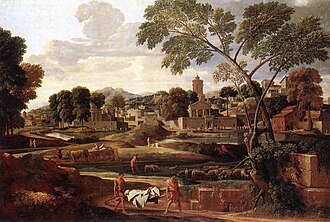


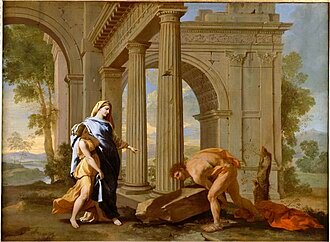


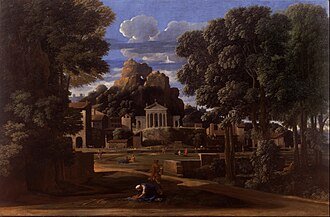


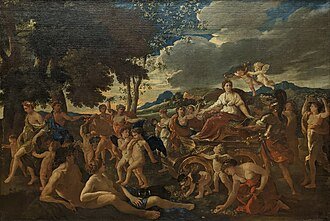


The painting takes its subject from the conquest of Jerusalem by the emperor Titus, as its title indicates. Dated 1635 and executed in oil on canvas, it is held in the Museum of Art History in Vienna. Nothing is known about its commission or reception, so any reading beyond the title and technical facts needs caution.

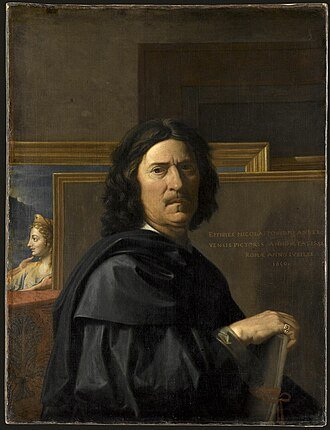
Self-portrait by Nicolas Poussin dated 1650 and held at the Louvre. The painter appears half-length, with a calm gaze directed at the viewer, in a restrained format that concentrates attention on his face and bearing. As a genre in which the artist presents himself as the subject, the work invites reflection on the image Poussin chose to project of himself. No further details about its commission or reception are recorded.

This painting depicts the Genesis flood: a lightning storm unleashes a deluge in which people struggle among the wreckage of a shipwreck and a boat. Noah's ark appears amid the waters, while a snake and a baby add to the scene's sense of desolation. Its title refers to winter, although the subject is biblical.

Landscape with Diogenes shows the philosopher Diogenes of Sinope beside a child who drinks at a watercourse, in a setting that suggests poverty and simplicity: a path, a broad-leaved plane tree and, in the distance, a city. Poussin arranges the scene as a historical landscape, where the human figures sit within nature and architecture. The Louvre holds the work.

Painted in 1655 by Nicolas Poussin, this oil on canvas belongs to religious art and depicts the Annunciation, the moment when an angel tells Mary she will bear a child. The work is held today by the National Gallery in London, where it can be seen by visitors.
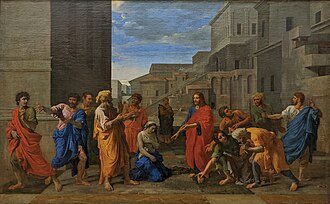
Painted by Nicolas Poussin in 1653 and held in the Louvre, this work depicts the Gospel episode of Christ and the woman taken in adultery. It belongs to Classicism and to religious painting. Its horizontal format and orderly arrangement of figures let the viewer follow the scene calmly.


A mythological painting dated 1626 that brings together Apollo and Bacchus, two gods of classical tradition linked to light, music and poetry, and to wine and revelry. The nude figures and oil on canvas show Poussin's early interest in classical subjects. The record offers no further details about its commission, purpose or history, so it is best to keep close to what the painting itself shows.


This 1635 painting by Nicolas Poussin shows John the Baptist baptising a group of people beside a lake. The landscape fills much of the canvas, with a hill and a rider on horseback appearing in the scene. Among those present are a woman and a man. Its commission and meaning are not documented here.

Dated 1650 and held at the Louvre, this religious painting centres on blindness, with a cliff edge and a distant city framing the scene. Its title points to Jericho, the biblical town, though the available details say little about how the figures are arranged, so the canvas itself rewards close looking.

Mythological painting showing Midas washing at the source of the Pactolus river. The scene also includes a child and another male figure beside the water. Dated 1627, this oil on canvas by Nicolas Poussin is held at the Metropolitan Museum of Art in New York.

Pan and Syrinx, painted by Nicolas Poussin in 1637, depicts a scene from classical mythology: the god Pan pursuing the nymph Syrinx. This oil on canvas belongs to the mythological genre and is held in Dresden at the Staatliche Kunstsammlungen. No further details about its composition or commission are recorded here.

The title refers to a will, so the scene probably centres on a final bequest and the people who receive it. Poussin painted it in 1644 in oil on canvas, and it is now held in the National Gallery of Denmark. The available information does not clarify who commissioned it or the exact circumstances of its making, so the work is best approached through its title and its composition.

This painting shows the earthly paradise as a lush fruit orchard, where Adam and Eve stand near the tree of the knowledge of good and evil, with God present. The orderly, luminous landscape reflects the balance valued by classicism, and the spring of the title seems to suggest renewal and the beginning of life in Eden.


In 1656 Poussin painted this scene of the Flight into Egypt, an episode from the Gospel of Matthew in which the Holy Family seeks refuge far from Herod. The composition centres on the Virgin and Child, who rest in the foreground, while the other figures and the landscape form a calm, unified whole. As a religious work, it invites quiet contemplation rather than dramatic storytelling. It is now held in the Hermitage Museum.


The painting depicts the myth of Midas, to whom the gods granted the power to turn everything he touched into gold. According to the legend, he bathed in the river Pactolus, whose sands were thereby turned golden. Painted by Poussin in 1626 in oil on canvas, it is a mythological subject now held at the Musée Fesch.

Painting by Nicolas Poussin, made in 1637 in oil on canvas and held at the Louvre Museum. It depicts the legendary abduction of the Sabine women, in which Romans, according to the subject recorded in the catalogue entry, seize women of the Sabine community during a fight. The scene is set in an urban space with monumental architecture, where soldiers, women and a temple can be made out. It belongs to classicism and blends history painting with a townscape.


Mythological painting by Nicolas Poussin, made in 1651 on a large scale. Its title refers to Pyramus and Thisbe, a pair of mythological lovers, yet the landscape plays a prominent role, with a thunderstorm filling the scene. It belongs to Classicism, the style Poussin practised with order and clarity.

The painting shows two figures, Erminia and Tancred, and its title points to this pair. Nicolas Poussin painted it in 1634 in oil on canvas. The available information about the work is limited, so the specific episode depicted, the circumstances of its commission and the precise meaning of the scene cannot be established with confidence.

This work shows the young Bacchus cared for by a nymph, with Silenus, a goat and a drink nearby, within a landscape dominated by a cliff. Poussin painted it in 1624 as a mythological picture, and it now belongs to the collections of the Louvre Museum.

Mythological painting by Nicolas Poussin, dated 1627 and executed in oil on canvas. Its title, Concert of Cupids, points to a gathering of these love gods around music, while a triumphal crown appears among the subjects shown. The work is held at the Louvre, where it can be seen alongside other paintings by the artist.

Nicolas Poussin painted this oil on canvas in 1652, now held at the Louvre. As a work of religious art, it depicts the biblical story of Ananias and Sapphira, with the apostle Peter among the figures. The composition centres on Sapphira and the moment of her fate, and its dramatic force lies in how the people gathered around her respond to it.


This history painting by Nicolas Poussin, dated 1633 and executed in oil on canvas, shows men seizing women while horses, a child and figures expressing pain and resistance appear around them. The scene draws on an episode from ancient Rome, the abduction of the Sabine women, and Poussin arranges it as a composition full of movement and intense gestures. It is worth noticing how the artist distributes the bodies across the foreground to give the action its dramatic weight.

Painting by Nicolas Poussin dated 1655, executed in oil on canvas. It depicts the biblical episode in which the apostles Peter and John heal a lame man, a subject from religious art. The record offers no further information about its commission or reception, so this reading is limited to what the scene shows.

This 1627 oil on canvas by Nicolas Poussin centres on a female figure and bears the title Bacchanal Scene, a term referring to revelries held in honour of Bacchus. The circumstances of its commission and its original patron are not known with certainty, so the painting is best approached through its title and its main figure.

This Assumption of the Virgin, painted by Nicolas Poussin around 1630, is an oil on canvas with a religious subject. The scene shows Mary rising at the moment of her passage into heaven. Without further references, the work can be described cautiously as a Christian devotional painting in which the central figure of the Virgin anchors the composition and guides the viewer's eye through the narrative.

Mythological painting showing the moment Odysseus uncovers Achilles, disguised among the women of the court on Skyros. Objects in the foreground, including a sword, a helmet and jewels, suggest a choice between domestic leisure and the warrior life. Deidamia, a key figure in the story, stands among the characters, and the hero's cross-dressing is the scene's central theme.


This mythological painting brings together Venus, a faun and several putti, figures drawn from the classical repertoire that Poussin painted in 1631. Without further evidence about its commission, it is safest to stick to what the title itself announces: the goddess of love alongside a woodland creature and winged children.

This 1649 painting depicts Moses striking a rock to bring forth water, an episode from the biblical account in which the people of Israel, thirsty in the desert, receive water by divine command. It is a religious work executed in oil on canvas by Nicolas Poussin and is held at the State Hermitage Museum.

Painted by Nicolas Poussin in 1629, this oil on canvas depicts Armida and Rinaldo, characters from Torquato Tasso's epic poem. The record offers no further information about its commission or reception, so the scene is best described cautiously: a couple set in an idyllic atmosphere, typical of the artist's early work in Rome.

Painted in 1662, this landscape shows a grape harvest, with figures carrying fruit through the scene toward a village, while a steep cliff and a mountain rise behind them. Poussin arranges the composition with calm order, typical of classicism, where people and nature share a measured balance rather than dramatic tension.

Painted by Nicolas Poussin in 1648, this wide horizontal oil on canvas takes its title from a scene of death: a man killed by a snake. The landscape is not merely a backdrop but the setting in which the event unfolds, and it shapes how the scene is read. The painting is held by the National Gallery in London.

Painted in 1637 in oil on canvas, this landscape by Nicolas Poussin shows a man scooping water from a stream. The scene is quiet and unhurried, with no dramatic event, so attention falls on how the figure is placed within its natural setting. The painting is held by the National Gallery in London.

Mythological painting by Nicolas Poussin, dated 1636 and executed in oil on canvas. Its subject belongs to classical mythology and centres on Pan, the god associated with shepherds and nature. Without information about its commission, it is best read through its composition and mythological theme.

Painted by Nicolas Poussin in 1648 in oil on canvas, this landscape takes its name from its central scene: a man washing his feet at a fountain in a quiet natural setting. It is held by the National Gallery in London. Looking slowly shows how the artist arranges the space around the small figure.

Oil on canvas dated 1651, this painting depicts the biblical episode from Exodus in which the pharaoh's daughter discovers the infant Moses abandoned on the Nile. Poussin, the French seventeenth-century painter who worked mainly in Rome, returned often to biblical and mythological subjects, and this work belongs to that religious output. Its calm handling of the story reflects the classicism that marks much of his art.

Oil on canvas dated 1638 by Nicolas Poussin, showing the Last Supper of Jesus of Nazareth, the moment traditionally linked to the institution of the Eucharist. It is held at the National Gallery in London. Reliable details about the commission and original setting are not available, so the composition is best read cautiously as a depiction of that foundational sacramental scene.

Painted by Nicolas Poussin in 1630, this oil on canvas belongs to the religious genre and is held at the Museo del Prado. It shows David, the biblical hero, holding a weapon, and its title points to a scene of victory. The available information does not allow us to determine the exact episode depicted.

This painting by Nicolas Poussin, dated 1647, forms part of a series of seven sacraments the artist made for the financier Paul Fréart de Chantelou. It shows the institution of the Eucharist, with Christ surrounded by his apostles in a calm, orderly composition. Without reference texts, it is safest to describe its religious subject and its place within that series.

The painting depicts the Sacrament of Extreme Unction, a rite of the Catholic Church administered to the gravely ill. Poussin painted it in 1644 on canvas, in a large landscape format. The available information does not establish who commissioned it or the circumstances of its making, so the scene should be read with caution.


This painting by Nicolas Poussin, dated around 1625 and executed in oil on canvas, depicts an episode from Ovid's Metamorphoses: Apollo, the god who appears as the protagonist of the scene, pursues the nymph Daphne. The record offers no further details about its commission or reception, so it is best to stay with what can be seen in the mythological composition and the identity of the figures depicted.


Poussin painted this large canvas in 1641, devoted to Saint Francis Xavier, the Jesuit missionary. The scene gathers the moment of the miracle in which the saint restores a girl to life, while an angel and a vision of heavenly glory accompany the prayer that brings about the prodigy. The record does not clarify the commission or its original setting, so it is best to stick to describing this devotional religious work, now held in the Louvre.

Nicolas Poussin painted this oil on canvas showing Saint Paul, or Paul of Tarsus, in a moment of ecstasy. An angel appears on a cloud close to the apostle, and a sword is included among the elements of the composition. As a work of religious art, it focuses on the apostle and the heavenly figure.

Oil painting by Nicolas Poussin dated 1640, showing Saint Matthew with an angel within a landscape. Its subject places it among religious works, though the natural setting carries considerable weight. No commission details are recorded here, so it is best approached through its composition and how the figures sit within the landscape.
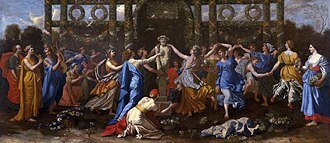

Nicolas Poussin painted this oil-on-canvas work in 1648. It depicts the Holy Family on a flight of steps, a religious subject. The figures are arranged in stepped planes that give the scene an orderly, unhurried structure, while color and light reinforce its calm. As in much of Poussin's output, the picture conveys a measured, classical balance.

Mythological painting by Nicolas Poussin, dated 1625 and executed in oil on canvas. The record describes a scene with nymphs and a satyr, and the Latin subtitle Amor vincit omnia, meaning 'love conquers all', points to a theme of love. A tree stands out as a prominent element of the composition. Without reference texts, details about its commission or reception cannot be confirmed.

Painted by Nicolas Poussin in 1627, this religious work is titled The Return of the Holy Family to Nazareth. A tree stands out among its elements and plays a notable role in the composition. Little is documented about its commission or original reception, so any claims beyond what the image shows remain uncertain. It is held at the Cleveland Museum of Art.

This mythological painting by Nicolas Poussin, dated 1630 and executed in oil on canvas, shows Selene and Endymion, two figures from Greek myth linked to the moon and to sleep. Without further documented information available, it is best to focus on the scene itself.
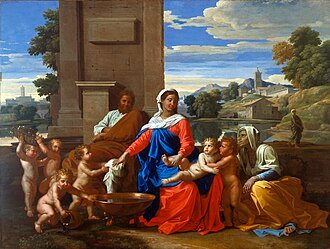
This oil on canvas, dated 1650 and attributed to Nicolas Poussin, brings together the Virgin, Joseph and the Christ Child in a calm setting, with the infant Saint John the Baptist and Saint Elizabeth also named in the title. The record gives no details about its commission or circumstances of creation, so the scene is best read with caution. What can be seen is an orderly, quiet composition typical of religious painting of the period, in which the figures gather together naturally.


Painted by Nicolas Poussin in 1657, this oil on canvas treats the Lamentation over the dead Christ, a religious subject in which the body of Jesus, laid out in the foreground, forms the centre of the scene around which the mourners gather. Little more can be said with certainty about its commission or original setting.

Painted by Nicolas Poussin in 1648, this small oil on panel shows the baptism of Christ by John the Baptist. The scene is arranged with a calm, restrained composition, with the main figures placed at the centre and the landscape supporting the sacred moment. No further information about its commission or reception is available.

This painting by Nicolas Poussin, dated 1651 and executed in oil on canvas, depicts the Holy Family together with the infant Saint John the Baptist and Saint Elizabeth. Beyond its date and subject, the available record offers no further information about its commission or reception, so any broader claims would be speculative. It is held at the Norton Simon Museum.

The painting bears the title The Exposition of Moses and is attributed to the French painter Nicolas Poussin. Its title suggests a scene from the early life of Moses, as told in the Old Testament, though no further details are available about its composition, commission or date. Without other reference material, the safest reading is to keep to this general theme.

Landscape with Saint Paul the Hermit is a painting by Nicolas Poussin in which the saint, withdrawn into the desert, appears as a figure of meditation within a natural setting. The landscape occupies much of the space and gives the whole a calm, contemplative mood. Without further reference material, it is best described cautiously: what sets it apart is the relationship between the hermit's solitary figure and the vastness of the nature surrounding him.
Where to see the work
- Louvre Museum Paris · 35
- National Gallery London · 10
- Hermitage Museum Saint Petersburg · 7
- Museo del Prado Madrid · 5
- Metropolitan Museum of Art New York City · 4
- Bavarian State Painting Collections Munich · 4
- Condé Museum Chantilly · 3
- Staatliche Kunstsammlungen Dresden Dresden · 3
- Pushkin Museum of Fine Arts Moscow · 3
- Cleveland Museum of Art Cleveland · 3
- Museum of Fine Arts of Lyon Lyon · 2
- National Galleries Scotland City of Edinburgh · 2
- Gemäldegalerie Berlin Berlin · 2
- Harvard Art Museums Cambridge · 2
- Museum of Fine Arts Boston Boston · 2
- National Gallery of Ireland Dublin City · 2
- Wallace Collection London · 1
- Musée Fabre Montpellier · 1
- Pinacoteca Vaticana Vatican City · 1
- National Gallery of Victoria City of Melbourne · 1
Teachers and pupils
Studied with
- Ferdinand Elle 1576–1637
- Georges Lallemand 1575–1636
Pupils
- Charles Le Brun 1619–1690
- Gaspard Dughet 1615–1675
- Pietro Santi Bartoli 1635–1700
- Pierre Le Tellier 1614–1702
Curiosities
A painting born from a change of plan
The Martyrdom of Saint Erasmus, commissioned for St Peter's Basilica, had first been given to Pietro da Cortona, who produced only preliminary designs before being moved to another project. Poussin painted it following Cortona's original design, with Cassiano dal Pozzo's help. It is his most openly Baroque work, yet it failed to please the authorities and brought him no further papal commissions, which pushed him towards private clients.
A painter who disliked Caravaggio
According to his biography, Poussin detested the work of Caravaggio, whom he considered born to destroy painting. The opinion sets him apart from many artists in Rome and reflects his rejection of Baroque emotionalism. His preference for drawing and clarity led him to look to Raphael and to antiquity as models of excellence.
A series that joins two worlds
In The Four Seasons, Spring is not personified by the Roman goddess Flora but by Adam and Eve in the Garden of Eden, and Summer is represented not by Ceres but by the biblical Ruth. Poussin thus mingled pagan and Christian themes in one series, what the art historian Willibald Sauerländer called a consonance between the pagan and the Christian worlds.