The Ambassadors
Hans Holbein the Younger, 1533
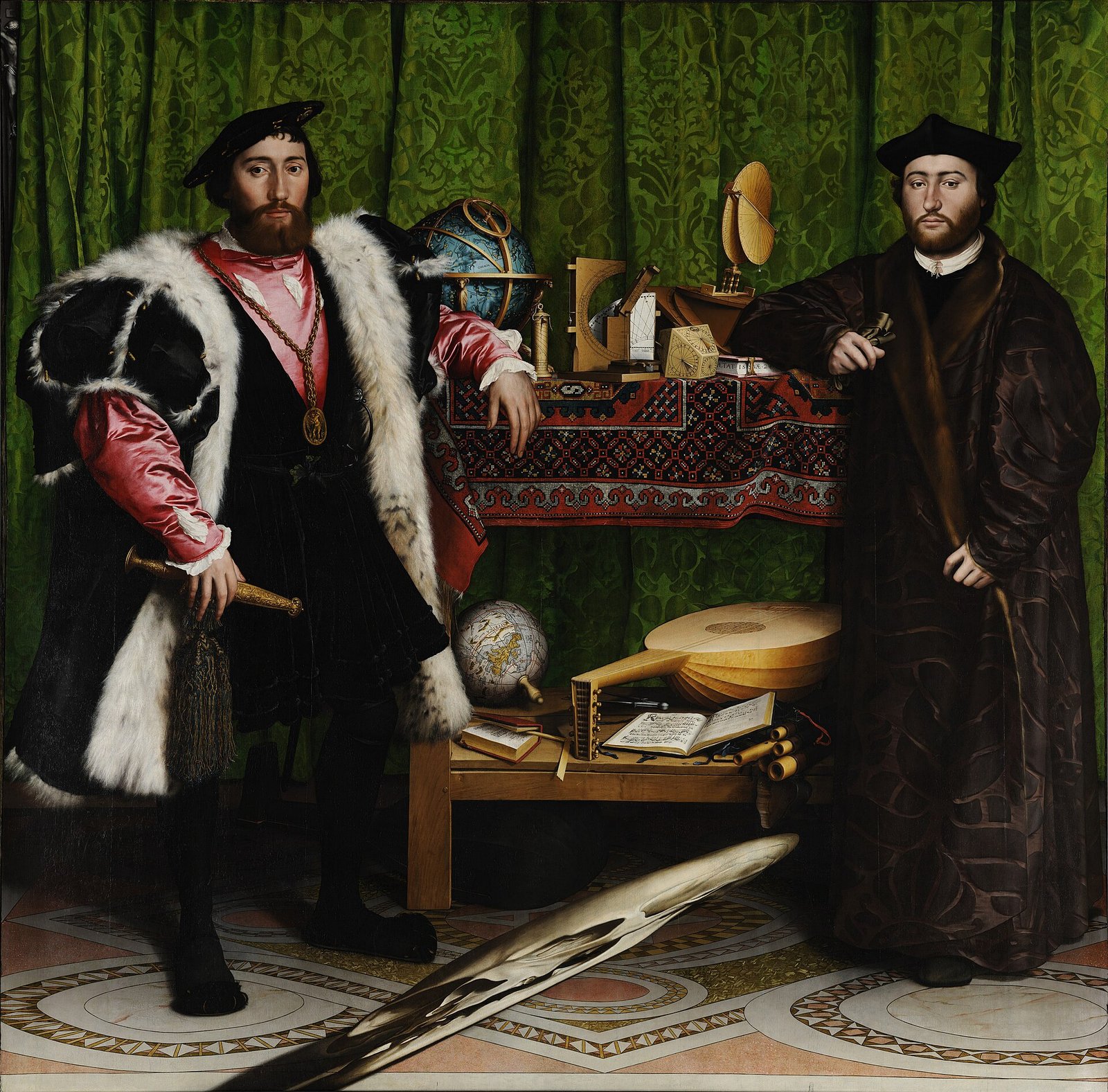
The Ambassadors is a double portrait painted by Hans Holbein the Younger in 1533, now in the National Gallery in London. It shows Jean de Dinteville, the French ambassador to England, on the left, and his friend Georges de Selve, bishop of Lavaur, on the right. Between them stands a two-tiered table laden with objects linked to the quadrivium, the four mathematical sciences: a celestial globe, timekeeping instruments, a terrestrial globe, books, a lute and flutes. The picture dates from a tense diplomatic moment, when talks between France, England and the papacy were shifting amid Henry VIII's break with Rome and the search for alliances. Its most striking feature is the elongated shape lying across the foreground: seen from an oblique angle, it resolves into an anamorphic skull, turning the work into a vanitas that reminds the viewer of death amid so many signs of learning and power. Its blend of precise painting, dense symbolism and hidden meaning has made it one of the most studied pieces of the late Renaissance.
- Painter
- Hans Holbein the Younger
- Date
- 1533
- Medium
- oil paint, oak panel
- Dimensions
- 207 × 209 cm
- Museum
- National Gallery, London
- Movement
- Mannerism
- Genre
- portrait
- Depicts
- Georges de Selve, Jean de Dinteville, Holbein carpet, man, human skull
More works by Hans Holbein the Younger