Tahitian Woman with a Flower
Paul Gauguin, 1891
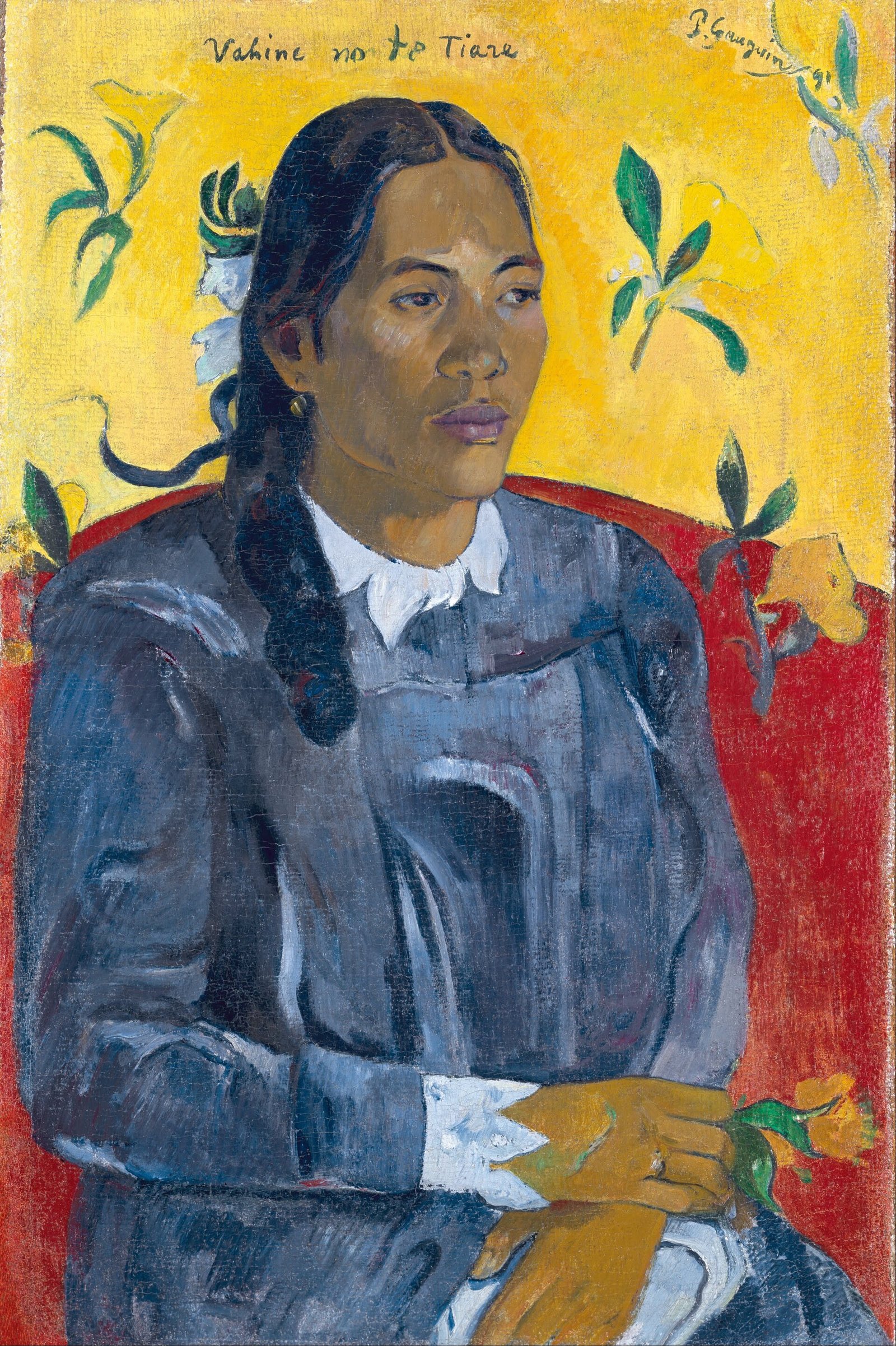
Tahitian Woman with a Flower is a portrait Paul Gauguin painted in 1891 during his first stay in Tahiti. It is now in the Ny Carlsberg Glyptotek in Copenhagen. The original Tahitian title, Vahine no te tiare, literally means "woman of the flower", and Gauguin rendered it in French as La femme à la fleur. Having only recently arrived on the island, he wanted to paint a Tahitian woman, drawn by the enigmatic quality of her smile. The sitter, a neighbour, at first refused, but soon afterwards she turned up wearing a colonial-style dress introduced by French missionaries. Even so, she wore a flower behind her ear, as tradition required: a tiare, the gardenia tahitensis, the island's emblematic flower, also used for perfume.
The painting brings two worlds together. On one side is the clothing imposed by colonisation; on the other, the naturalness and dignity of the woman, visible in her calm gaze and posture. In Noa Noa, Gauguin wrote about her and described his wish to capture fear and pleasure, melancholy and a passivity charged with restrained passion. There is an irony here: while the sitter appears in European dress, the painter himself had taken up the Tahitian pareo.
Formally, the red and yellow background is decorated with stylised flowers, a device he had already used in his Self-Portrait with a Portrait of Bernard. This ornament gives the composition balance, and the yellow ground sets off the warm, tawny tone of the face. It was also the first Tahitian portrait Gauguin sent to Europe. In a letter to his friend Daniel de Monfreid, he remarked that it could sell well, since it was something entirely new, which shows his awareness of its novelty within his artistic search.
- Painter
- Paul Gauguin
- Date
- 1891
- Medium
- oil paint, canvas
- Dimensions
- 70 × 46 cm
- Museum
- Ny Carlsberg Glyptotek, Copenhagen Municipality
- Genre
- portrait
- Depicts
- woman, flower
More works by Paul Gauguin


