Nevermore
Paul Gauguin, 1897
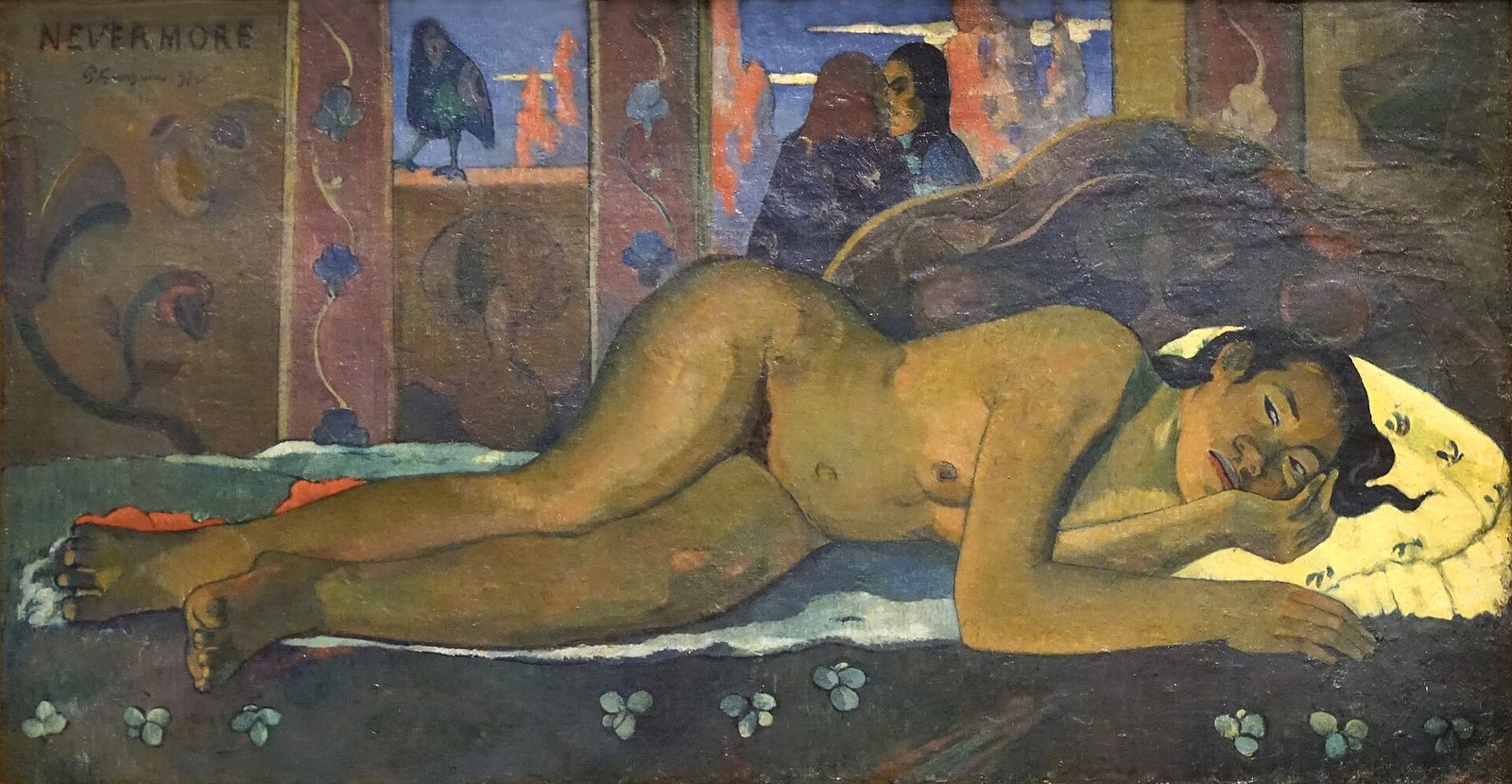
Nevermore, also titled Nevermore O Taïti, is an oil on canvas that Paul Gauguin painted in 1897 during his second stay in Tahiti. It shows a young Tahitian woman lying on her left side, facing the viewer, her gaze turned to the right. The nudity is not provocative; her expression is distant, a mixture of sadness and wariness, as if she were attentive to the conversation of two women chatting in the doorway behind her. The model was Pau'ura, Gauguin's partner, whom the painter spelled Pahura. Behind her, a raven sits at a window amid floral decoration. The title is inscribed in three lines in the upper left corner.
The word "Nevermore" refers to the refrain of Edgar Allan Poe's poem "The Raven", which was well known in Paris, where Mallarmé had published a French translation illustrated by Manet and had recited it before Gauguin. In the poem, the bird answers every question with the same word. Gauguin turns it into a symbol of the Tahitian world he felt was vanishing and would never return. The spelling "Taïti" is the French form, and the preposition "O", used in Tahitian before place names, was often wrongly absorbed into them by Europeans. The composition recalls Ingres's Grand Odalisque, but the colour and the vertical lines of the background, which emphasise the body's curves, create a mysterious, symbolic atmosphere.
The painting was bought in 1898 by the English composer Frederick Delius. It is now held by the Courtauld Institute of Art in London.
- Painter
- Paul Gauguin
- Date
- 1897
- Medium
- oil paint, canvas
- Dimensions
- 60 × 161 cm
- Museum
- Courtauld Institute of Art, London
- Genre
- nude
More works by Paul Gauguin