Landscape with the Good Samaritan
Rembrandt, 1638
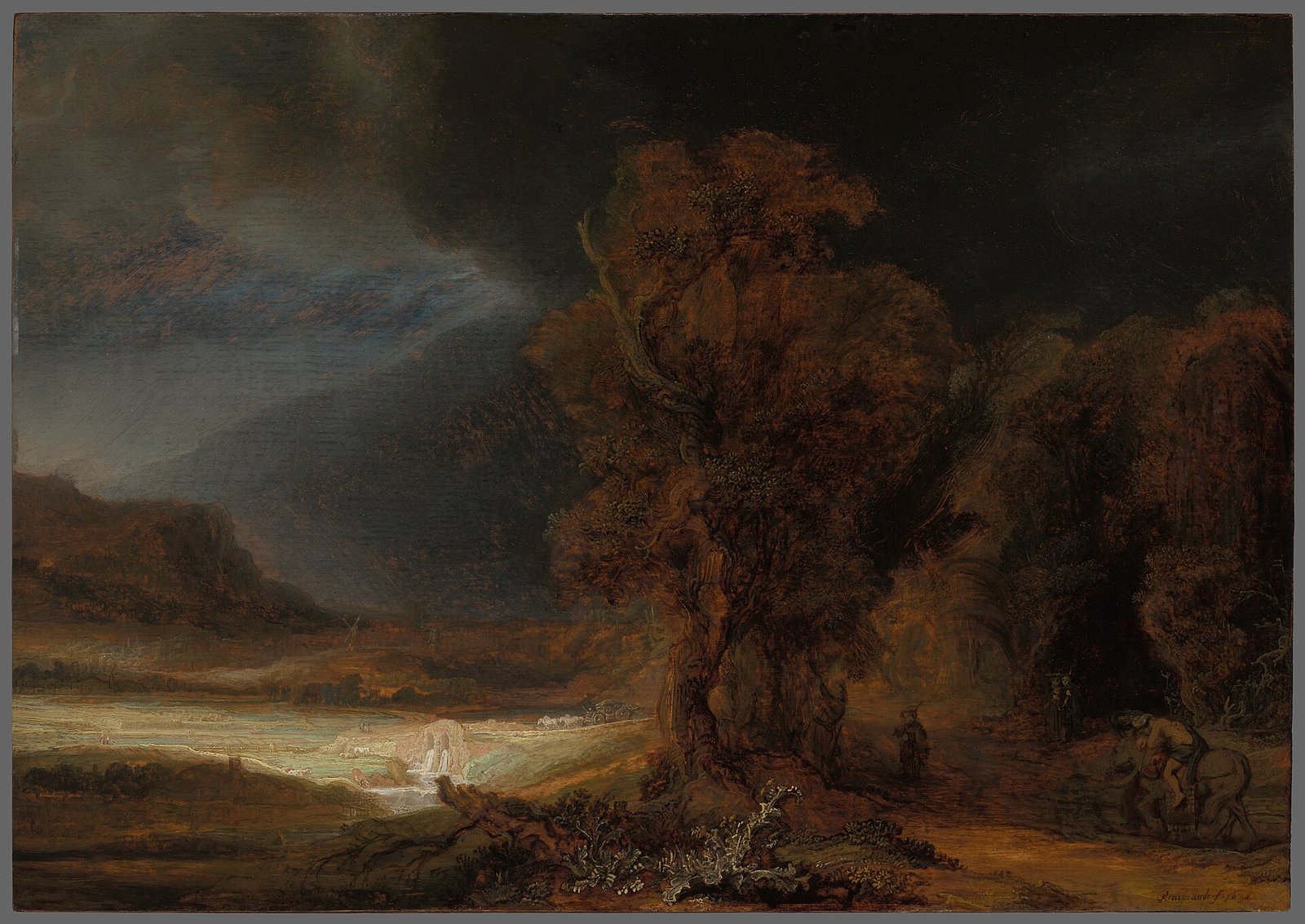
Landscape with the Good Samaritan is an oil painting on oak panel that Rembrandt completed in 1638. It illustrates the parable from the Gospel of Luke: a wounded traveller lies by the road while a man from Samaria stops to help him. Rembrandt places the story within a broad landscape, with architecture in the background and light falling unevenly across the ground, giving the natural setting an unusual degree of attention in his work. For this reason the picture is regarded as one of the few oil landscapes by the artist, which makes it especially useful for studying how he approached the genre.
The painting's history is equally striking. It was bought at a Paris auction by Jean-Pierre Norblin de La Gourdaine and then entered the collection of the Polish noblewoman Izabela Czartoryska at the Dom Gotycki in Puławy. That collection was later moved to Kraków, and during the German occupation in 1939 the work was among several paintings looted. After the Second World War, thanks to the research of the art historian Karol Estreicher, it returned to Kraków, where it is now held at the Czartoryski Museum.
As part of the Dutch Golden Age, the work is one of three Rembrandts in Polish collections, alongside The Girl in a Picture Frame and The Scholar at the Lectern. Its significance lies both in its quality and in what it reveals about the painter's career, as well as in the fate many works suffered in the twentieth century.
- Painter
- Rembrandt
- Date
- 1638
- Medium
- oil paint, panel
- Dimensions
- 46 × 66 cm
- Museum
- Czartoryski Museum, Kraków
- Movement
- Dutch Golden Age painting
- Genre
- historical landscape, religious art
- Depicts
- parable of the Good Samaritan
More works by Rembrandt


