Polyptych of the Misericordia
Piero della Francesca, 1460
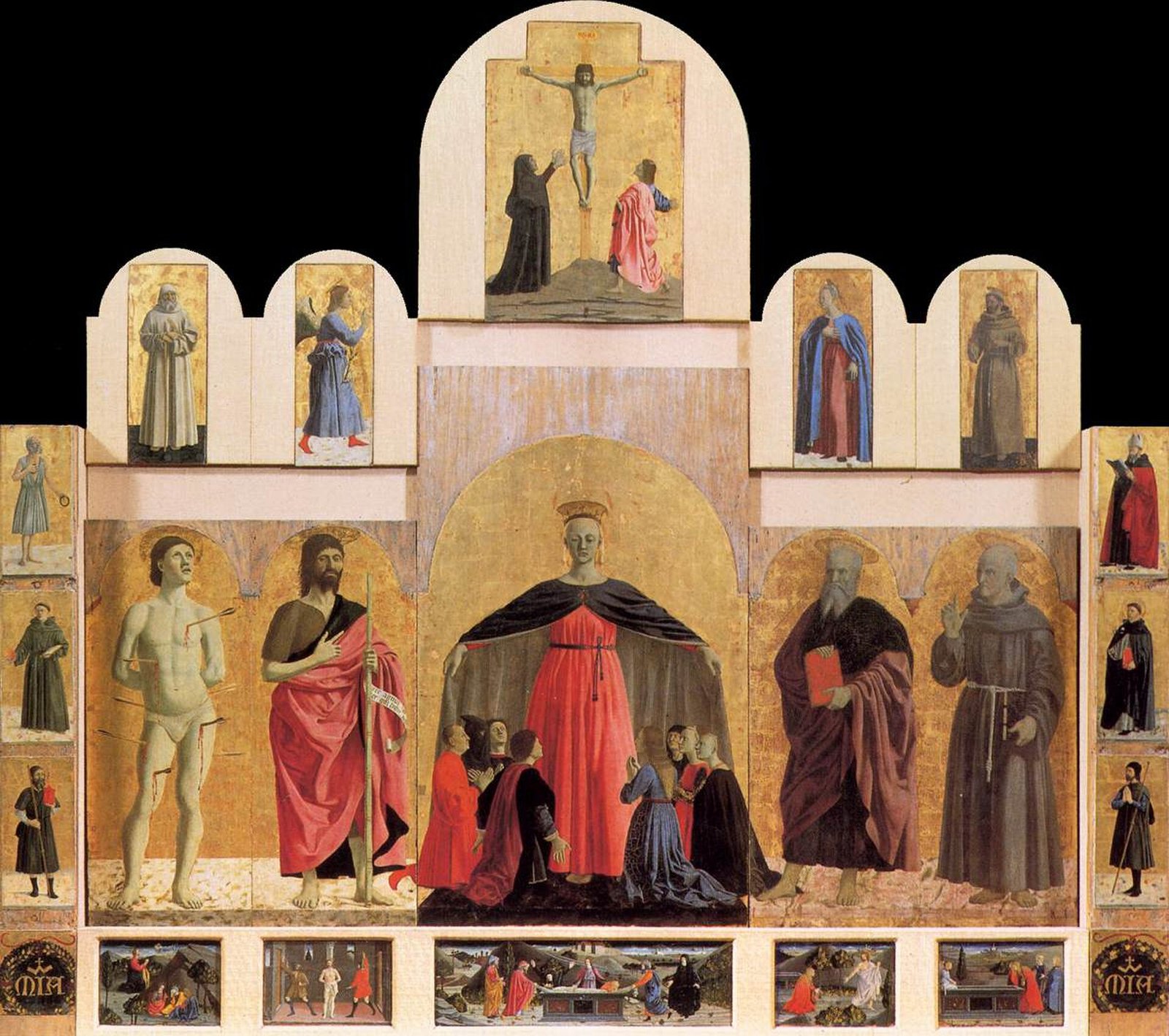
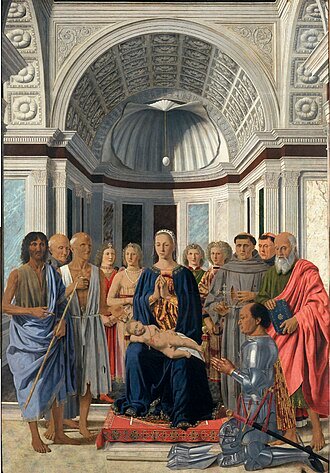
The Polyptych of the Misericordia is one of Piero della Francesca's best-known works and one of the most complex commissions of his career. The local confraternity of the Misericordia ordered it in 1445 for the altar of their church in Borgo San Sepolcro, with a contract requiring completion within three years. The painter took far longer: its dating ranges from 1448 to 1462, and the ensemble was not finished until that last year. Workshop collaborators painted part of it, especially the predella and some panels of the upper section. The centre is the most prominent panel: the Virgin spreads her cloak to shelter the kneeling members of the confraternity at her feet. Piero handled the demand for a flat gold background skilfully, creating a realistic space beneath the cloak that resembles an apse. The Virgin's figure is static and symmetrical, with a composition organised through circles and pentagons. The side figures, such as Saint Sebastian and Saint John the Baptist, show the solid bodily presence associated with Masaccio. The work also became famous for a wartime story from 1944, when a British artillery officer, having read Aldous Huxley, ordered a temporary halt to fire to spare the painting.
- Painter
- Piero della Francesca
- Date
- 1460
- Dimensions
- 273 × 330 cm
- Museum
- Museo Civico di Sansepolcro, Sansepolcro
- Movement
- Early Renaissance
- Genre
- religious art
- Depicts
- Virgin of Mercy, Saint Sebastian, Mary, woman
More works by Piero della Francesca