The Archangel Leaves Tobias and his Family
Rembrandt, 1637
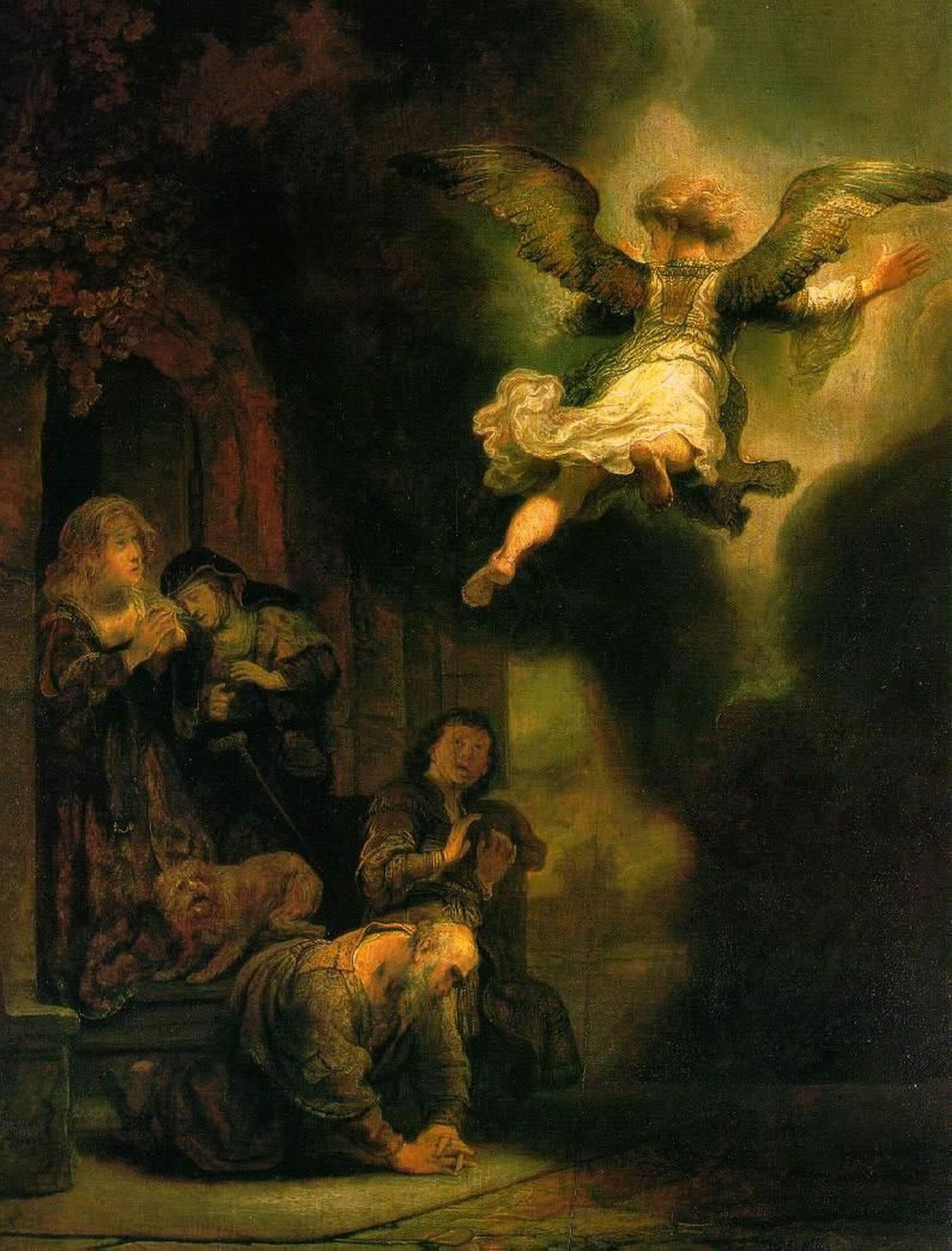
Rembrandt painted this scene in 1637, and it is now held in the Louvre in Paris. Its subject comes from the Book of Tobit, a story in the Old Testament about a Hebrew family. The elderly Tobit, who has gone blind, sends his son to collect a debt in Media, and the young man travels with a companion who turns out to be the archangel Raphael. After the mission, which included curing his father's blindness and freeing the young woman Tobias will marry, the angel takes his leave. The painting does not show the journey itself but its final moment: the angel reveals his identity and rises back to Heaven.
Rembrandt chose to show the angel from behind and foreshortened, lifting upward, which underlines his physical and spiritual distance from the family. An intense light radiates from him and cuts through dense, dark clouds of rising smoke, producing strong contrasts of light and shadow that create depth. The light is applied selectively and falls mostly on the family gathered on the steps of their house. Tobit kneels in recognition, his son gazes up in astonishment, and his new young wife, moved, presses her hands together in prayer. Anna, the mother, startled by the dazzling glow, lets her staff fall beside a frightened dog. Every figure expresses a mixture of wonder, fear, faith and gratitude.
The subject recurs in Rembrandt's prints, and in 1641 he made an etching of this same episode, adding two onlookers to the scene. The painting later entered the collection of Louis XV after its purchase in 1742. Its interest lies in how it turns a supernatural moment into a domestic scene, where the characters' emotion and the play of light concentrate the meaning of the story.
- Painter
- Rembrandt
- Date
- 1637
- Medium
- oil paint, panel
- Dimensions
- 66 × 52 cm
- Museum
- Louvre Museum, Paris
- Movement
- Dutch Golden Age painting
- Genre
- religious art
- Depicts
- Tobias, Raphael, cloud, family
More works by Rembrandt


