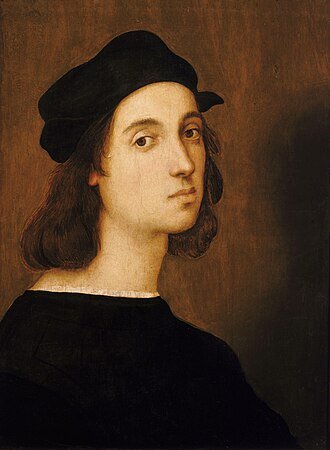
Portrait of a Man
Raphael, 1503

The Portrait of a Man is an early work by Raphael, the Italian painter of the High Renaissance, dated by the reference texts to around 1500 to 1504, while the record gives 1503. It is a half-length portrait of a man painted in oil on panel, a common format for likeness-making at the time. The sitter is shown almost frontally, looking toward the viewer against a restrained background, so that attention settles on the face, the shoulders and the subtle handling of light. The painting has an unusual attributional history: for a period it was assigned to Hans Holbein or to Perugino, which shows how closely Raphael's early style could resemble that of his contemporaries. Its association with Raphael became firmer as scholars compared the modelling of forms, the soft transitions of light and the calm expression with his other youthful works. A restoration in 1911 means that, as with many older panels, the original surface and the precise tonal nuances should be considered with some caution. Today it hangs in the Galleria Borghese in Rome, where it can be seen alongside other works that help trace the painter's development. Its main interest lies in what it foreshadows: a balance between naturalism and idealization that Raphael would pursue with greater ambition in his later portraits and religious compositions.
- Painter
- Raphael
- Date
- 1503
- Medium
- oil paint, panel
- Dimensions
- 46 × 31 cm
- Museum
- Galleria Borghese, Paris
- Movement
- High Renaissance
- Genre
- portrait
- Depicts
- man
More works by Raphael