
Albert Bierstadt
1830–1902 · American landscape painter of German birth, associated with the Hudson River School
Albert Bierstadt (January 7, 1830 – February 18, 1902) was a German-American painter best known for his monumental landscapes of the American West. He belonged to the second generation of the Hudson River School, and some of his works are also linked to the Rocky Mountain School and American Luminism. His significance lies in making the western landscape a central subject of nineteenth-century American painting, at a time when few Americans or Europeans had seen those lands.
Childhood and first drawings
He was born in Solingen, in the Rhine Province of Prussia, and was only a year old when his family emigrated to New Bedford, Massachusetts, in 1831. His father was a cooper. As a boy he made clever crayon sketches and developed a taste for art. His older brothers, Edward and Charles, became stereo view photographers, and that household exposed Albert early to the daguerreotype and the new medium of photography. He began painting in oils around 1851, and between 1850 and 1853 he produced monochrome illustrations for a local newspaper. His training was largely self-taught.
Düsseldorf and the academy
In 1853 he returned to Germany intending to study with Johann Peter Hasenclever, a distant relative, but on reaching Düsseldorf he learned that Hasenclever had died shortly before. For roughly four years he studied landscape painting with Karl Friedrich Lessing and Andreas Achenbach at the city's Academy of Fine Arts. He travelled through Germany and Switzerland, sometimes in the company of Emanuel Leutze or Worthington Whittredge, filling sketchbooks that he later turned into oil paintings in his studio. After a stay in Rome with Sanford Robinson Gifford, he ended the European period in 1857. Paintings of New England and northern New York date from this time. His first exhibited work, Lake Lucerne (1858), was shown at the National Academy of Design in New York, and the following year he showed eight more canvases there.
The West and the expedition with Lander
In 1859 he made his first journey west, accompanying Frederick W. Lander, a federal government surveyor equipped with mapping instruments. The trip proved decisive. It supplied him with sketches of the Rocky Mountains, which he carried back to his studio in the Tenth Street Studio Building in New York and turned into numerous canvases. In 1860 he exhibited his first western subject at the National Academy of Design, but his real breakthrough came with The Rocky Mountains, Lander's Peak (1863), which sold in 1865 for $25,000. In 1863 he travelled west again, this time with the writer Fitz Hugh Ludlow, and the two spent seven weeks in Yosemite Valley. From these expeditions he drew material for large exhibition canvases, and his technical command, acquired through European landscape study, let viewers who had never seen those mountains see them convincingly.
Europe and international success
After Ludlow's divorce, Rosalie, his former wife, married Bierstadt in 1866. In 1867 the couple returned to Europe and spent two years travelling through several countries. In his Rome studio he painted Among the Sierra Nevada, California, which he showed in Berlin and London before shipping it to the United States. In December 1867, in London, he presented two western landscapes at a private reception attended by Queen Victoria. His paintings impressed European audiences and strengthened the image of the American West as a land of promise at a time of rising emigration to the United States. Bierstadt paired his grand subjects with a keen business sense: his exhibitions came with publicity and ticket sales, and one critic spoke of a vast machinery of advertising and puffery.
Yosemite, California and late commissions
Back in the United States, he returned to California in 1871, where he stayed two years and met the photographer Eadweard Muybridge. In February and March 1872 he went back to Yosemite Valley to paint it under snow, and in June he returned to work in more favourable weather. Between 1874 and 1876 he painted two history pictures, Discovery on the Hudson River and Entrance into Monterey, for the House of Representatives in the United States Capitol. His wife Rosalie was diagnosed with tuberculosis in 1876, and Bierstadt spent more and more time with her in the warmer climate of Nassau in the Bahamas, until her death in 1893. In 1882 a fire destroyed his studio at Irvington, New York, and many of his paintings were lost with it.
Decline and legacy
By the late 1880s his professional success had faded. The Last of the Buffalo was rejected at the Paris Exposition Universelle of 1889, and critics regarded his style as theatrical and out of date, while taste was moving toward the Barbizon school, Impressionism and smaller, more intimate canvases. Bierstadt died in New York in 1902 and was buried in New Bedford. He is credited with about 500 paintings, and for nearly sixty years his name was largely forgotten. Interest revived in the 1960s with an exhibition of his small oil studies. His reputation remains divided: some see him as an extravagant champion of Manifest Destiny, while others point out that his landscapes helped build support for the conservation movement and the establishment of Yellowstone National Park.
Works (129)


Bierstadt painted this small oil landscape of the Sierra Nevada in California, with Lake Tahoe as its geographical reference. The record dates the work to 1868, and its modest format suggests a study or intimate piece rather than a large exhibition canvas. Described cautiously, it brings together mountains, water and light in a wild natural scene typical of nineteenth-century American landscape painting.

Landscape painting by Albert Bierstadt, dated 1877, showing the Hetch Hetchy Valley in California. Executed in oil on canvas, it belongs to the landscape genre. Without further documentation on its commission or reception, what can be said rests on its subject, medium and genre alone.

A landscape by Albert Bierstadt dated 1862, painted in oil on canvas. The scene shows Indigenous people spearing fish, so the human figure sits within the natural setting rather than dominating it. The available record does not describe its commission or early reception, so reading it rests mainly on the image itself, which the Museum of Fine Arts, Houston now holds.
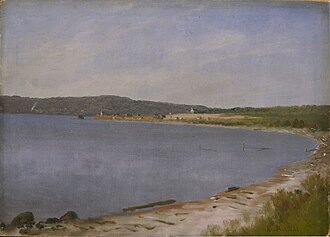
Painted by Albert Bierstadt in 1871, this oil on paperboard shows San Francisco Bay, in California, with a tree in the foreground. The record offers no further details about its commission or reception, so it is best described cautiously: it belongs to nineteenth-century American landscape painting, with its interest in the nature of the American West.


Laramie Peak is an 1870 oil on canvas by Albert Bierstadt that depicts the Rocky Mountains landscape, specifically the peak that gives the painting its name. The available information says nothing about its commission or reception, so it is best to read the scene cautiously: a dominant summit, broad light, and a panoramic treatment typical of the artist.

In 1863 Albert Bierstadt painted this view of the Rocky Mountains, where a snow-capped peak rises above a broad valley beneath a bright sky. The composition places the summit at the center, while the slopes and foreground ground lead the eye upward toward it. No further details about its commission or circumstances of creation are recorded.

Oil on canvas by Albert Bierstadt, dated 1886, showing a canoe within a natural landscape. The available record offers little further information, so the commission context, the specific place depicted and the precise meaning of the scene cannot be confirmed. Like other works by the painter, it blends genre and landscape, with attention to atmosphere and to the light typical of nineteenth-century American landscape painting.

Landscape painting by Albert Bierstadt, dated 1850, whose central motif is a wooded scene. The available information does not specify its commission, original location or technique, so any reading of its composition should be approached cautiously. Specialist studies would be the best route to deeper context on this work.


Albert Bierstadt painted this oil on canvas of Yosemite Valley in 1864, focusing on Mirror Lake. The scene shows a calm landscape where the still water mirrors the slopes and vegetation, which gives the place its name. The work belongs to the landscape painting of its time, when American nature was depicted with careful detail and quietness.


Landscape by Albert Bierstadt, painted in 1891, showing Mount Baker, a snow-capped volcanic peak in the northwestern United States, in Washington State. The available record offers no further details about its commission, technique or reception, so this reading is limited to its subject: a snowy summit dominating the scene, within the nineteenth-century American landscape tradition.


Landscape painting by Albert Bierstadt, made in 1870 in oil on canvas. It shows the Sierra Nevada under a passing storm, a theme that landscape art often uses to set the power of nature against the broad expanse of the horizon. The available information does not allow us to say more about its commission.

This seascape by Albert Bierstadt, dated 1872, places its scene at the Farallon Islands, a group of rocks along the coast where seals rest. The painting blends marine landscape with animal subject matter: the seals, stretched across the stone, sit within a coastal setting on a small format. No further details about its commission or reception are recorded, so it is best read as a close look at the shoreline.

Landscape painting by Albert Bierstadt, dated 1870 and executed in oil on canvas. It depicts the Sierra Nevada at morning. The available information says nothing about its commission or finer compositional details, so this description stays with its subject and medium. Its large, horizontal format is the most noticeable feature of the work.

A small panel by Albert Bierstadt dated 1859, showing a Sioux encampment near Fort Laramie. The scene pairs a record of Native American life with a wide landscape, where the settlement sits within its natural surroundings. Given its modest size, the painting is mainly of interest as an early view by the artist of the American West.

This work by Albert Bierstadt, dated around 1850, is classed as a genre scene. The record offers no further details about its commission or the precise circumstances of its creation, so it is best described cautiously. Its title, The Ambush, suggests a scene of tension or lying in wait, though the exact character of the composition can only be judged from the original image.

This seascape depicts the Golden Gate strait, the opening that links San Francisco Bay with the Pacific Ocean. Bierstadt, a landscape painter, worked in oil on canvas. The composition centres on the water, the coastline and the light spreading across the horizon, offering a view of this natural passage.

Painted by Albert Bierstadt in 1860, this small oil on cardboard shows Chimney Rock, the rock formation that gives the scene its name, with an Ohalilah Sioux village in the foreground. The title places the landscape and the human settlement within a single view, presenting the site together with the community standing in front of it.

This small oil painting by Albert Bierstadt, dated 1850, shows a river estuary beneath a broad sky, with the water stretching toward the horizon. It belongs to the landscape genre, and its modest size suggests a study or studio work rather than a large public composition. The support combines hardboard, canvas and cardboard, a detail that hints at the materials available at the time.

This work by Albert Bierstadt, dated 1855, shows a rustic mill set within a rural landscape. Catalogued as both an architectural view and a landscape painting, it gives the building and its surroundings roughly equal weight. Without further reliable documentation, it is best to stick to what is visible: a modest structure that hints at farming life of the period.


A landscape painting dated 1850, attributed to Albert Bierstadt, showing a lake surrounded by mountains. Reliable information about its commission or reception is not available, so it is best read as a straightforward image of nature, where water and rugged terrain dominate the scene.


A European landscape painted in 1856 by Albert Bierstadt, the American artist who trained in Düsseldorf, where landscape painting was highly regarded. The work belongs to the genre in which nature is the main subject. Without further references, the specific place depicted and its original patron cannot be determined.

This 1870 oil painting by the American artist Albert Bierstadt presents an open prairie under an evening sky bathed in warm tones. The composition spreads the space along a broad horizontal, guiding the eye across the land toward the distance. Without further documentary references, it is best to rely on what the picture itself shows: the golden light and the vastness of the terrain as the scene's main elements.

This seascape by Albert Bierstadt, painted in 1872 in oil on cardboard, depicts the Farallon Islands, a natural arch rising from the Pacific Ocean. Given its small format, it may have been a quick study made from observation, though this is not documented. It is held today at the Hirshhorn Museum and Sculpture Garden.

Small oil study on cardboard by Albert Bierstadt, dated 1869. Here the subject is modest: ferns and stones at the foot of an embankment, seen up close. The reduced scale and close attention to plant and rock suggest direct observation rather than a grand, monumental composition.

A small seascape painted by Albert Bierstadt in 1857, showing fishing boats off the island of Capri. The record describes oil on paper mounted on canvas, which suggests a quick study made from nature rather than a large composition. The available information does not clarify the commission or the work's original purpose.

Landscape painting dated 1850 and attributed to Albert Bierstadt, centred on fishing from a canoe. No further information is available about its commission, setting or technique, so any reading must stay close to what the title and genre suggest: an activity carried out on water within a natural environment.


Landscape painting dated 1862 and made by Albert Bierstadt in oil on panel. Its title, Guerrilla Warfare, suggests a military theme, yet the available information does not clarify the scene depicted or the circumstances of its creation. Today it is held by the Century Association. Readers interested in its background should consult specialized catalogues.
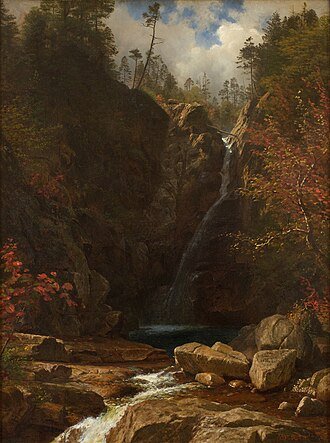

Albert Bierstadt painted this view of Niagara Falls in 1869, a landscape in which the great mass of water fills the centre of the scene. As an oil on canvas of modest size, the composition relies on the contrast between the falling water and the calm surroundings. The record offers no further details about its commission or reception, so it is best to keep claims to what the painting itself shows.

This small painting by Albert Bierstadt, dated 1881, depicts one of the waterfalls of the Yellowstone River, with water plunging between rocky walls and vegetation. It is a landscape work that records the scenic appeal of this area, though no further details about its commission or reception are available.

This oil-on-canvas painting shows Niagara Falls from a low viewpoint, placing the cascade of water close to the viewer and filling much of the picture. Dated 1850 and attributed to Albert Bierstadt, a landscape painter, it is a relatively small canvas. The available information does not clarify who commissioned it or the circumstances of its making.


Painting by Albert Bierstadt, dated 1850, depicting Horseshoe Falls at Niagara, one of the best-known waterfalls in North America. It belongs to the landscape genre, where the main interest lies in nature and its scale. The record offers no further details about its commission or reception, so it is best to keep to what the image and its data allow us to state.

Oil on paper dated 1877, showing Niagara Falls as seen from the American side. Given its small format and support, it may be read as a study rather than a large finished composition. Attention falls on the rush of water and the surrounding landscape, framed in a broad view.
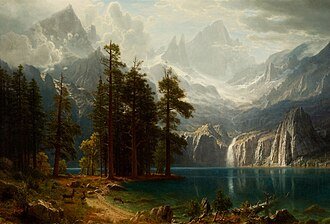
This oil on canvas by Albert Bierstadt, dated 1850, belongs to the landscape genre and depicts the Sierra Nevada mountain range, with a waterfall as its main feature. The available record does not clarify who commissioned the work or the specific circumstances of its creation, so it is best to focus on what the image shows: a broad view of a mountain landscape where water and rugged terrain structure the scene.


Landscape painting by Albert Bierstadt, dated 1863, showing a waterfall among rocks and vegetation. Painted in oil on canvas, the work focuses attention on the water tumbling down the terrain, a common subject in nineteenth-century landscape art. It is held by the Art Institute of Chicago.
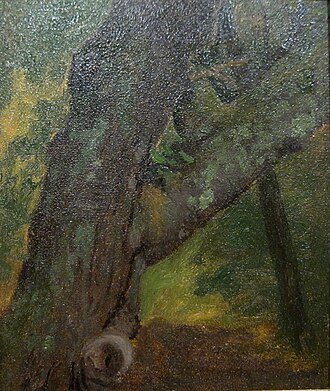
A study of a tree by Albert Bierstadt, dated 1850 and executed in oil on paper, a small format typical of sketches made from nature. The record offers little further information, so the work is best understood as a direct observation of a single tree, probably made outdoors or from a preliminary sketch rather than as a finished composition.

Oil on canvas by Albert Bierstadt, dated 1869, showing buffalo moving along a trail beneath a threatening sky. A solitary tree stands out in the landscape, and the title points to a storm about to break. It belongs to animal painting, where the animals are the central subject, while the scene's mood depends largely on the sky and the open ground.

Albert Bierstadt painted this 1876 oil-on-canvas landscape, centred on Mount Corcoran, a peak rising above a calm lake. In the foreground are a tree, a grassy shore and a small waterfall tumbling toward the water, while a bear appears within the natural setting. It belongs to the landscape genre and is held by the National Gallery of Art.

Landscape by the American painter Albert Bierstadt, dated 1871, showing Lake Donner in California. The work is recorded as oil on paper and canvas, so it may be a study that was later developed in more detail, though this is uncertain. It is held at the Museum of Fine Arts in San Francisco.

In this architectural view, Albert Bierstadt gathers a church, a staircase, a doorway, a statue and a tree under sunlight. Bright patches and bands of shadow fall across the scene, guiding the eye between its different planes. Details about its commission are scarce, so the image itself remains the main point of interest.

Oil on canvas sketch that, as its title indicates, served as a study for a larger composition. It shows buffalo, a horse and Native American figures within a genre scene. Its small format probably allowed the painter to test the arrangement of animals and people before settling on the final composition.


Oil on paper mounted on board, dated 1877, in which Albert Bierstadt depicts the harbour of Nassau with sailing vessels, small boats and a canoe beside a jetty. A lighthouse and an American flag appear along the shore, and a male figure stands in the foreground. The work belongs to the marine genre, and its small format suggests a quick study rather than a large-scale composition.

Oil on canvas by Albert Bierstadt, dated 1873, depicting an autumn scene in the mountains. It belongs to landscape painting, a genre the artist worked in often. The record offers no details about its commission, reception or history, so any reading remains limited to what the title suggests: a view of the autumn season in a mountain range.

Landscape painting by Albert Bierstadt dated 1872, showing Middle Cathedral Rock, a granite formation in Yosemite Valley, framed by a tree in the foreground. The small work was executed in oil on paper mounted on canvas, a support often used for studies made from nature. Its interest lies in the direct record of a landscape the American painter returned to often.

Albert Bierstadt painted this view of Donner Lake at dawn in 1871. The scene rests on the soft early light that colors the water and the surrounding slopes, creating a calm atmosphere that invites the viewer to linger over the landscape. The record lists a mixed technique of oil on paper and canvas, so visitors may consult the museum for further details about its support.

This Albert Bierstadt work, dated 1872, depicts sunrise over the Sierra Nevada mountains, with the peaks forming the centre of the landscape. It is executed in oil on paper mounted on board, a format that suggests a small scale and probably a study rather than a large finished composition.

Oil painting by Albert Bierstadt dated 1882, showing a landscape in Yosemite National Park with a river, trees, mountains and a cloud-filled sky. The record notes that it was made on paper and canvas, and the work is held by the Smithsonian American Art Museum. No information is available about its commission or reception.


Albert Bierstadt painted this work in 1891, and it is classified as a seascape and landscape painting. It depicts the island of New Providence, where sea and shoreline shape the scene. The available information does not establish the commission, the intended audience or the specific choices of composition and colour, so any closer reading should be approached with caution.


A landscape by Albert Bierstadt depicting the subject titled Old Faithful, dated 1850 and executed in oil on paper. The available information does not establish its commission, intended audience or historical context, so the viewer is best guided by its composition, light and atmosphere.


Pioneers of the Woods is an 1850 painting by Albert Bierstadt. The record offers no further details about its commission, destination or context, so any reading of the scene should be approached with caution. Its title suggests settlers moving into dense woodland, a theme common in mid-nineteenth-century American painting.


Oil sketch by Albert Bierstadt, dated 1888 and painted on cardboard in a small format. As its title indicates, it is a preparatory study for a composition known as The Last of the Buffalo, so it likely served to test the arrangement of the scene before a larger work. Its informal, quick character offers insight into the artist's working process.
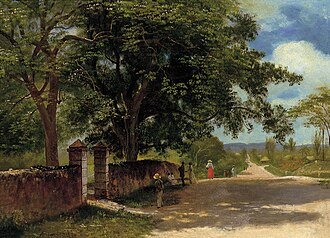
This small painting by Albert Bierstadt, dated 1878, shows a street in Nassau, the capital of the Bahamas. The record offers no further details about its commission or reception, so it is best read as a travel-inspired view of the city. Its modest size and its oil-on-canvas-and-board technique place it among the artist's studies of urban landscape.

Preparatory study by Albert Bierstadt, dated 1850 and classed as an architectural view. The available record offers no further information on its subject, technique or purpose, so it is not possible to say which building or scene it depicts or how it relates to any finished painting. Its title points to an interest in contrasts between light and shade, a common concern in such studies.

This landscape by Albert Bierstadt, painted in oil on canvas in 1889, takes its title from a sunrise at a place called Glacier Station. The available record gives no details about the specific subject, commission or composition, so any reading of the scene must rely on the title alone, which suggests early light falling over a setting probably shaped by ice.

Oil on canvas by Albert Bierstadt, dated 1868, showing the Yosemite Valley at sunset. It belongs to the landscape genre and reflects the interest of American painters in depicting the country's western scenery. Since no further information is available about its commission or reception, it is best described cautiously, based on its subject and date.

Small oil on cardboard by Albert Bierstadt, dated 1869, showing a landscape beneath a heavy sky of dark clouds. Its modest size and loose handling suggest a sketch made from nature rather than a large studio painting. Little is recorded about its commission or original owner, so its purpose remains uncertain.

Landscape painting by Albert Bierstadt, completed in 1870 in oil on canvas. The title points to a pool of emerald-green water, drawing the eye to its surface and to the light playing across it. The painting's wide horizontal format suggests a broad view of the natural setting, in keeping with the landscape tradition in which the work belongs.

This seascape by Albert Bierstadt, dated 1859, depicts the island of Capri through a view of the Marina Piccola. Painted in oil on canvas in a horizontal format, it focuses on the sea and the shoreline, within the seascape genre where water and light take centre stage. The work is held by the Albright-Knox Art Gallery, where it stands as an early example of the painter's interest in Mediterranean landscape.

Oil on canvas dated 1895, showing the Morteratsch Glacier in the Upper Engadine valley near Pontresina, Switzerland. A landscape held by the Brooklyn Museum. Without reference sources, the commission and the circumstances of its making cannot be confirmed, so the painting is best approached through its subject and its mountain setting.


Seascape in oil on canvas dated 1850, centred on a breaking wave. Without further information about its commission or context, the reading rests on what is visible: a mass of water at the moment it collapses, with white foam standing out against the sea.
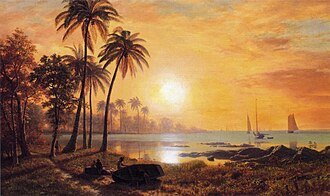

Small seascape in oil on paper mounted on fiberboard, dated 1886 and attributed to Albert Bierstadt. Its title points to a coastal scene in the West Indies, though the record does not specify the exact location or the circumstances of its making. Given its modest size and unusual support, it was probably a sketch-like study rather than a large finished canvas.
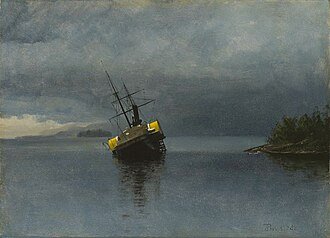

This 1881 landscape painting depicts Old Faithful, the Yellowstone geyser that gives the work its name. Albert Bierstadt worked in oil, a medium that likely allowed him to render the steam, water and surrounding light with care. Beyond its subject and date, little is documented about its commission or reception, so any reading of the artist's intentions should remain tentative.


Oil on canvas from 1873 by Albert Bierstadt, a landscape painter, depicting Yosemite Valley as seen from the Glacier Point Trail. The scene focuses on the vastness of the natural setting rather than on human presence. It is now held by the Yale University Art Gallery.

A study of a bighorn sheep (Ovis canadensis) painted by Albert Bierstadt in 1879 in oil on paper mounted on board. It is a small work focused on the animal, shown at close range with a quick handling. Its interest lies mainly in its direct record of Rocky Mountain wildlife rather than in a large-scale landscape.

Black Horse is a small oil on canvas by Albert Bierstadt, dated 1859 and belonging to the animal painting genre. Its subject is a single horse, shown on a modest format. Little is documented about its commission or original context, so the work is best approached through its image and its handling of paint.

Small oil on paper by Albert Bierstadt showing a bull elk, Cervus canadensis. Its modest size suggests a study made from direct observation rather than a finished composition, and it shows the artist's attention to the animal's anatomy and antlers. It is dated 1850.

Small oil painting on paper mounted on cardboard, dated 1850, in which Albert Bierstadt devotes the whole composition to two horses. Its modest size and lack of landscape place it within animal painting. Little is known about its commission, so it is best viewed as a close study of the animal's form.

An 1875 oil on canvas by the landscape painter Albert Bierstadt, showing the Sacramento River in California's San Joaquin Valley. The record offers no further details about its commission or reception, so it is best to stick to what the picture suggests: a broad view of plain and sky, within the nineteenth-century American landscape tradition.

A small seascape by Albert Bierstadt dated 1850, showing the bay of Monterey in California. Oil on masonite, a rigid board with a smooth surface, gives it a modest scale; its reduced format suggests a sketch or study rather than a large studio work. It belongs to the genre of marine and landscape painting.

Landscape by Albert Bierstadt dated 1872, focused on California and, judging by its title, on its redwoods, very tall trees native to the region. The record notes oil on paper and canvas, in a small format. The available information does not allow us to say more about its composition or commission.

A seascape by Albert Bierstadt dated 1882, showing the coast of California. Painted in oil on canvas, it belongs to the marine genre, in which the sea and shoreline form the core of the composition. The available information does not establish the specific scene depicted or the circumstances behind its commission.


Oil on canvas from 1872 showing seals lying on the rocks of the Farallon Islands, a group of islets off the coast of California. It belongs to the marine genre, where the sea and shoreline dominate the scene. The animals occupy the foreground, while the rock and the coastal light complete the composition.


Painted in 1863, this landscape depicts Yosemite Valley in California, a vast natural setting that many American painters of the nineteenth century chose as their subject. It is made of oil on canvas and paper. The available information does not clarify who commissioned it or the exact circumstances of its creation, so it is best viewed with some caution.

An oil on paper dated 1873 by Albert Bierstadt, the American painter best known for his grand landscapes of the American West. Here he works on a more intimate scale, depicting a landscape near Oakland, California, bathed in golden summer light. The available record offers no further details about its commission or history, so the work is best appreciated for its calm atmosphere and luminous tone.

A small oil painting on paper mounted on cardboard, it shows an autumn landscape in New England. Given its modest size and support, it may be a study or sketch rather than a large finished composition, though the record does not confirm this. Its appeal lies in its subject, the light and colour of the season in a northeastern region of the United States, handled at an intimate scale.

Small oil-on-canvas painting dated 1850 and attributed to Albert Bierstadt. It blends landscape with a buffalo, which stands as the animal focus within its natural setting. With no further documentation available, it is best to describe only what the picture shows and its place among landscapes of American wildlife.


This landscape painting, dated 1850 and attributed to Albert Bierstadt, depicts a scene from Florida. The available record offers no further details about its composition, commission or context, so its technique and any symbolic meaning cannot be established with confidence. What the title does convey is an interest in the natural surroundings of the region.

This oil on canvas, dated 1871, is a nocturnal landscape by Albert Bierstadt, in which a mountain appears lit by moonlight. The subject lets the painter focus on contrasts between light and shadow, and on the stillness a night scene can evoke. Little more can be said about its commission or original destination with confidence.

The painting shows the Platte River and, as its title suggests, a midday rest. It is a small work in oil on paper and canvas, where genre scene, animal painting and landscape come together. Its modest size invites a close look, and the title's word 'nooning' refers to the pause taken during the hottest part of the day.


This oil painting by Albert Bierstadt, dated 1889, places the viewer beside the Hudson River at Irvington, where several sailing boats move across the water. It belongs to the landscape genre and shows a calm stretch of river, with the movement of the sails providing the main point of interest. The available information does not allow us to say more about its commission or reception.

This small oil painting by Albert Bierstadt, dated 1859, shows a surveyor's wagon set against mountains in the Rockies, as its title indicates. The oil was applied to paper later mounted on Masonite, which points to a modest work, possibly a study made from nature. Bierstadt is associated with the Hudson River School, known for its broad, detailed views of the natural world.


A large-scale landscape in which Albert Bierstadt depicts Mount Adams in Washington State, with soft light enveloping the mountain and the foreground. The work belongs to the landscape genre and is dated 1875. The available information does not allow us to confirm the circumstances of its commission or its later history, so it is best to focus on what the painting shows.


Painted by Albert Bierstadt in 1893, this work depicts Columbus's landing on San Salvador, the island he reached in 1492. The available information does not clarify its commission or reception, so it is best read as a later pictorial interpretation of the event rather than a firsthand record.
Where to see the work
- Smithsonian American Art Museum Washington, D.C. · 7
- Fine Arts Museums of San Francisco San Francisco · 6
- Museum of Fine Arts Boston Boston · 5
- Galería Nacional de Arte Washington, D.C. · 4
- Saint Louis Art Museum St. Louis · 4
- Metropolitan Museum of Art New York City · 3
- Gilcrease Museum Tulsa · 3
- Hirshhorn Museum and Sculpture Garden Washington, D.C. · 3
- Buffalo Bill Center of the West Wyoming · 3
- Brooklyn Museum New York City · 2
- Thyssen-Bornemisza Museum Madrid · 2
- Haggin Museum Stockton · 2
- Buffalo AKG Art Museum Buffalo · 2
- Blanton Museum of Art Texas · 2
- Birmingham Museum of Art Birmingham · 1
- Portland Art Museum Portland · 1
- Seattle Art Museum Seattle · 1
- Timken Museum of Art San Diego · 1
- Currier Museum of Art Manchester · 1
- Harvard Art Museums Cambridge · 1
Teachers and pupils
Studied with
- Karl Friedrich Lessing 1808–1880
Curiosities
A war seen through photography
His painting Guerrilla Warfare, Civil War (1862) was based on a stereoscopic photograph taken by his brother Edward, who ran a studio in Virginia. Curator Eleanor Jones Harvey described the picture as the work of a voyeur, privy to the stories but untouched by the violence of first-hand combat. Bierstadt himself was drafted in 1863 and paid a substitute to serve in his place.
Mountains named after him
Colorado has Mount Bierstadt and Bierstadt Lake, named in his honour for his interest in mountain scenery. He was probably the first European to reach the summit of what is now Mount Blue Sky in 1863, and he called it Mount Rosa, a reference both to Monte Rosa and to Rosalie Ludlow, his future wife. The name was changed to Evans in 1895 and to Blue Sky in 2023.
From painting to postage stamp
In 1998 the United States Postal Service issued a set of twenty commemorative stamps titled Four Centuries of American Art, one of which reproduced The Last of the Buffalo. In 2008 it issued a stamp in its American Treasures series featuring Valley of the Yosemite from 1864. These honours show a public presence that contrasts with the critical neglect he suffered for much of the twentieth century.