
Ernst Ludwig Kirchner
1880–1938 · German Expressionist painter and printmaker
Ernst Ludwig Kirchner (6 May 1880 – 15 June 1938) was a German Expressionist painter and printmaker, and one of the founders of Die Brücke (“The Bridge”), the Dresden group that helped launch Expressionism in twentieth-century art. His paintings of city life, the nude and the Alpine landscape shaped European painting in the early decades of the century. Today the Kirchner Museum in Davos holds the largest collection of his work in the world.
Childhood and training
His father, a chemical engineer who worked on papermaking, was of Prussian descent, and his mother came from a family of Huguenots, an ancestry Kirchner often mentioned. The father’s search for work meant the family moved often. In 1890 Kirchner started school in Chemnitz, where he made his first woodcuts under his father’s guidance. On a school trip to Nuremberg in 1898 he saw printing blocks for early woodcuts at the Germanisches Nationalmuseum and decided to become a painter. He later wrote that the experience had shaped his aim of renewing German art.
His parents supported his vocation but wanted him to finish a formal education. In 1901 he began studying architecture at the Polytechnic in Dresden, where he became close to Fritz Bleyl. Between 1903 and 1904 he studied in Munich, at the Polytechnic School and the Debschitz school, and in 1905 he returned to Dresden to take his degree and devote himself fully to painting.
Die Brücke in Dresden
In 1905 Kirchner founded Die Brücke with Bleyl, Karl Schmidt-Rottluff and Erich Heckel. The name suggested a bridge between past and present. The group wanted to break with academic conventions and looked both to Dürer, Grünewald and Cranach and to the international avant-garde. From the Fauves, and from Gauguin and Van Gogh, they took the expressive, symbolic use of colour. They also revived the woodcut, a medieval technique, and its influence shows in their angular outlines, flat forms and unnatural, warm, subjective colour. Perspective was pushed into impossible foreshortening.
Their subjects were often unsettling: prostitutes, disreputable night venues and narrow streets peopled by strange figures. Kirchner’s studio, which Bleyl described as the lodging of a true bohemian, became the group’s meeting place. They used friends and acquaintances as models rather than professionals, and poses lasted only a quarter of an hour to encourage spontaneity. Their first group exhibition, in September and October 1906, focused on the female nude. From 1907 to 1911 Kirchner spent summers with other members at the Moritzburg lakes and on the island of Fehmarn, where the nude was set in natural landscapes. His main model in those years, the milliner Doris Große, posed for him until 1911.
Berlin and the end of the group
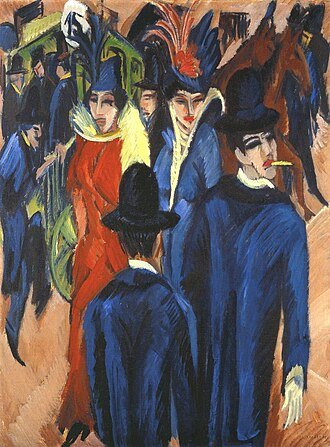
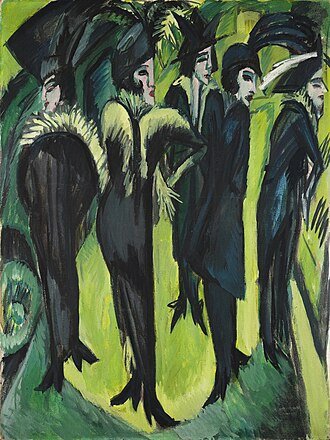
In 1911 he moved to Berlin with Max Pechstein to found a private art school, aiming to promote “modern teaching of painting”. It failed and closed the following year. In 1912 he began a relationship with the dancer Erna Schilling that lasted the rest of his life. In the capital he found material for his urban work: the restless energy of a modern metropolis, its streets and the world of street prostitution. He painted a series of “Straßenszenen”, street scenes with women waiting on corners and hurried passers-by, in a nervous style.
In 1913 the writing of his Chronik der Brücke led to the end of the group, and each member went his own way. That year his work was shown at the Armory Show in New York, and the Folkwang Museum in Essen gave him his first solo exhibition, which helped establish his own identity.
War and breakdown
When the First World War began in 1914 he volunteered, at the age of 35. In July 1915 he was sent to Halle to train as a driver in an artillery unit, but after a mental breakdown he was discharged without seeing combat. He then painted Self-Portrait as a Soldier, which shows him with his right hand severed, an image that struck those who saw it. In December 1915 he entered a sanatorium in Königstein, where he was diagnosed with alcoholism and dependence on Veronal. He kept working, and in 1916 sold a good number of works, but in December he suffered another breakdown and was admitted to a clinic in Berlin.
Davos
In 1917 Helene Spengler invited him to Davos, in Switzerland. His first stay lasted only ten days, because the exceptional cold sent him back to Berlin. Soon afterwards he returned for treatment under the lung specialist Lucius Spengler, who imposed strict rules that Kirchner tried to get around. In 1918 he was granted a residence permit and moved into a traditional house in the Grisons, whose rooms he decorated with furniture he carved himself. He wrote to Henry van de Velde that he lived in an old house with a kitchen that looked like Rembrandt’s studio. His health improved, although he remained dependent on morphine.
He came to know the local farmers, who were amazed by his gramophone, and he recorded his admiration for their careful work in his diary. He painted mostly mountain landscapes, interiors and everyday figures. Critics today rate this period below his Berlin years, although much of his maturity developed here. In 1921 he began designing carpets, which were woven by Lise Gujer. In 1923 he moved to the Wildboden house above Frauenkirch, which he called a turning point in his life. From 1925 his painting became more schematic.
Final years and degenerate art
In 1931 he was elected to the Prussian Academy of Arts. After the Nazis took power in 1933, selling his paintings became impossible, and in 1937 he had to resign from the Academy. That same year his work was labelled “degenerate art”, and 25 of his 639 works were removed from German museums. Increasingly troubled, Kirchner worried about the destruction of German culture and about rumours of the persecution of Jews. He organised a large exhibition in Basel, which received mixed reviews. After the Anschluss he feared that Germany might invade Switzerland.
On 15 June 1938 he took his own life with a gunshot in front of his house in Frauenkirch, although some doubt has been raised about whether it was suicide. He was buried three days later in the Waldfriedhof cemetery. Erna Schilling continued to live in the house until her death in 1945.
Legacy
Kirchner is one of the central names of German Expressionism. His work, from the Dresden woodcuts to the Swiss landscapes, has been the subject of major exhibitions in the United States, London and Amsterdam, and many of his paintings are held in museums in Berlin, Munich, Madrid and Essen. His urban scenes, with the street and street prostitution as their setting, remain the most studied and most recognisable part of his output.
Works (64)



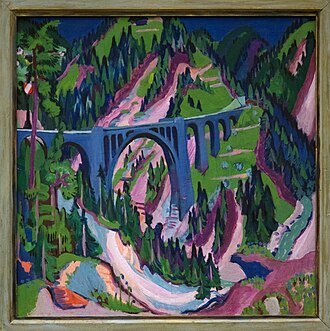
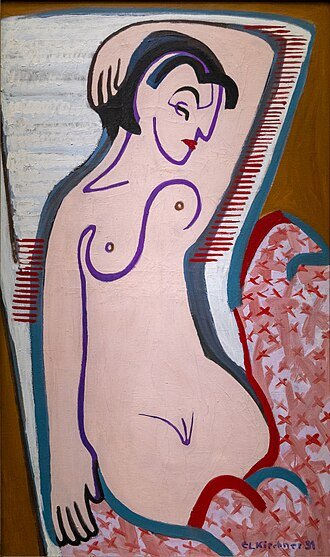
Painted in 1931 in oil on canvas by Ernst Ludwig Kirchner, this work belongs to the nude genre and shows a reclining figure. It is held by the Kirchner Museum in Davos, an institution devoted to the artist's work. The available information does not clarify the circumstances of its making or the compositional choices, so the painting itself is the best guide to its colour and handling.


Alpine landscape painted by Ernst Ludwig Kirchner in 1919, taking as its subject the Tinzenhorn, a mountain in the Grisons, and the Zügen canyon near Monstein. Executed in oil on canvas, the picture places the viewer before a high mountain setting. The work is held today by the Kirchner Museum in Davos.

Kirchner's Street Scene, an oil on canvas dating from 1913, appears to depict an urban setting. Without further documentation, its exact location, any commission and its early reception remain uncertain. The title points to a street scene in which the artist recorded an everyday moment. Visitors will get the most from looking closely at its composition, colour and handling of figures and space.


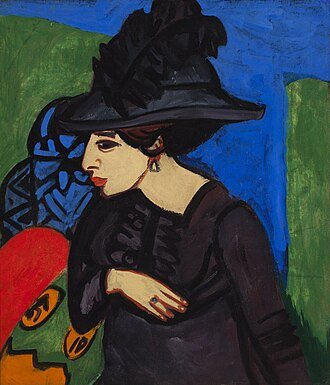
Portrait by Ernst Ludwig Kirchner, dated 1911, painted in oil on canvas and belonging to German Expressionism. The female figure is treated with a colour and formal language deliberately distant from naturalism: strong outlines, intensely expressive hues and a face built around character rather than likeness. Without further sources, it is best to keep to this general description, which places the work at a time when the Die Brücke group sought to break with academic tradition.

Self-portrait by Ernst Ludwig Kirchner, painted in 1914. Its title, The Drinker, suggests the artist presents himself in the act of drinking, a scene that invites reading the figure as one of solitude or dejection. Without further documentation about its context, any interpretation should be treated with caution.
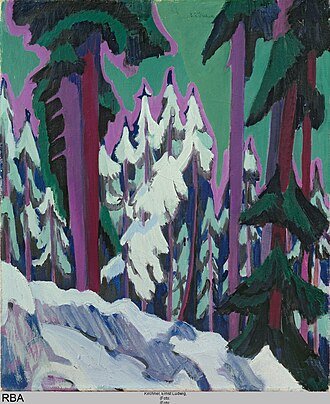

This 1928 work by Ernst Ludwig Kirchner shows several brown-toned figures gathered in a café. It is held in the Museum Ludwig. Without further references, it can be described as an interior scene in which the atmosphere and the presence of the people shape the composition, with a palette dominated by browns.


Two Bathers by Ernst Ludwig Kirchner, painted in 1912, shows two nude women. The title points to the island of Fehmarn, on the Baltic coast. The picture reflects the artist's interest in outdoor nude figures, rendered with simplified outlines and vivid colour. It is held at the Berlin National Gallery.

This oil on canvas by Ernst Ludwig Kirchner is dated 1910. The record gives neither a subject nor a title, so its imagery cannot be described with confidence here. It is held by the Jenaer Kunstverein, the Jena art society, and the entry offers only basic material information about the work.

Oil on canvas by Ernst Ludwig Kirchner, dated 1912, in a tall, narrow format. The title points to a woman as its subject, but no information is available about her identity, any commission, or the circumstances of its making, so any reading of its meaning remains open and should be held with caution.
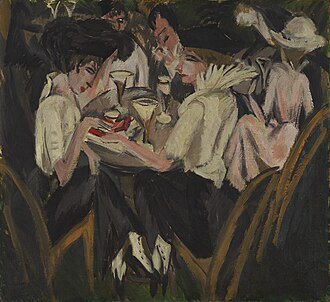
Kirchner painted this oil on canvas in 1914. Its title places the scene in a café garden, an open-air setting whose exact location and meaning are not documented in the available record. Today the work is held at the Brücke Museum in Berlin, where it can be seen.

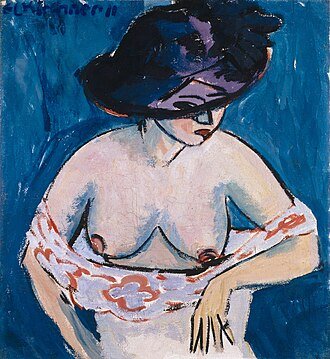
A 1911 nude by Ernst Ludwig Kirchner, a member of the Expressionist group Die Brücke. The sitter is Doris Grosse. The figure stands against a flat blue ground, with strong outlines and simplified anatomy that puts colour and line first. Beyond what the record shows, little more can be stated with confidence.

Kirchner painted this oil on canvas in 1921, classed as a genre scene: an interior in which a painter appears. The available records are limited, so the commission and the exact circumstances of its making cannot be confirmed. Its interest lies in the subject, the artist placed within his own surroundings, which visitors can see at the Buchheim Museum of Imagination.

This 1910 painting by Ernst Ludwig Kirchner shows a painter beside a nude female model, set in an interior of strong colours and simplified forms. The composition draws attention to the relationship between the person creating the image and the one posing for it, a theme that recurs in the artist's work. Without further references, it is best described cautiously: the flattened treatment of volumes and the colour contrasts are its most visible features.
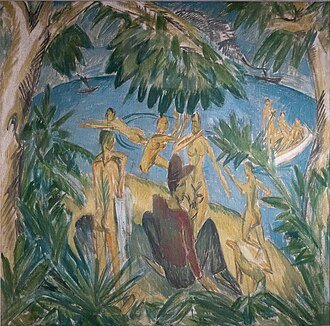
Painted by Ernst Ludwig Kirchner in oil on canvas, this work has a nearly square format measuring 117 by 114 centimetres. The available record does not clarify its subject, date or commission, so any reading of its content would be speculative. It is held by the Westphalian State Museum of Art and Cultural History.

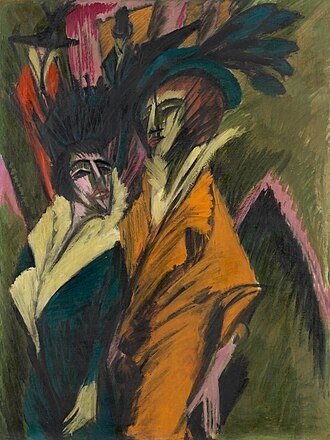
Dated 1914 and painted in oil on canvas, the work shows two women on a street, as its title indicates. Reliable information about its commission, composition or meaning is not available here, so any closer reading must rest on the image itself. It is held by the Kunstsammlung Nordrhein-Westfalen.
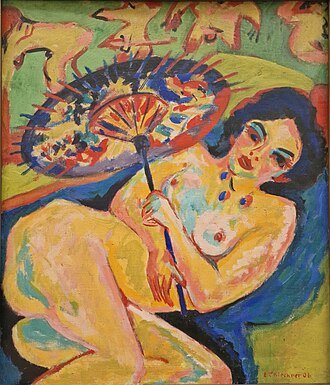
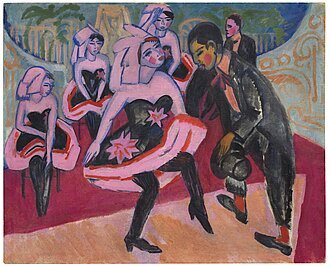

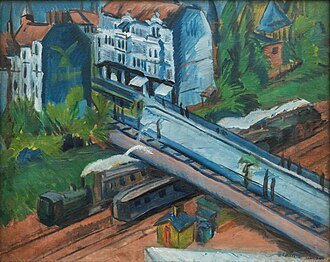


Landscape by Ernst Ludwig Kirchner from 1908, painted in oil on canvas and focused on the island of Fehmarn, as its title indicates. Little is documented about its commission or the circumstances of its making, so reading the work rests mainly on what the picture shows: a direct view of the landscape and its color.

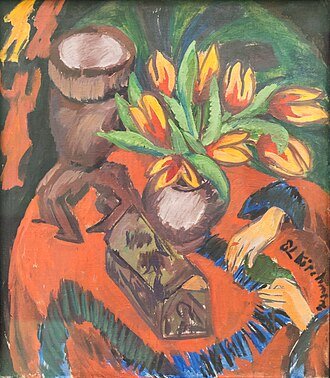
Oil on canvas dated 1912 and classified as a still life, showing a hand beside a tulip. No details survive about who commissioned it or what the scene means, so any reading should stay close to what is visible. Placing a hand next to a flower gives a familiar still-life subject a more personal and unexpected character.
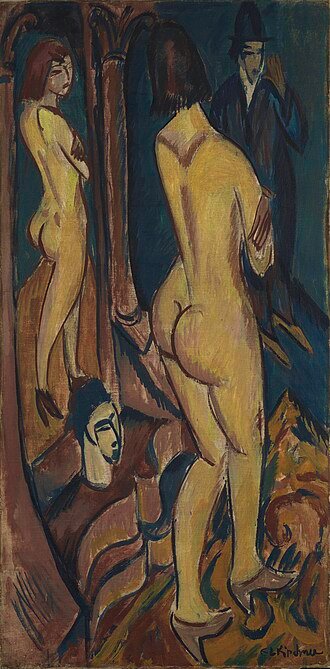


Painted in 1912 by Ernst Ludwig Kirchner in oil on canvas, this work belongs to German Expressionism. It falls within the nude genre and shows wooden figures, including a woman and a man, presented as sculptures rather than living people. The subject invites viewers to consider the relationship between the human body and the material it is carved from.

A portrait of Lina Franziska Fehrmann, known as Fränzi, who often posed for Ernst Ludwig Kirchner in those years. The young woman stands before a carved wooden chair, with a calm expression and a slightly stiff posture. Kirchner worked with strong colours and bold outlines, traits that define his Expressionist style. The 1910 painting shows how the artist simplified forms to give the figure greater presence.

This 1908 oil on canvas shows young nude women standing beside an oven, turning a domestic setting into a nude study. The figures reveal the mount of Venus and look straight out at the viewer, creating a direct and uneasy encounter with whoever stands before the painting. The work is held in Dresden.

Ernst Ludwig Kirchner's oil on canvas, dated 1915, presents a bathing scene that its title identifies as artillerymen in a shower. The available record offers no further details about commission or reception, so any reading should rest on what is visible: the figures, their arrangement in the room, and the handling of paint and colour.

Painted in 1913 by Ernst Ludwig Kirchner, this oil on canvas depicts the Müggelberge, a landscape of sand hills near Grünau. Available information says nothing about who commissioned it or what the artist intended, so reading the work should begin with its subject: an open stretch of sandy ground that Kirchner chose as the painting's central theme.


Landscape with Chestnut Tree is an oil on canvas painted in 1913 by the German artist Ernst Ludwig Kirchner, a member of the Die Brücke group. It belongs to the landscape genre and is now held at the Museo Nacional Thyssen-Bornemisza in Madrid. The available information does not clarify the commission or the exact site depicted, so any reading of the work should remain cautious and focus on its composition and palette.

This painting by Ernst Ludwig Kirchner shows two dancers in motion, with elongated figures and angular outlines that merge into the background. The composition seems to convey movement and energy rather than a precise scene. The record identifies it as oil on canvas, held at the Kunstmuseum in The Hague. To place its visual language, it helps to recall Kirchner's association with German Expressionism.
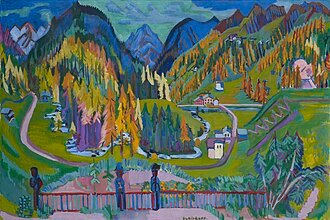
Oil on canvas, dated 1925, by the German painter Ernst Ludwig Kirchner. The picture shows a landscape of the Sertig valley in autumn and is now held at the Kirchner Museum in Davos. The available information does not allow us to say more about its commission or its critical reception.
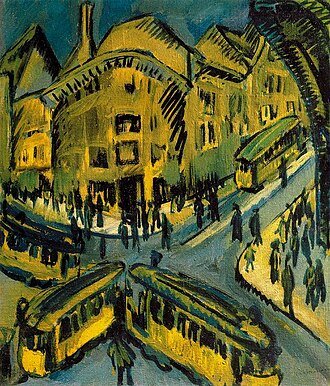
Oil on canvas dated 1912 by Ernst Ludwig Kirchner, titled after Nollendorfplatz, a square in Berlin. No details about its commission or making are recorded, so the painting is best approached through its title: probably an urban scene from the German capital, painted in the year given.


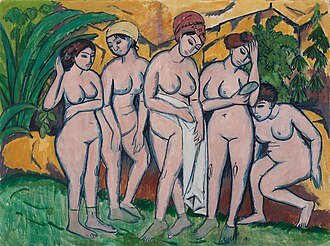
Painted in oil in 1926, this work by Ernst Ludwig Kirchner shows a group of nude bathers at Moritzburg, the place that gives the picture its title. It belongs to Expressionism, a movement in which artists sought to convey feeling through bold forms and vivid colour rather than faithful observation.

An oil on canvas dated 1938, in which Kirchner takes up a simple subject: a flock of sheep. The available information says nothing about the setting, any commission or the artist's intentions, so any reading of its meaning remains open. The painting is held at the Brücke Museum in Berlin.

Painted by Ernst Ludwig Kirchner in 1912, this canvas shows several nudes in a studio, placing the human figure within a working space. The available information does not specify a commission or reception, so its composition and colour are best observed carefully before attributing particular intentions. The work is held by the Leopold Museum.
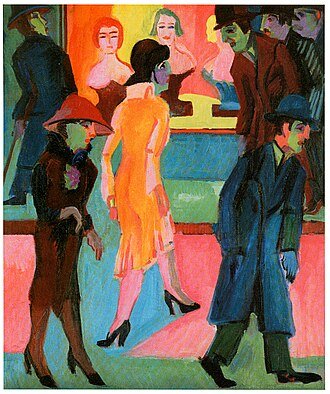
Painted in 1926 by Ernst Ludwig Kirchner, this oil on canvas depicts an urban street in which a hairdresser's salon can be made out. It is classified as an urban landscape and is held by the Staatliche Kunstsammlungen Dresden, the State Art Collections of Dresden, which keeps it today.


Self-portrait in oil on canvas, dated 1925, in which Ernst Ludwig Kirchner depicts himself through an image centred on the head. Because the framing is tight, attention falls on the face. The work is held at the Kirchner Museum in Davos, which houses much of his output.

Where to see the work
- Museum Ludwig Cologne · 7
- Kirchner Museum Davos Davos · 7
- Brücke Museum Berlin · 4
- Neue Nationalgalerie Berlin · 3
- Thyssen-Bornemisza Museum Madrid · 3
- Westphalian State Museum of Art and Cultural History Münster · 3
- Städel Museum Frankfurt · 3
- Von der Heydt Museum Wuppertal · 2
- Virginia Museum of Fine Arts Richmond · 2
- Kunstsammlung Nordrhein-Westfalen Düsseldorf · 2
- Milwaukee Art Museum Milwaukee · 2
- Staatliche Kunstsammlungen Dresden Dresden · 2
- Neue Galerie New York City · 1
- "degenerate art" collection · 1
- Museum of Modern Art New York City · 1
- Museum Folkwang Essen · 1
- Moderna Museet Stockholm Municipality · 1
- Buffalo AKG Art Museum Buffalo · 1
- Germanisches Nationalmuseum Nuremberg · 1
- Wallraf–Richartz Museum Cologne · 1
Curiosities
An alias for writing about himself
To shape public opinion about his work and free himself from dependence on the critics of the day, Kirchner began writing reviews of his own art under the pseudonym Louis de Marsalle. Under that name he commented on exhibitions that included his work, and when a major show of his paintings opened in Berlin in 1921, the reviews were favourable. It was an unusual step for a painter of his time and shows how carefully he wanted to control the reception of his art.
A sculpture instead of a mural
In the winter of 1935 a new school was planned in Frauenkirch, and Kirchner offered to paint a mural for the building. The project was dropped, so he made a sculpture to be placed above the schoolhouse door instead. At the inauguration in 1936 there were songs, dancing and speeches, and Kirchner wrote that the villagers had included him in the celebration, which moved him because they had welcomed him kindly two decades earlier.
A painting that came home
Kirchner’s Sand Hills in Engadine was seized by the Nazis in 1935, after its owner, Max Fischer, fled Germany for the United States. The painting later entered the collection of MoMA in New York, but in 2015 it was returned to Fischer’s heirs. It is one of many cases in which Jewish collectors, persecuted by the regime, had to sell or lost their Kirchner works.