
Hendrick ter Brugghen (Deventer, c. 1588 – Utrecht, 1629) was a Dutch painter and one of the leading Caravaggisti of Utrecht, alongside Gerrit van Honthorst and Dirck van Baburen. He mattered because he brought Caravaggio's lessons to the Netherlands at a time when few Dutch painters travelled to Italy.
Little is known of his youth. His family moved to the Catholic city of Utrecht in the early 1590s, and he began painting around the age of thirteen under Abraham Bloemaert, from whom he learned the basics of the craft. Around 1604 he went to Italy, reaching Rome, where he could have seen Caravaggio's work first-hand, though direct contact is not certain. He also studied Caravaggio's Italian followers, such as Orazio Gentileschi, and admired painters including Annibale Carracci, Domenichino and Guido Reni.
Back in Utrecht he worked alongside Honthorst and joined the Utrecht Guild of Painters in 1616, the year he married Jacomijna Verbeeck. His style combines Caravaggio's sharp chiaroscuro with intense emotional charge. He favoured half-length figures of drinkers and musicians, but also painted large religious scenes and group portraits. Notable works include The Adoration of the Magi (1619), The Calling of Saint Matthew (1621), A Singer Accompanying Himself on the Lute (1624) and Esau Sells his Birthright (c. 1624), now in the Thyssen-Bornemisza Museum in Madrid.
He died in Utrecht on 1 November 1629, probably a victim of the plague. He had eight children, and the last, Hennickgen, was born four months after his death.
Although he died young, his work was well received and influenced others. His treatment of religious subjects has been compared with Rembrandt's, and elements of his style appear in the paintings of Frans Hals and Johannes Vermeer.
Works (23)


Duet is a genre scene painted by Hendrick ter Brugghen in 1628, in oil on canvas. It shows a man singing while playing the lute, in an intimate setting with no dramatic action. The record offers no further details about its commission or history, so it is best to stay with what the image suggests: a musical scene of everyday tone.
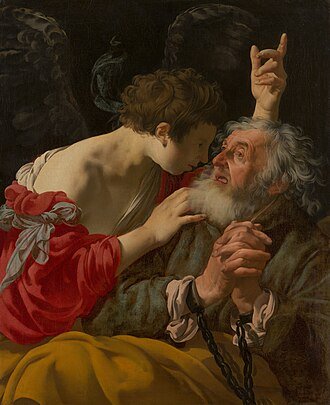
Painted in 1624 in oil on canvas, this religious work is held at the Mauritshuis. Its title, The Liberation of Saint Peter, points to the apostle's release from prison, though the available information does not clarify how the scene is staged or who commissioned it. Visitors are best served by looking closely at what the painting shows.

This 1624 oil painting by Hendrick ter Brugghen shows a man singing while accompanying himself on the lute, a hat on his head. It belongs to the Utrecht Caravaggist school, and within this genre scene the handling of light on the figures reflects that style. With the available information, nothing more can reliably be said about its commission or setting.
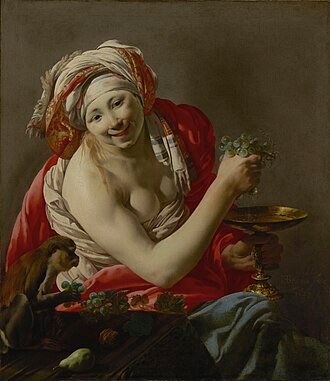


Hendrick ter Brugghen painted this oil on panel work in 1629, showing Mars, the Roman god of war, asleep, as its title suggests. It is held at the Centraal Museum. Beyond these basic facts, little is documented about its commission or meaning, so any interpretation should be treated cautiously.

Dated 1626, this oil on canvas belongs to the genre of everyday scenes and is known in English as The Concert. Its title points to a gathering centred on music, though the record does not describe the figures or their arrangement in detail. It is held in the National Gallery in London, where it serves as an example of seventeenth-century genre painting.

The painting shows Pilate washing his hands, the biblical episode in which the Roman governor distances himself from Jesus's condemnation. The subject lets the artist focus on a single gesture and the quiet tension of a decisive moment. Dated 1617, it is held today at the National Museum in Lublin, Poland.

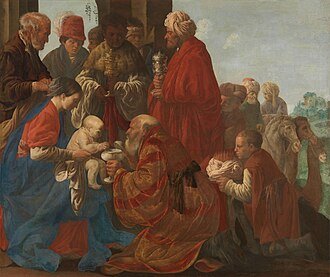
Hendrick ter Brugghen's painting, dated 1619, depicts the Adoration of the Magi: the Virgin Mary holds the infant Jesus as the wise men approach to offer their gifts. It is held at the Rijksmuseum. With the available record, no further details about its commission or reception can be confirmed.

It belongs to a series on the five senses and here stands for hearing, shown through a young man playing the lute. Hendrick ter Brugghen painted it in oil on canvas in 1620. As a genre scene, it captures an everyday moment, and its interest lies in music being suggested rather than seen.

A genre scene dated 1620 that belongs to a series devoted to the five senses. This painting stands for taste, shown through a young woman holding a glass. The work invites reflection on sensory pleasure within a simple, everyday setting with no dramatic action. It is held at the National Museum in Stockholm.
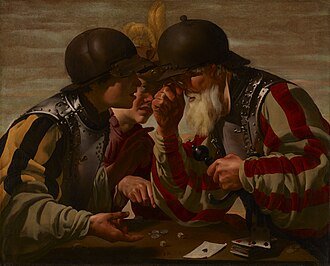
This genre scene shows several men absorbed in a game of cards and dice, with a sword and a suit of armour in the background that hint at a soldiers' setting. The figures are grouped in a shallow, enclosed space, and attention falls on the hands and gestures of the players. Beyond what the picture itself shows, little more can be said with confidence: gambling as the central theme, with its tension and everyday air.

Esau Selling His Birthright is an oil on canvas by Hendrick ter Brugghen, dated 1627 and held at the Museo Nacional Thyssen-Bornemisza. Classed as religious art, it depicts the biblical episode in which Esau gives up his birthright in exchange for a meal. The painting belongs to the work of a artist associated with Dutch Caravaggism, whose strong light contrasts and close, large-scale figures are visible here. Beyond these basic facts, little more can be said with certainty about its commission or reception.


This 1621 oil on canvas depicts the calling of Saint Matthew, the biblical episode in which Christ invites the apostle to follow him. The available information says nothing about its commission or composition, so any detailed reading of the scene remains unconfirmed. It was painted by the Dutch artist Hendrick ter Brugghen.

The painting depicts a scene from Genesis in which Esau, exhausted after hunting, gives his birthright to his brother Jacob in exchange for a bowl of food. Hendrick ter Brugghen painted it in 1626 on canvas as a religious subject. It is now held in the Gemäldegalerie in Berlin, where the artist focuses attention on the moment of the exchange.


Dated 1623, this painting depicts a biblical episode in which the women of Israel come out to greet David after his victory. Ter Brugghen worked in oil on canvas, arranging grouped figures around the gesture of welcome. Its horizontal format and moderate size invite the viewer to follow the narrative from left to right.
Where to see the work
- National Gallery London · 2
- Rijksmuseum Amsterdam · 2
- Nationalmuseum Stockholm · 2
- Allen Memorial Art Museum Oberlin · 1
- Metropolitan Museum of Art New York City · 1
- Art Institute of Chicago Chicago · 1
- Louvre Museum Paris · 1
- Mauritshuis The Hague · 1
- Musée des Beaux-Arts de Bordeaux Bordeaux · 1
- J. Paul Getty Museum Los Angeles · 1
- Statens Museum for Kunst Copenhagen Municipality · 1
- Centraal Museum Utrecht · 1
- National Museum in Lublin Lublin · 1
- Minneapolis Institute of Art Minneapolis · 1
- Thyssen-Bornemisza Museum Madrid · 1
- National Museum in Warsaw Warsaw · 1
- Jacques Goudstikker collection · 1
- Gemäldegalerie Berlin Berlin · 1
- Leiden Collection New York City · 1
- Museo de arte de Carolina del Norte Raleigh · 1
Teachers and pupils
Studied with
- Abraham Bloemaert 1565–1651
Curiosities
A son born after his death
The last of the painter's eight children, Hennickgen, was born four months after his father died in Utrecht. The death is probably attributed to the plague, an epidemic that hit the city hard in those years. The story of a posthumous birth sums up the brevity of a career that nonetheless left a mark on seventeenth-century Dutch painting.
Praise from Rubens
Peter Paul Rubens described ter Brugghen's work as superior to that of all the other artists of Utrecht, a notable judgement coming from one of the most admired painters in Europe at the time. The remark shows that his work was valued by his contemporaries beyond his own city, at a moment when Dutch art was beginning to look past its borders.