
Jerónimo Jacinto de Espinosa (Cocentaina, 1600 - Valencia, 1667) was a Spanish Baroque painter who, after the death of the Ribalta family in 1628, became the most prominent artist in Valencia and the leading figure of the Valencian school. His significance lies in keeping a warm, tenebrist naturalism alive in a city largely cut off from the decorative trends of Madrid and Seville.
The son of the painter Jerónimo Rodríguez de Espinosa, he trained in his father's workshop and signed a small panel as early as 1612. He married Jerónima de Castro in 1622. His first major work, The Miracle of the Christ of the Rescue (1623), already shows a mature style, and he soon received commissions from convents and the local nobility. Late in life he worked for the cathedral and painted an Immaculate Conception for the festivities of 1661. He excelled mainly in religious painting and, less often, in portraiture. His legacy continued through his son Jacinto Espinosa de Castro, the most direct follower of his style.
Works (4)
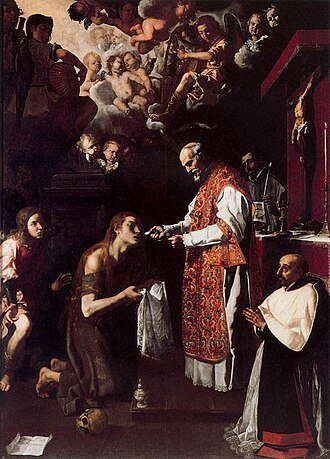


Religious painting in oil on canvas, dated 1601 and attributed to Jerónimo Jacinto Espinosa. Its title refers to Christ gathering his robes. Little is known about its commission, composition or original setting, so any reading of the scene should be approached cautiously. It is now held at the Museo del Greco.
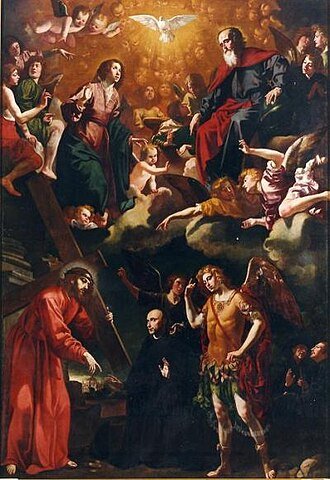
This large canvas by Jerónimo Jacinto Espinosa, dated 1631 and painted in oil, depicts the apparition of Christ to Saint Ignatius of Loyola, founder of the Society of Jesus. Given its monumental format, probably intended for a place of worship, it is a work of religious and devotional character. It is held by the Museo de Bellas Artes de Valencia.
Where to see the work
- Museu de Belles Arts de València Valencia · 2
- El Greco Museum Toledo · 1
Curiosities
A vow made during the plague
During the plague of 1646 he fell ill with a throat ailment and vowed to paint a picture for the altar chapel of Saint Louis Bertrand. Once recovered, he credited his cure to a miracle of the saint. His sworn testimony was published much later, in 1743, by Father Vidal in his Life of Saint Louis Bertrand, while the finished painting was delivered to the Dominican convent of Santo Domingo in 1653.
A will and a Dominican habit
He drew up his will hurriedly on 20 February 1667, asking to be buried in the Dominican convent of Santo Domingo dressed in the Dominican habit. He probably died that same day, since he was buried on the 21st as his will had specified. He chose a place in the church, in front of the altar of souls, in the tomb of the Ivars family, a noble family from Cocentaina.
An unfinished work
At his death he left unfinished the Martyrdom of Saint Leodegar and Saint Gliseria, a rarely depicted subject now kept at the Colegio del Corpus Christi in Valencia. His son Jacinto Espinosa de Castro, born in 1631, completed it and carried the family tradition into the eighteenth century.