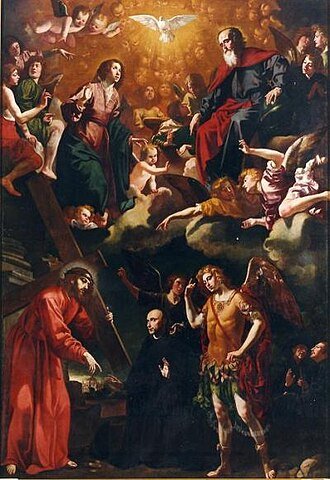
Última comunió de la Magdalena
Jerónimo Jacinto de Espinosa, 1665

The Communion of Mary Magdalene is one of Jerónimo Jacinto Espinosa's late works, painted by the Valencian Baroque artist. His signature uses the form «fat.» (faciebat), the imperfect tense, instead of the more common «fecit», which probably indicates that the painting was left unfinished. It was made for the Capuchin friars of Masamagrell, a foundation of Saint John of Ribera, who placed the Eucharist at the heart of his devotion. The composition is built on horizontal lines, with Saint Maximinus as its axis, and two diagonals crossing at the Holy Host. Mary Magdalene appears as a penitent, dressed in coarse sackcloth and beside a skull, a symbol of vanitas and of meditation on death, a motif very common in the devotion of the period. Above, a Baroque glory of clouds with cherubs and musician angels adds movement. The painting is read as a defence of the sacraments of penance and the Eucharist, central themes of the Counter-Reformation against Protestant reform, and it draws on Jacobo de la Vorágine's Golden Legend.
- Painter
- Jerónimo Jacinto de Espinosa
- Date
- 1665
- Medium
- oil paint, canvas
- Dimensions
- 315 × 226 cm
- Museum
- Museu de Belles Arts de València, Valencia
- Genre
- religious art
More works by Jerónimo Jacinto de Espinosa