Ōgata Kōrin (c. 1657-1658 – 1716) was a Japanese painter and lacquer artist from Kyoto, a central figure of the Rinpa school and one of the great names of Japanese decorative art. His importance lies in reducing screen painting to simplified, idealised and nearly abstract forms, focusing on colour and the material qualities of paint rather than on realism.
He came from a family of wealthy textile merchants with samurai ancestry and links to Kōetsu's artistic colony in Kyoto. As a young man he showed little interest in art, preferred a luxurious lifestyle and squandered the money his family gave him. Once ruined, he took painting seriously and became a pupil of Yamamoto Soken, a member of the Kanō school who had mastered ink and traditional Tosa painting. His early works still show strong debts to that training and to predecessors such as Kōetsu, Kanō Yasunobu, Sumiyoshi Gukei and Tawaraya Sōtatsu.
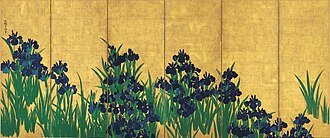
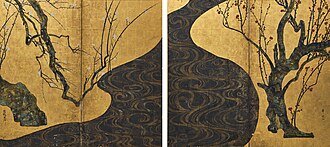
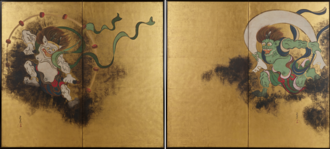
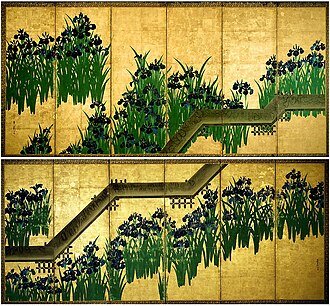
Around 1697, when he reached artistic maturity, he moved away from tradition and developed a distinctive style in both painting and lacquer. By 1701 he was regarded as one of the leading professional painters and was recognised by the painters' guild. His career falls into three phases: an early period in Kyoto that produced the Irises screen (1701); a stay in Edo from 1704 to 1711, with commissions from wealthy merchants and daimyō, including a screen of flowers representing the four seasons; and a return to Kyoto, where he revisited Sōtatsu and produced reinterpretations of his works, such as Wind God and Thunder God. He also designed for ceramics and textiles, partly to support his brother Kenzan's business.
His style passed to his pupils Kagei Tatebayashi and Shiko Watanabe, but it was Sakai Hōitsu who rediscovered and spread his work in the nineteenth century. Today he is considered one of the pillars of the Rinpa school.
Works (9)
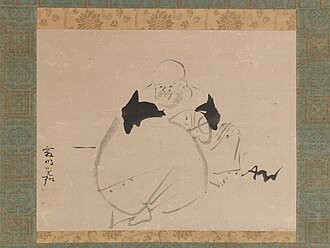
This painting depicts Hotei, a popular figure in Japanese tradition. It is the work of Ōgata Kōrin and is dated 1704. Information about its commission, technique or meaning is not available here, so a deeper reading would require consulting specialist studies.
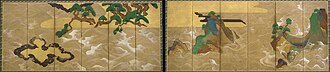
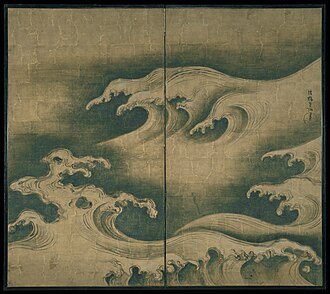
This work by Ōgata Kōrin is a byōbu-e, a painting made for a folding screen in the Japanese tradition. Its title points to the coastal landscape of Matsushima, and the motif of waves runs across the surface of the screen, so the eye follows the rhythm of the panels as they open and close.
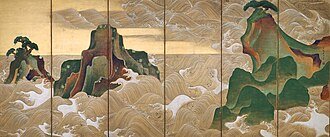
This horizontal folding screen, a byōbu-e, takes the wave as its main subject, a recurring theme in Japanese screen painting. It is attributed to Ōgata Kōrin, but the date recorded for it, 1800, is considerably later than the painter's lifetime, so both attribution and dating should be treated with caution. Its main interest lies in the decorative treatment of moving water.
Where to see the work
- Metropolitan Museum of Art New York City · 4
- Nezu Museum Tokyo · 1
- Tokyo National Museum Tokyo · 1
- Freer Gallery of Art Washington, D.C. · 1
- Museum of Fine Arts Boston Boston · 1
Curiosities
Designs beyond the screen
Although he is remembered mainly for his folding screens, Kōrin also designed motifs for ceramics and textiles. According to the sources, he did this to help the business of his brother Ogata Kenzan, who was a painter and potter. His decorative aesthetic thus left the screen format and reached everyday objects, in a family collaboration that joined art and craft.
From a life of luxury to the workshop
According to his biography, Kōrin had little interest in art at first. He preferred to live luxuriously and squandered the money his family gave him, until he was left ruined. It was then that he turned to painting and became a pupil of Yamamoto Soken. The move from a life of excess to a professional career is one of the most striking features of his story.