
Peter Danckerts de Rij (Amsterdam, 1605 – Amsterdam, 1660 or 1661) was a Dutch Golden Age painter who worked largely in the Polish–Lithuanian Commonwealth and Sweden. He is significant for bringing Dutch-trained court portraiture to the northern European courts.
He was the son of the painter Cornelis Danckerts de Ry, from a large family of printers, painters and engravers. Around 1640–41 he worked alongside Joachim von Sandrart, who later engraved some of his paintings. Between 1634 and 1638 he settled in Warsaw and later in Danzig and Vilnius, serving as court painter and architect to King Władysław IV Vasa. In 1648 he moved to the court of Queen Christina in Stockholm, where Charles X Gustav held him in high regard. He returned to the Dutch Republic in 1659.
His Baroque style is seen in royal portraits of the Polish court, such as those of King Władysław IV and Prince John Casimir Vasa, and in religious compositions such as The Mystical Marriage of Saint Catherine (1659). His legacy lies mainly in the visual record he left of the Polish and Swedish courts in the mid-17th century.
Works (6)

A religious painting from 1659 showing the mystical marriage of Saint Catherine of Alexandria to Jesus, with the Virgin Mary present. The record also classifies it as a portrait, suggesting some female figures may represent real people, though the details are not specified. This large oil on canvas is held at the National Museum in Warsaw.
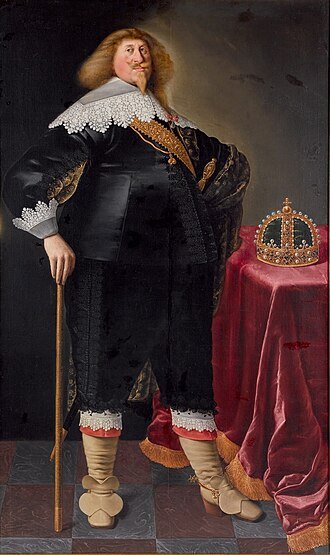

Full-length portrait of Władysław Dominik Zasławski-Ostrogski dressed in Polish costume, dated 1640 and attributed to the painter Peter Danckerts de Rij. The young nobleman wears traditional clothing of the Polish aristocracy, and the canvas is now held at the Palace Museum in Wilanów, Warsaw. The available information does not allow us to determine with certainty the commission or the exact circumstances in which it was painted.

A 1638 oil-on-canvas portrait of John II Casimir Vasa by Peter Danckerts de Rij. It belongs to the portrait genre and centres on the sitter who gives the work its name. Its large format suggests it was probably meant as a formal image of rank, designed to be seen up close.


Where to see the work
- National Museum in Warsaw Warsaw · 1
- Royal Castle in Warsaw Warsaw · 1
- Palace Museum in Wilanów Warsaw · 1
- Germanisches Nationalmuseum Nuremberg · 1
- Wawel Castle Kraków · 1
Curiosities
A legend of highway robbery
It has been claimed that Danckerts died in August 1661 after a highway robbery in the Rūdninkai Forest near Vilnius. That account, however, involves an unnamed artist aged 78, whereas Danckerts would have been 55. The incident may instead concern one of his successors at the Polish court.
Portraits of his parents
In 1634 he painted companion portraits of his parents. His mother's portrait hangs in the Johannesburg Art Gallery, while his father's, the painter Cornelis, is in the Royal Museums of Fine Arts of Belgium. The two works now sit on different continents, making them a rare surviving family pairing.
A poem in his honour
According to Houbraken, a poem was written in Danckerts's honour, praising his work in Poland. It attests to the warm reception he received at the court of King Władysław IV, where he served as court painter. Beyond Houbraken's account, little more is known about the poem.