Bacchus and Ariadne
Titian, 1520
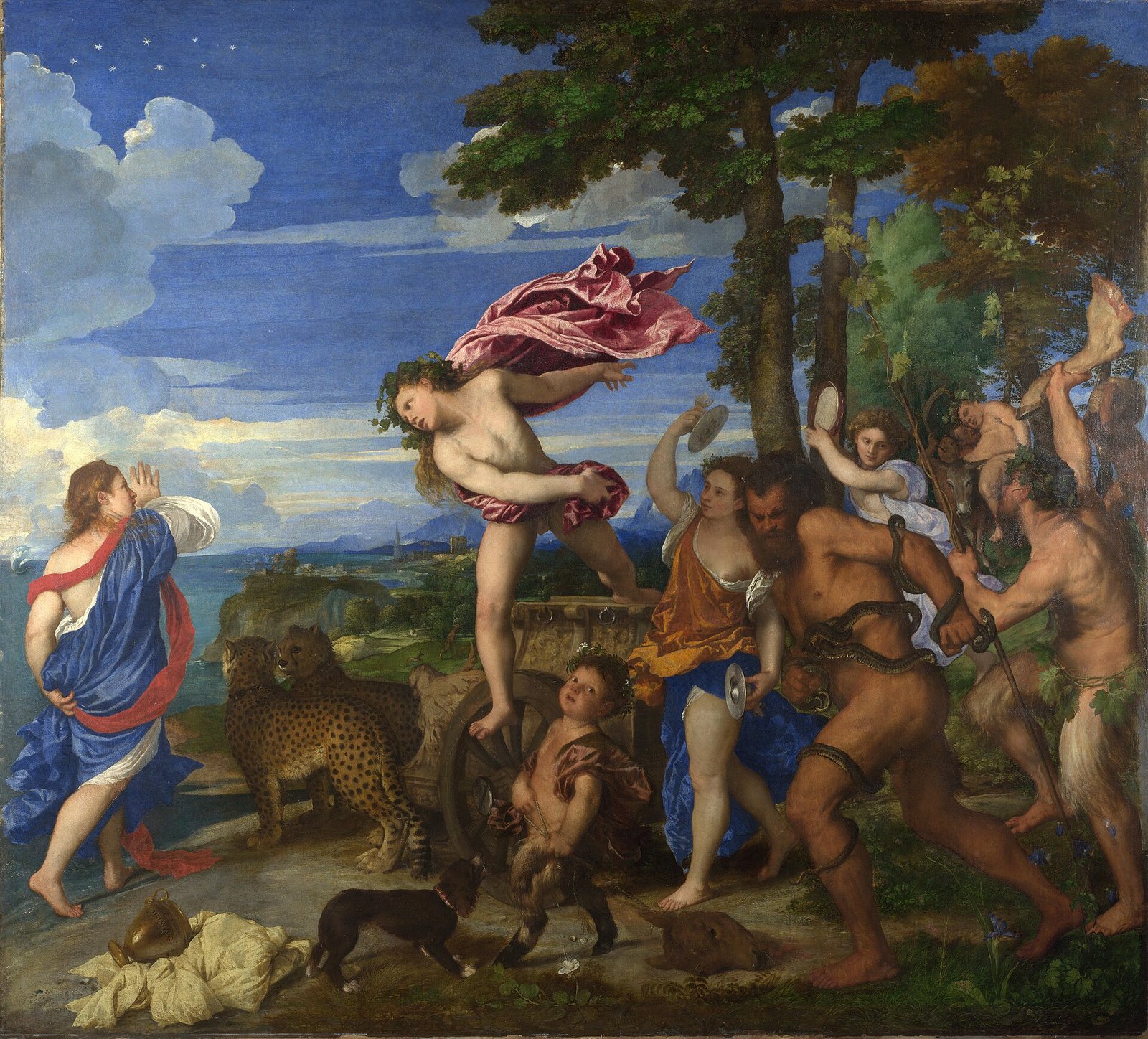
Bacchus and Ariadne is one of the mythological canvases that Titian painted around 1520–1523 for the Camerino d'Alabastro, a private room in the palace of Alfonso I d'Este in Ferrara, decorated with scenes drawn from classical texts. The commission had first gone to Raphael, who received an advance for a Triumph of Bacchus, but when he died in 1520 only a preliminary sketch existed, and the task passed to Titian. The subject comes from the Latin poets Catullus and Ovid and tells of the meeting between the god and Ariadne, the Cretan princess whom Theseus had abandoned on the island of Naxos while she slept.
The moment chosen is the most dramatic one: Bacchus has just stepped down from his chariot, pulled by panthers, and Ariadne, still startled, turns toward him with her body twisted, from the boat visible behind her shoulder toward the god, leaning slightly so that she must gather up her drapery. That turn also shapes how the picture is read, as the eye moves from the foreground across to the left. Ariadne, Bacchus and the cymbal-playing maenad form a principal triangle that dominates the scene. Around them gather the followers: a faun dragging a calf's head, a muscular satyr wreathed in serpents, a maenad with a tambourine, a satyr blowing a horn, the drunken Silenus riding a donkey and a wine carrier. An urn bearing the painter's signature and a small dog help balance the group.
Although every figure shows agitation, the whole keeps a restrained, classical air, broken mainly by the gestures of the two protagonists. The stars placed above Ariadne's head and Bacchus's raised arm suggest that the god, as he descends, snatches her crown to fling it into the sky, the mythological origin of the constellation Corona Borealis.
The painting is admired for its rich, harmonious colour. Titian used highly pure pigments, often without mixing them with one another, and preferred brushstrokes over the traditional dark shading to model the folds. Ultramarine blue dominates much of the picture, mixed with lead white in the sky and the lighter tones, while greens appear in the landscape and foliage. Technical studies show that, despite his reputation as a painter who worked directly with colour, Titian began with a rough drawing that fixed the main elements before he painted.
The canvas, regarded as one of his masterpieces, is now in the National Gallery in London. In 1598, after the Este family lost control of Ferrara, it was taken with other works from the cycle to Rome, to the Aldobrandini family, and it appears in their inventories of 1603 and 1626.
- Painter
- Titian
- Date
- 1520
- Medium
- oil paint, canvas
- Dimensions
- 176 × 191 cm
- Museum
- National Gallery, London
- Movement
- High Renaissance, Venetian school
- Genre
- mythological painting
- Depicts
- Corona Borealis, cliff, nudity, tree, coastal landscape, dance, jar, fig leaf
More works by Titian