Assumption of the Virgin
Titian, 1517
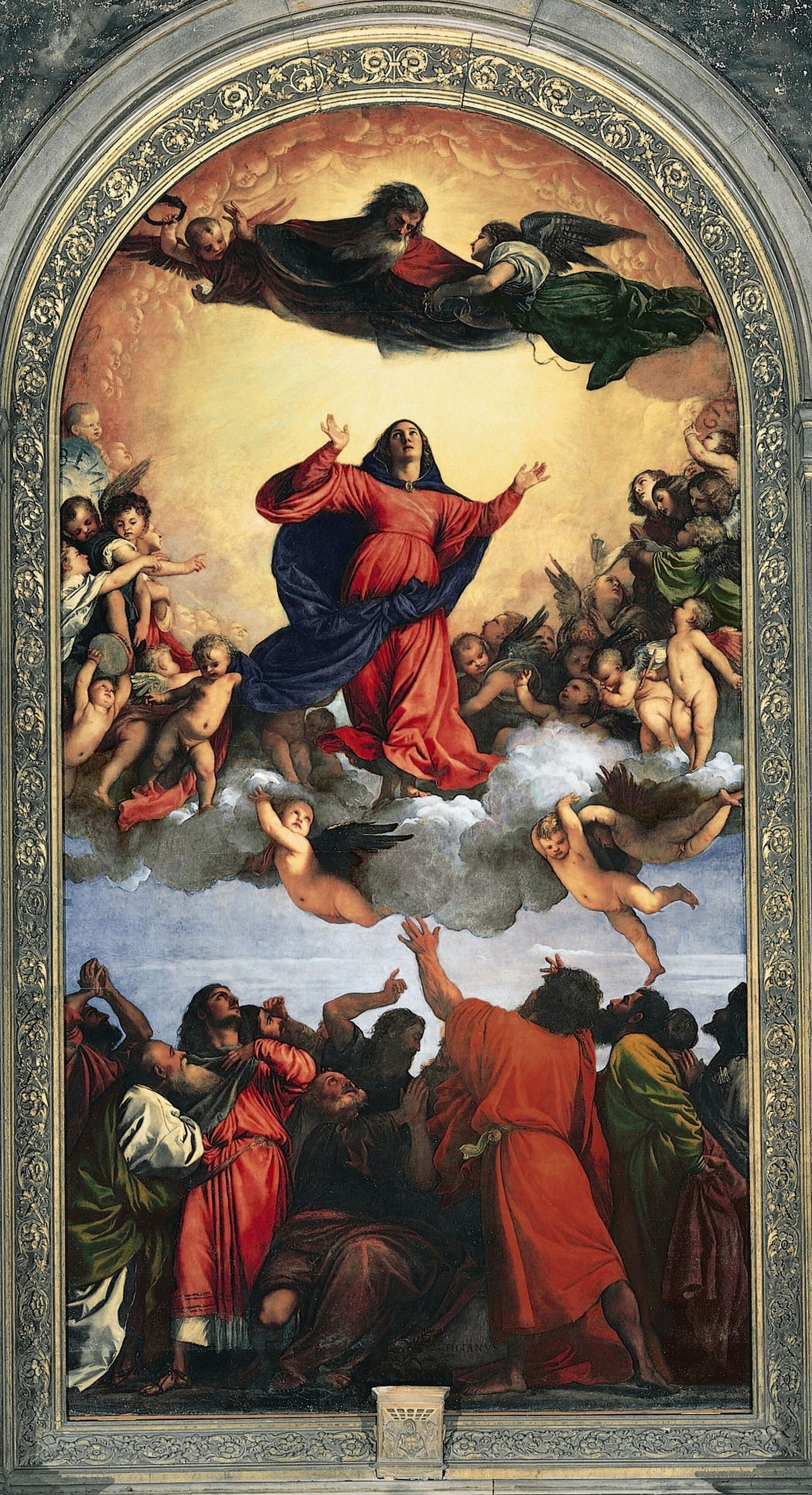
The Assumption of the Virgin, also known as the Assunta, is a large altarpiece painted in oils on panel by Titian between 1515 and 1518. It still stands in the place it was designed for, on the high altar of the Basilica di Santa Maria Gloriosa dei Frari in Venice. Its figures are well above life-size, which suits the vast church, where a considerable distance separates the altar from the congregation, and it is the largest altarpiece in the city.
The subject is a Marian doctrine that was still optional in the early sixteenth century: the idea that the Virgin's body was taken physically into heaven. The Franciscans, who served the church, strongly promoted this and related beliefs, such as the Immaculate Conception, which was then still hotly debated. Near the base a stone sarcophagus can be glimpsed, a detail that let viewers interpret the event differently depending on whether they thought Mary had died before rising.
The composition falls into three zones. Below, the apostles are tightly packed in a range of dramatic poses, looking upward. At the centre, the Virgin, dressed in red and blue, rises on clouds among a crowd of angels, and above her God the Father is about to receive a crown offered by an angel. Titian left out any landscape; the blue-grey sky suggests an outdoor setting, while the golden light of the upper zone recalls the gold grounds of mosaics and Gothic painting.
The work broke with the meditative stillness that characterised Venetian paintings of saints, and it was probably startling to its first audiences. It was soon recognised as a masterpiece that confirmed Titian as the leading painter in Venice and one of the most important in Italy, a rival to Michelangelo and Raphael.
- Painter
- Titian
- Date
- 1517
- Medium
- oil paint, panel
- Dimensions
- 668 × 344 cm
- Museum
- Santa Maria Gloriosa dei Frari, Venice
- Movement
- High Renaissance, Venetian school
- Genre
- religious art
- Depicts
- Assumption of Mary, God the Father, John the Evangelist, Saint Peter, Mary, Twelve Apostles
More works by Titian


